
Aqaba New Port

  • Aqaba Port Expansion Projects to Boost Oil Handling, Cargo Capacity and Regional Transit Trade

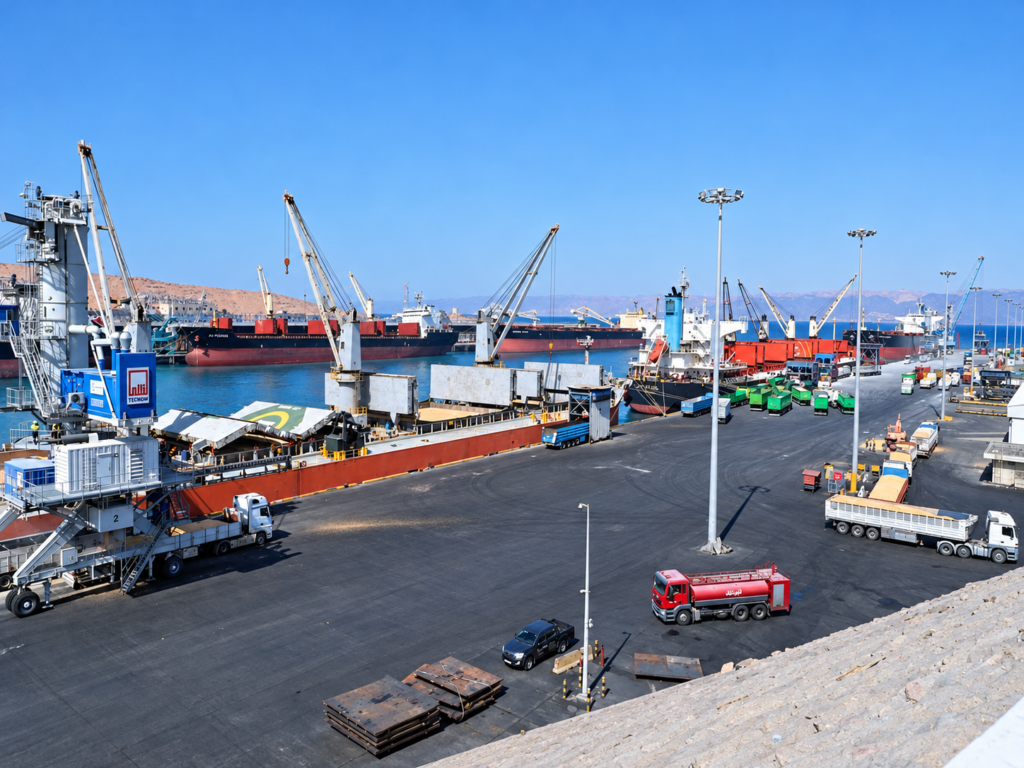
    Shipping Arabia, November 11, 2026 – Aqaba Development Corporation (ADC) is advancing major port expansion projects to increase oil handling capacity, expand vehicle and container storage facilities, and strengthen Aqaba’s position as a regional maritime, logistics and energy trading hub. The investments aim to accommodate rising cargo volumes, improve operational efficiency and expand the port system’s ability to support regional transit trade.

    ADC CEO Hussein Al-Safadi outlined the developments in an interview with the Jordan News Agency (Petra). He said the projects respond to growing cargo handling and trade activity while strengthening Aqaba’s competitiveness in regional and international markets.

    The expansion program follows a recent visit to Aqaba by Jordanian Prime Minister Jafar Hassan, during which the government emphasized the importance of accelerating port development and infrastructure projects.

    New Oil Jetty to Increase Aqaba’s Handling Capacity to 11 Million Tonnes

    Among the most significant Aqaba port expansion projects is the development of a new oil jetty designed to accommodate vessels of up to 160,000 deadweight tonnes (DWT).

    The facility will handle crude oil, petroleum products, chemicals, bitumen and ammonia. Its targeted annual handling capacity is 5 million tonnes, increasing Aqaba’s total oil handling capacity to approximately 11 million tonnes per year.

    According to Al-Safadi, the project will help meet domestic energy requirements while expanding Aqaba’s capabilities in petroleum exports and regional energy trade.

    Implementation will follow two separate contractual arrangements. ADC will undertake the marine construction works through an Engineering, Procurement and Construction (EPC) contract, for which the tender has already been issued.

    A specialized operator will separately equip and operate the facility under an Equip-Operate-Transfer (EOT) arrangement. ADC expects to issue the operator tender shortly, while completion of the oil port development and expansion projects is planned within the next two years.

    In parallel, ADC is developing a Single Point Mooring (SPM) facility offshore to support crude oil and heavy fuel oil exports.

    The SPM project will be financed and implemented by the private sector under a Build-Operate-Transfer (BOT) model. Al-Safadi indicated that the relevant agreement is expected around mid-2027, with the facility scheduled to enter service within eight months of signing.

    Both energy infrastructure projects are expected to support Iraqi oil exports through Aqaba and strengthen regional transit trade. They will also help relieve operational pressure on the existing oil terminal, which is currently operating at full capacity.

    Vehicle Storage Expansion and Strong Cargo Growth

    ADC is also implementing substantial improvements to vehicle and container storage infrastructure in response to increasing cargo volumes.

    The corporation has allocated approximately 150,000 square meters adjacent to Aqaba New Port to expand vehicle storage capacity from 6,000 to 17,000 vehicles.

    Additionally, a 67,500-square-meter area near Aqaba Container Terminal has been allocated for empty container storage. Further storage capacity is being made available through private logistics companies and Aqaba Logistics Village.

    These developments coincide with significant increases in cargo handling and transit activity across Aqaba’s ports.

    During the first nine months of 2026, cargo throughput at Aqaba New Port, the multipurpose port, increased by 63.6% to reach 5.85 million tonnes. During the same period, oil terminal throughput rose by 39.3% to 3.43 million tonnes.

    Transit cargo volumes recorded particularly strong growth. Aqaba New Port handled 1.8 million tonnes of transit cargo, compared with approximately 38,900 tonnes during the corresponding period of 2025.

    Meanwhile, transit container throughput at Aqaba Container Terminal increased by 151.8%, reaching 115,762 twenty-foot equivalent units (TEUs).

    Al-Safadi said the figures demonstrate the growing importance of Aqaba in regional trade and reinforce the need for continued investment in port infrastructure, logistics facilities and operational services.

    To accommodate rising vehicle imports and cargo handling demand, ADC has temporarily permitted roll-on/roll-off (RoRo) vessels and heavy cargo operations at Aqaba Cruise Terminal.

    The cruise terminal has handled 79,795 vehicles since the beginning of 2026, providing additional capacity for vehicle traffic while other port facilities undergo expansion.

    ADC has also coordinated with the Land Transport Regulatory Commission to allow foreign vehicle transport trucks to load directly from the port, supporting more efficient vehicle movements.

    Improving Border Connectivity and Multimodal Transport

    Alongside its port expansion projects, ADC is working to improve land transport connections and facilitate cross-border cargo movements.

    The corporation is coordinating with the relevant authorities and the Saudi side to improve truck movements through the Durra border crossing between Jordan and Saudi Arabia.

    Plans also include preparing a temporary truck staging area within the border crossing to accommodate increased truck and cargo traffic.

    Al-Safadi emphasized the importance of integrating Aqaba’s maritime infrastructure with the planned Aqaba–Shidiya–Ma’an railway and Aqaba–Ma’an dry port projects.

    These developments are intended to strengthen connections between Aqaba’s ports, production centers, storage facilities and regional markets.

    Improved multimodal connectivity would support more efficient cargo transportation and strengthen Aqaba’s role as a gateway for imports, exports and regional transit cargo.

    ADC is also seeking greater private-sector participation in developing and operating specialized facilities through partnership arrangements similar to those planned for the oil jetty and SPM project.

    The corporation considers these partnerships important for expanding operational capacity, improving service efficiency and attracting additional investment.

    South Aqaba Investment Complex Expansion and New Logistics Opportunities

    Beyond maritime infrastructure, ADC is pursuing new investment opportunities in logistics, industrial development and energy-related activities.

    A major component is the South Aqaba Investment Complex, developed by National Real Estate Company (NREC), with an investment of approximately JOD 21 million.

    The complex occupies more than 1.5 million square meters of developed land and includes 12 modern warehouses, four ready-built industrial buildings and additional serviced plots designated for storage and light industrial activities.

    According to Al-Safadi, the complex reached full occupancy during 2026, highlighting demand for industrial and logistics facilities in Aqaba.

    ADC is currently holding discussions with NREC regarding a further expansion of approximately 500 dunums. The additional land would create opportunities to attract more industrial, warehousing and logistics investments.

    The corporation expects its infrastructure and investment projects to generate direct employment during construction and operational phases. Additional indirect employment opportunities are anticipated in transportation, storage, maintenance and supporting services.

    The projects are also expected to create opportunities for local companies to participate in supply chains associated with port development, industrial facilities and logistics operations.

    Al-Safadi said ADC will announce further investment projects and their details as the necessary procedures are completed.

    Taken together, the Aqaba port expansion projects form part of a wider development strategy extending beyond additional cargo handling capacity. By combining new oil infrastructure, expanded storage facilities, improved transport connectivity and private-sector investment, ADC aims to strengthen Aqaba’s role in regional maritime trade, energy logistics and transit cargo movements.

    Source: Al Dustour
  • Aqaba Ports Cargo Throughput Rises 12% to 19.68 Million Tons in First Nine Months of 2026

    Shipping Arabia, October 23, 2026 – Aqaba ports cargo throughput increased by 12% during the first nine months of 2026, reaching approximately 19.68 million tons, according to a report issued by Aqaba Development Corporation (ADC). The growth was accompanied by higher container volumes and vessel arrivals, although performance varied significantly across cargo segments and port facilities.

    The report, prepared by ADC’s Transport and Logistics Directorate, showed that container throughput increased by 6.58% to 786,950 TEUs. Meanwhile, vessel arrivals rose 7% to 2,060 ships, compared with 1,932 during the corresponding period of 2025.

    The figures also revealed contrasting trends across the port system. Aqaba New Port and the oil terminal recorded substantial cargo growth, while phosphate shipments, liquefied natural gas (LNG) volumes, and cruise ship arrivals declined.

    Aqaba New Port Records 64% Cargo Growth

    Aqaba New Port recorded a 64% increase in total cargo handling during the first nine months of 2026. Throughput reached 5,848,640 tons, compared with 3,574,052 tons during the same period in 2025.

    Grain handling was a major contributor to this growth, increasing 45% to 3,624,452 tons from 2,498,051 tons a year earlier. Coal volumes also increased significantly, rising 60% to 518,911 tons, compared with 324,125 tons.

    The port handled 810,402 tons of bulk sugar during the reporting period, compared with no recorded volumes during the corresponding period of 2025.

    Other general cargo handled at Aqaba New Port increased 20% to 894,875 tons, up from 746,476 tons.

    The report also recorded a 38% increase in the category identified as stone containers, from 68,314 to 94,530. In contrast, livestock numbers declined 38%, falling from 873,442 to 543,593.

    Aqaba Container Terminal Throughput Reaches 786,950 TEUs

    Container handling at Aqaba Container Terminal increased by 6.58% during the first nine months of 2026. Total throughput reached 786,950 TEUs, compared with 738,348 TEUs during the corresponding period of 2025.

    The report showed a 12% increase in imported containers, including transit containers. Volumes reached 415,382 container units, compared with 371,437 during the first nine months of 2025.

    However, imported containers excluding transit traffic declined by 14%. Volumes fell to 299,620 container units, compared with 347,844 during the same period last year.

    These figures highlight the difference between overall import container growth, including transit movements, and the decline in imported containers excluding transit traffic.

    Oil Terminal Cargo Handling Rises 39% as LNG Volumes Decline

    Cargo handling through Aqaba’s oil terminal increased by 39%, reaching 3,433,461 tons during the first nine months of 2026. This compares with 2,465,170 tons during the corresponding period of 2025.

    Crude oil accounted for the largest reported volume, increasing 14% to 1,223,957 tons from 1,075,146 tons.

    Diesel handling rose 7% to 799,561 tons, compared with 746,540 tons. Meanwhile, gasoline throughput increased 50% to 805,468 tons, up from 535,791 tons during the same period last year.

    Other liquid cargo categories also recorded substantial increases. A separately reported gas category rose 176% to 54,151 tons, while potassium hydroxide handling increased 77% to 21,363 tons.

    Phenol throughput climbed 309% to 147,036 tons. Chemical cargo handling also increased sharply, rising 943% to approximately 46,511 tons from 4,458 tons.

    Mineral oil volumes increased 1,047% to 32,715 tons, compared with 2,853 tons in the corresponding period of 2025.

    Vegetable oil handling reached 302,700 tons, compared with no recorded volumes during the previous year. In contrast, magnesium chloride volumes declined from 32,750 tons to zero.

    Performance also varied across Aqaba’s gas facilities.

    Liquefied petroleum gas (LPG) throughput increased 11% to 413,181 tons, compared with 371,664 tons during the first nine months of 2025.

    However, liquefied natural gas (LNG) handling declined by 31%, falling to 464,837 tons from 670,931 tons during the corresponding period last year.

    Dry Bulk, Liquid Bulk and General Cargo Record Growth

    The ADC report showed that dry bulk cargo handling increased 8% during the first nine months of 2026. Total dry bulk throughput reached 11,905,204 tons, compared with 11,043,692 tons during the corresponding period of 2025.

    The growth reflected higher grain and coal handling, alongside the addition of bulk sugar volumes. However, several established dry bulk cargo categories recorded declines.

    Phosphate handling fell 19.1% to 4,062,887 tons. Sulfur volumes declined 31% to 528,033 tons, while fertilizer throughput decreased 11% to 527,421 tons.

    In contrast, grain volumes rose 45% to 3,624,452 tons, while coal throughput increased 60% to 518,911 tons. Bulk sugar handling reached 810,402 tons during the same period.

    Liquid bulk cargo recorded stronger overall growth, increasing 16% to 5,428,110 tons, compared with 4,694,287 tons in the first nine months of 2025.

    The increase reflected higher volumes of crude oil, diesel, gasoline, LPG, and several chemical products. Nevertheless, ammonia and phosphoric acid handling each declined by 6%, while LNG throughput fell 31%.

    Beyond dry and liquid bulk cargo, general cargo handling across the port system increased by 25%. Total volumes reached 2,033,142 tons, compared with 1,626,697 tons during the corresponding period of 2025.

    Vessel Arrivals Increase 7% Despite Decline in Container Ship Calls

    Total vessel arrivals at Aqaba’s ports increased 7% during the first nine months of 2026, reaching 2,060 ships compared with 1,932 during the same period in 2025.

    Liquid bulk vessel arrivals increased 22% to 196 ships, compared with 161 vessels a year earlier.

    Dredging vessel arrivals rose 28% to 102 vessels, up from 80. Dry bulk ship calls also increased slightly, rising 1% to 278 vessels from 275 during the corresponding period.

    However, container vessel arrivals declined 2%, falling to 438 ships from 446 during the first nine months of 2025. This decrease occurred despite the 6.58% increase in overall container throughput.

    Cruise ship arrivals recorded a sharper decline, falling 80% to just two vessels compared with 10 during the corresponding period last year.

    Separately, the report recorded 95 arrivals in a category classified as vehicle-designated tourist vessels. No arrivals were recorded in this category during the first nine months of 2025.

    Passenger Traffic Rises Despite Declines in Cruise Activity

    The ADC report also covered passenger movements and air cargo activity during the reporting period.

    Total passenger movements by land and air increased 2% to 422,487 passengers, compared with 413,718 during the corresponding period of 2025.

    However, the report indicated a decline in passengers traveling aboard cruise ships, alongside the reduction in cruise vessel arrivals.

    Air cargo activity also decreased during the reporting period, although the published figures did not specify the extent of the decline.

    Overall, the nine-month results show higher Aqaba ports cargo throughput, container handling, and vessel arrivals. At the same time, the figures demonstrate differing performance across individual facilities and cargo segments, including declines in phosphate exports, LNG handling, and cruise activity.

    Source: Al Mamlaka

Back to top button