Customs Clearance

  • Iraq Moves to Ease Umm Qasr North Port Congestion Amid ASYCUDA Disruption

    Shipping Arabia, November 2, 2026 – Iraq’s General Company for Ports of Iraq (GCPI) is implementing urgent measures to address Umm Qasr North Port congestion and delays in cargo truck movements. The action follows disruptions to the ASYCUDA customs system, which have affected clearance procedures and contributed to truck congestion at the port’s Grand Welcome Yard.

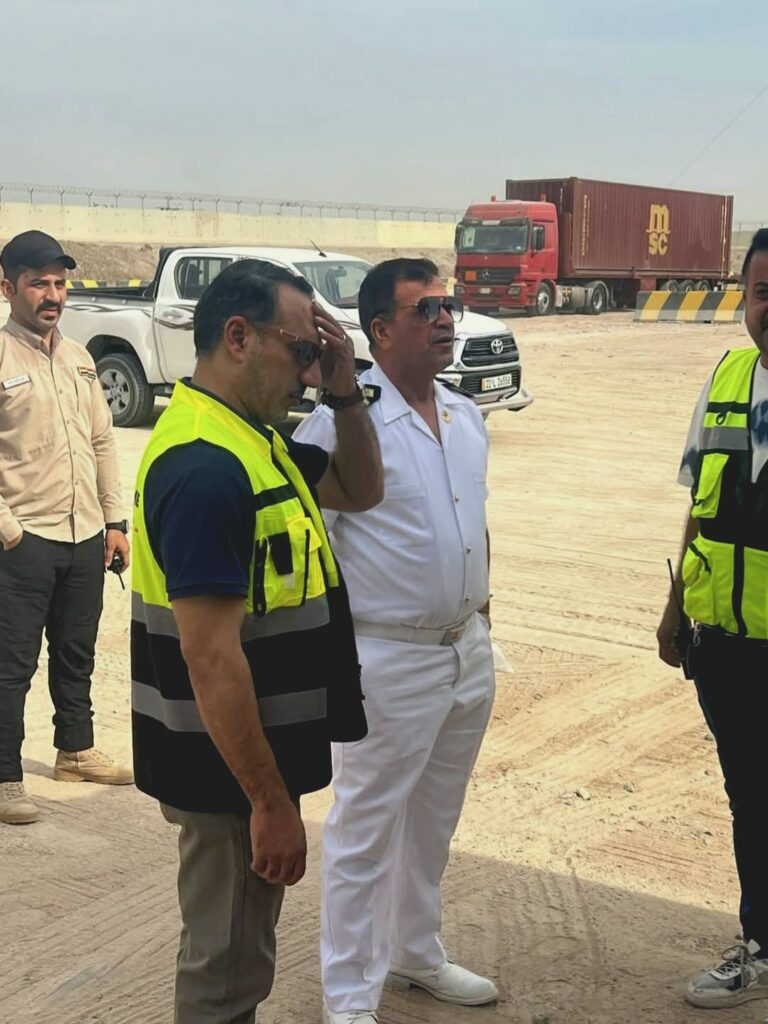
    The management of Umm Qasr North Port held an expanded coordination meeting chaired by Port Director Capt. Salem Jabbar Hussein. The meeting focused on identifying the causes of congestion, accelerating the departure of loaded trucks and improving operational efficiency.

    The discussions formed part of efforts to maintain smoother cargo flows and strengthen coordination among the government agencies and commercial operators involved in port operations.

    ASYCUDA Disruption Affects Customs Clearance and Truck Movements

    A central issue discussed during the meeting was the disruption of the ASYCUDA customs system within the relevant customs departments. The disruption has affected the processing of customs procedures and contributed to delays in releasing cargo trucks from the Grand Welcome Yard.

    Participants examined the main operational challenges affecting truck movements and considered measures to reduce waiting times and accelerate customs transaction processing.

    The discussions also addressed the need to ease congestion within the yard and prevent further bottlenecks. Particular emphasis was placed on improving coordination between the authorities responsible for customs clearance, cargo handling and truck exit procedures.

    The meeting highlighted the importance of addressing both administrative and operational obstacles to improve cargo movements through Umm Qasr North Port.

    Transport Ministry Directives Drive Coordinated Response

    The meeting followed directives issued by Iraq’s Minister of Transport, Wahb Al-Hassani, and instructions from the senior management of the General Company for Ports of Iraq, led by Director General Abdullah Ati Abdullah.

    The directives focus on resolving operational difficulties, strengthening cooperation among relevant authorities and ensuring more efficient cargo and truck movements across Iraqi ports.

    The meeting brought together officials from several organizations involved in port and border operations. Participants included the Director of the Umm Qasr North border crossing, the Director of Customs at the Grand Welcome Yard and a representative of the company operating the yard.

    Representatives of the National Security Service and intelligence authorities also attended, alongside the directors responsible for cargo loading and unloading operations at Umm Qasr North and Umm Qasr South ports.

    Their participation reflected the need for coordination across the different authorities responsible for processing and facilitating cargo movements through the port.

    Urgent Measures Target Truck Delays and Operational Bottlenecks

    The meeting concluded with a series of urgent directives and measures intended to address the causes of delays and improve the movement of trucks leaving the Grand Welcome Yard.

    The participating authorities emphasized the importance of reducing truck waiting times, accelerating customs procedures and easing congestion within the facility.

    They also stressed the need to maintain continuous coordination and follow-up to ensure implementation of the agreed measures. This cooperation will involve the relevant government departments and operational stakeholders responsible for managing cargo and truck movements.

    The General Company for Ports of Iraq aims to improve operational efficiency at Umm Qasr North Port and the Grand Welcome Yard through these measures, while preventing further congestion and supporting smoother cargo flows.

    Source: Iraqi Ministry of Transport / General Company for Ports of Iraq
  • Nuweiba Port Truck Yard Upgrade Aims to Strengthen Aqaba Trade Corridor and Logistics Capacity

    Shipping Arabia, October 25, 2026 – Egypt’s Red Sea Ports Authority is planning a comprehensive Nuweiba Port truck yard upgrade to increase handling capacity, improve operational efficiency and strengthen maritime and land transport connections with Jordan and other Arab markets. The development will focus on modernizing truck staging areas, internal roads, electronic systems and port gates to reduce congestion and accelerate cargo movements.

    According to government sources cited by Al Borsa News, the planned improvements form part of Egypt’s broader strategy to modernize port infrastructure and strengthen the role of its maritime facilities in supporting trade, transport and logistics activities.

    The project aims to accommodate growing truck traffic, shorten processing times and improve services for road transport operators, freight companies and other port users.

    Nuweiba Port Truck Yard Upgrade to Improve Traffic Flow

    The development plan includes rehabilitating internal roads serving the port’s truck staging areas and upgrading electronic systems and access gates.

    These improvements are intended to accelerate truck entry and exit procedures, reduce customs clearance and loading times, and improve vehicle circulation throughout the port.

    The Authority also plans to provide the logistics services and supporting facilities required by truck drivers, road transport operators and freight companies.

    Government sources indicated that the Nuweiba Port truck yard upgrade will help accommodate increasing truck movements while reducing congestion within the port and its surrounding areas.

    A major component of the project involves organizing truck staging areas using modern technological and operational systems. The objective is to improve traffic management and maximize the efficient use of available space.

    The proposed improvements will also strengthen safety and security standards within the port, creating a more efficient operating environment for transport and logistics companies.

    By improving truck circulation and staging arrangements, the Authority aims to increase vehicle turnover and enable the port to process more trucks daily.

    Faster Customs Procedures Expected to Reduce Transport Costs

    The planned development is expected to improve cargo movement efficiency by reducing truck waiting periods and accelerating customs and logistics procedures.

    According to the sources, shorter processing times could reduce freight transport costs and improve the competitiveness of Egyptian products in regional markets.

    The improvements are particularly relevant to Egyptian exports destined for Arab countries, where faster cargo processing and more efficient transport operations can support trade flows.

    The Authority also expects the modernization of truck staging areas to improve the operational cycle of vehicles moving through the port.

    Reducing delays during loading, clearance and other logistics procedures would allow transport operators to complete movements more efficiently while improving the overall flow of imports and exports.

    In addition, improved infrastructure and operating systems are expected to strengthen the quality of services provided to shipping and logistics companies using Nuweiba Port.

    Nuweiba–Aqaba Corridor Central to Regional Trade Connectivity

    An important objective of the development plan is to enhance the role of the Nuweiba–Aqaba maritime corridor in connecting Egypt with Jordan and other Arab markets.

    The proposed improvements are intended to strengthen maritime and land transport connectivity, making the route more attractive to road freight operators and shipping companies.

    According to the government sources, more efficient truck handling and improved logistics services could also support additional transit cargo movements through Nuweiba.

    The Nuweiba Port truck yard upgrade is therefore expected to contribute to the port’s position within the regional transport and logistics network.

    By reducing waiting times and improving the coordination of truck movements, the planned project aims to facilitate cargo flows along the maritime connection between Egypt and Jordan.

    These improvements would support trade between the two countries while strengthening access to other Arab markets served through regional transport networks.

    Higher Truck Throughput Could Strengthen Port Revenues

    Beyond the expected logistics benefits, the Red Sea Ports Authority aims to improve the economic utilization of Nuweiba Port’s existing infrastructure and operational assets.

    Government sources indicated that increasing truck-handling capacity and improving vehicle turnaround could generate additional revenues from port fees and services.

    Faster processing would allow the port to accommodate more trucks each day, potentially increasing operating volumes and improving the financial returns generated by its facilities.

    The planned investments in internal roads, truck yards, electronic systems and supporting services are intended to support this objective while improving the overall efficiency of port operations.

    The development forms part of Egypt’s wider efforts to strengthen port competitiveness, reduce logistics costs and improve the movement of goods through its maritime gateways.

    For the Nuweiba–Aqaba route, the proposed improvements could enhance the efficiency of cross-border freight movements and reinforce the corridor’s role in supporting trade between Egypt, Jordan and the wider Arab region.

    Source: Al Borsa News

  • Faisal M. Higgi & Associates Unveils FMH Marine Services Brand at Saudi Maritime & Logistics Congress 2026

    Shipping Arabia, October 21, 2026 – Saudi Arabia’s Faisal M. Higgi & Associates Co. Ltd. has officially introduced FMH Marine Services as its new brand identity at the Saudi Maritime & Logistics Congress 2026. Effective October 20, the rebranding marks a new phase in the company’s development as it seeks to strengthen its market positioning, expand its maritime and logistics capabilities, and support its long-term growth strategy.

    The FMH Marine Services brand identity reflects the company’s ambition to build on its established operations while pursuing new commercial opportunities in Saudi Arabia’s maritime sector. The company confirmed that the change represents a new corporate brand identity, while its registered company and legal entity remain unchanged.

    The announcement also aligns with Saudi Vision 2030 and the Kingdom’s wider economic transformation, including ongoing investments in maritime infrastructure and international trade development.

    FMH Marine Services Builds on Nearly Four Decades of Operations

    Faisal M. Higgi & Associates Co. Ltd. has operated continuously in Saudi Arabia since 1988, providing maritime and logistics services across all ports in the Kingdom.

    The company’s service portfolio includes ship agency, special project cargo handling, customs clearance, supply and procurement, and logistics support. Through these activities, FMH provides customers with a single point of contact for various maritime and logistics requirements.

    The introduction of FMH Marine Services reflects the company’s intention to further develop these capabilities while strengthening its commercial relationships and pursuing new partnerships.

    According to the company’s announcement, the rebranding extends beyond a visual identity change. It represents a broader strategy to enhance service capabilities, strengthen operations, improve the customer experience, and reinforce FMH’s position within Saudi Arabia’s maritime and logistics industry.

    The company also aims to build on its existing business foundations while adapting to opportunities arising from the Kingdom’s expanding maritime infrastructure and growing international trade activities.

    Rebranding Supports Growth Strategy and Saudi Vision 2030

    The FMH Marine Services rebranding comes as the company positions itself to participate in Saudi Arabia’s evolving maritime and logistics landscape.

    Its strategic direction focuses on strengthening operational capabilities, developing commercial partnerships, and supporting customers across the shipping and logistics sectors.

    The company views Saudi Arabia’s economic transformation and maritime infrastructure investments as important elements of its long-term development strategy.

    Commenting on the announcement, Abdulaziz Higgi, Managing Director of FMH, said:

    “FMH’s new brand identity represents an important step in our company’s evolution in the local and international markets. We are proud of the foundations on which the business has been built and of the relationships we have developed over the years. As we look ahead, our objective is to build on that heritage with a clear vision, stronger capabilities and an even greater commitment to our clients and partners.”

    Strengthening FMH’s Maritime and Logistics Presence

    The launch of the FMH Marine Services brand identity represents the beginning of a new chapter for the Saudi maritime services provider.

    While retaining its existing legal structure, the company aims to reinforce its corporate identity and strengthen its role in the Kingdom’s maritime and logistics market.

    Its development strategy includes expanding service capabilities, improving operational performance, and building stronger relationships with clients and industry partners.

    Through these initiatives, FMH seeks to contribute to Saudi Arabia’s ambitions to strengthen its position as a regional and international maritime and logistics hub.

    The company reaffirmed its commitment to serving customers and partners while continuing to develop its maritime and logistics services across Saudi Arabian ports.

    Source: FMH Marine Services

  • Jordan Pushes Supply Chain Resilience as Aqaba Takes Center Stage in Logistics Security

    Shipping Arabia, September 20, 2026 – Jordan is moving to strengthen supply chain resilience, strategic inventories and alternative logistics routes, with industry representatives calling for faster customs clearance and continued coordination with global shipping lines to safeguard cargo flows through Aqaba.

    The discussions follow directives by Crown Prince Al Hussein bin Abdullah II, while chairing part of a Cabinet session on September 16, to treat supply chains as a national priority and take measures to maintain strategic stocks of essential goods amid regional economic and logistics pressures.

    Nabil Al-Khatib, First Vice Chairman of the Amman Chamber of Commerce, said Jordan should move beyond the traditional concept of strategic stockpiles toward a broader national logistics security framework. He proposed establishing a national council bringing together the public and private sectors to oversee supply chain continuity, strategic inventories and measurable implementation plans.

    Al-Khatib said priorities should include diversifying supply sources and transport routes, accelerating cargo clearance and release, improving logistics efficiency and developing an integrated national database covering inventories and supply chains.

    Dr. Deifallah Abu Aqoula, President of the Clearance Companies and Cargo Transporters Syndicate, called for greater use of pre-arrival clearance and green-lane procedures for essential goods, alongside incentives to expand private-sector storage capacity. He also stressed the need to diversify import origins and transport corridors rather than relying on a single route.

    Abu Aqoula said rising freight and insurance costs and disruption to international logistics corridors have increased the importance of coordinated contingency planning, data sharing and faster decision-making between government agencies and the private sector.

    Hamza Al-Halaika, Board Member of the General Syndicate of Foodstuff Traders, highlighted the maritime dimension of the strategy, calling for closer coordination with global shipping lines to maintain the priority and continuity of cargo arrivals at Aqaba Port, alongside faster movement through customs and other regulatory procedures.

    The proposals place Aqaba, Jordan’s principal maritime gateway, at the center of efforts to build a more resilient national logistics system, supported by diversified transport routes, faster cargo flows, strategic storage and closer public-private coordination.

    Source: Jordan News Agency – Petra

  • Jordan Extends Aqaba Export Free Time as Government Moves to Ease Port and Supply Chain Pressure

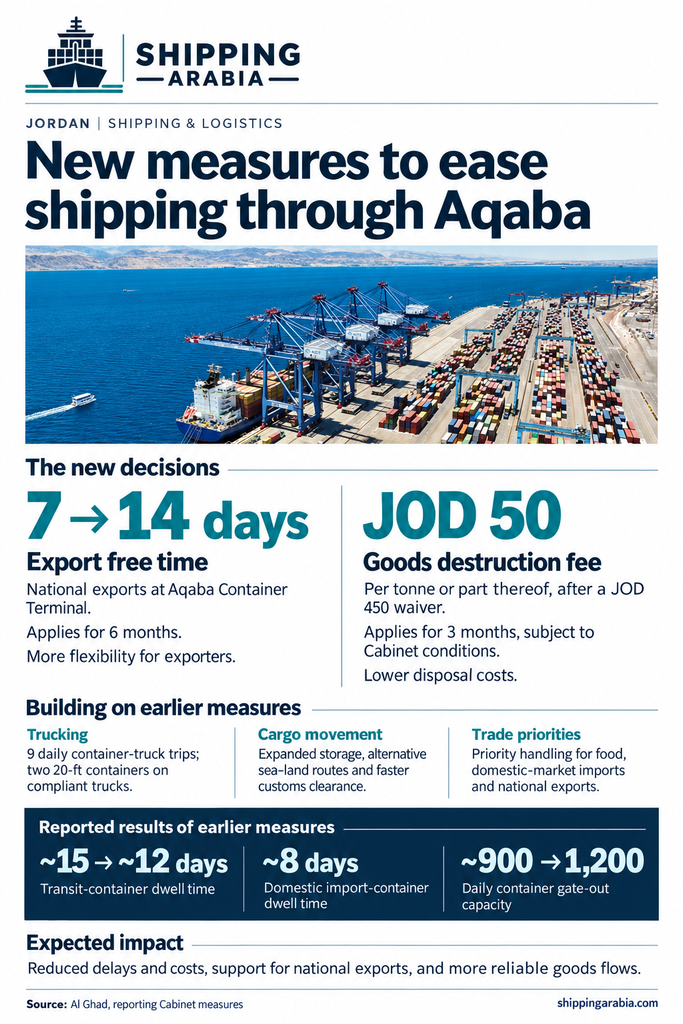
    Shipping Arabia, September 19, 2026 – Jordan has approved a new package of measures to ease operational pressure across Aqaba’s port and logistics system, including doubling the free period for national exports at Aqaba Container Terminal from seven to 14 days for six months, as the kingdom moves to strengthen supply chain resilience and maintain cargo flows.

    The measures were approved by the Cabinet, chaired by Prime Minister Dr. Jaafar Hassan, and build on earlier steps to expand storage capacity, develop logistics centers and supporting infrastructure, accelerate customs clearance and provide alternative sea-land multimodal corridors.

    The government also reduced the charge associated with the destruction of cargo from JOD 450 to JOD 50 per tonne or part thereof for three months, subject to specified conditions and coordination with the Ministry of Finance.

    Operational measures already introduced include transferring part of customs clearance activity to Amman Customs, exempting transit truck movements through border crossings from existing trip limits for three months and increasing the permitted number of daily container-truck trips to nine.

    Trucks meeting technical and safety requirements are also being permitted to carry two 20-foot containers on a single vehicle, while priority in handling, clearance and gate-out is being given to food cargo, imports destined for the domestic market and Jordanian exports.

    The measures are already being reflected in port performance. Average dwell time for transit containers has fallen from around 15 days to 12 days, while inbound local containers are averaging around eight days. Daily container gate-out capacity has increased from approximately 900 to 1,200 containers, helping reduce pressure on the port and accelerate cargo movement.

    The latest measures reinforce Aqaba’s role as Jordan’s principal maritime gateway and an increasingly important regional transit corridor, with the government seeking to increase port capacity and logistics flexibility while limiting additional costs caused by shipping delays and regional supply chain disruption.

    Source: Alghad

Back to top button