Jeddah Islamic Port

  • Saudi Ports Authority Highlights 2.4 Million m² Al-Khumrah Logistics Area Near Jeddah Islamic Port

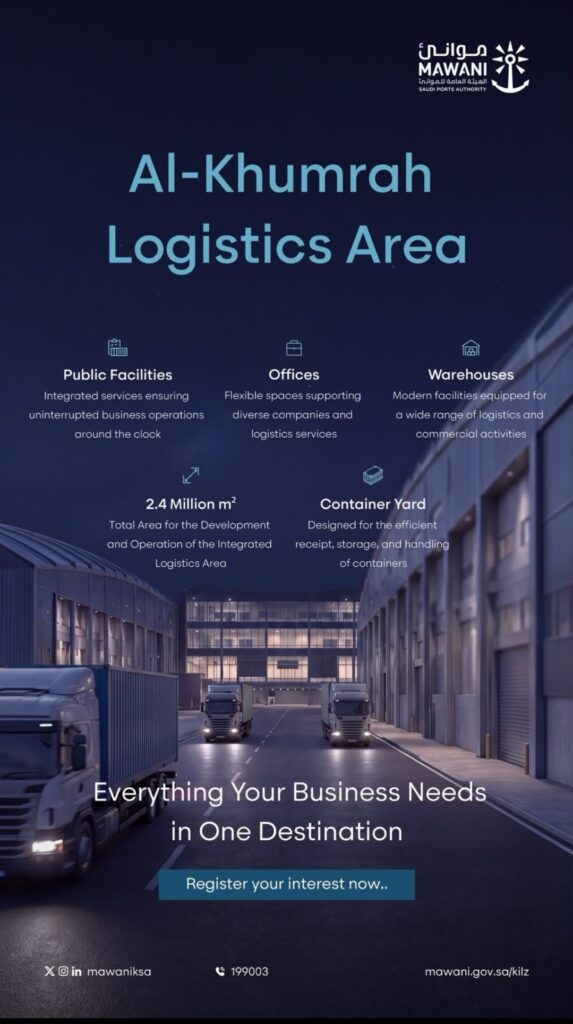
    Shipping Arabia, October 29, 2026 – The Saudi Ports Authority (Mawani) has highlighted the Al-Khumrah Logistics Area, a 2.4 million m² integrated logistics development near Jeddah Islamic Port, designed to enhance logistics operational efficiency and strengthen business competitiveness.

    The development brings together warehousing facilities, office spaces, container yards and supporting infrastructure within a single logistics environment. According to Mawani, the project aims to provide businesses with integrated facilities that accommodate a wide range of logistics and commercial activities.

    Al-Khumrah Logistics Area Offers Integrated Facilities

    The Al-Khumrah Logistics Area covers a total of 2.4 million m² designated for the development and operation of integrated logistics facilities. Its location near Jeddah Islamic Port provides a setting for businesses seeking warehousing, container handling and supporting services within one logistics area.

    The development includes modern warehouses designed to accommodate various logistics and commercial activities. It also features dedicated container yards intended to support the efficient reception, storage and handling of containers.

    In addition, the logistics area offers flexible office spaces designed to serve companies and logistics service providers. These facilities form part of the integrated environment promoted by Mawani to support different business requirements.

    Public facilities are another component of the development. According to the authority, these facilities provide integrated supporting services designed to enable uninterrupted business operations around the clock.

    Supporting Logistics Efficiency and Business Competitiveness

    Mawani has positioned the Al-Khumrah Logistics Area as an integrated destination where businesses can access multiple logistics and commercial facilities in one location.

    By combining warehouses, container storage and handling areas, offices and supporting infrastructure, the development aims to improve logistics operational efficiency while enhancing business competitiveness.

    The Saudi Ports Authority is also inviting interested companies and businesses to register their interest in the Al-Khumrah Logistics Area as part of its promotion of the development.

    Source: Saudi Ports Authority (Mawani)

  • Saudi Red Sea Ports See Rising Cargo Demand as Shipping Disruptions Reshape Regional Trade

    Shipping Arabia, October 28, 2026 – Shipping disruptions across the Middle East are reshaping regional maritime trade, increasing demand for Saudi Red Sea ports while driving up vessel operating costs and freight expenses. Red Sea Gateway Terminal (RSGT) has reported a 20% increase in demand for its services since the beginning of 2026, reflecting the diversion of cargo flows from disrupted regional shipping routes.

    The changing trade patterns have created new operational and investment opportunities for Saudi port operators. However, shipping companies are facing higher fuel expenses, insurance premiums, longer voyages and congestion at some regional ports.

    Executives from Red Sea Gateway Terminal and Folk Maritime outlined these developments during the Saudi Maritime & Logistics Congress 2026 in Jeddah. Their remarks highlighted the contrasting effects of regional disruptions on port operators, shipping lines and cargo owners.

    Saudi Red Sea Ports Benefit From Shifting Cargo Flows

    Badr Al-Otaibi, Chief Operating Officer of Red Sea Gateway Terminal, told Asharq Al-Awsat that demand for the company’s services had increased by approximately 20% since the beginning of 2026.

    The growth has been driven by rising transshipment activity and cargo diversions from maritime routes and ports affected by regional instability. Al-Otaibi said demand continues to increase, with further growth expected in the coming period.

    Previous infrastructure investments and capacity expansions at Saudi Red Sea ports have helped operators accommodate the additional cargo flows. According to Al-Otaibi, these improvements have enabled terminals to handle more vessels and containers while limiting operational delays.

    He also highlighted the importance of Saudi port readiness in managing the effects of disruptions around the Strait of Hormuz. The availability of alternative maritime gateways has helped address some of the challenges facing importers and exporters.

    To respond to the changing operating environment, Red Sea Gateway Terminal has invested approximately SAR 200 million ($53.3 million).

    Al-Otaibi said the company had previously invested around SAR 3.6 billion ($960 million) in developing its operations and infrastructure.

    He also outlined major development projects involving SAR 1.6 billion ($426.6 million) in multipurpose cargo facilities. A separate container terminal project, developed in partnership with a French company, involves investment of the same amount.

    These investments aim to strengthen cargo-handling capabilities, improve operational efficiency and support the growing demands placed on Saudi maritime infrastructure.

    Looking beyond its existing terminal operations, RSGT is also evaluating opportunities in warehousing and logistics services outside port boundaries. Al-Otaibi said any expansion would depend on market requirements and investment feasibility.

    For now, the company’s investment activities remain focused on the development and operation of maritime terminals.

    Rising Fuel and Insurance Costs Pressure Shipping Lines

    While some Saudi ports are attracting additional cargo, shipping companies are experiencing significant cost increases.

    Poul Hestbaek, CEO of Folk Maritime, told Asharq Al-Awsat that vessel fuel expenses had reached three times their normal levels during certain periods of the disruptions.

    Although costs have moderated, he said they currently remain approximately 2.5 times their usual levels.

    Insurance premiums have also increased substantially. In some cases, coverage for vessels operating in high-risk maritime areas has become several times more expensive than under normal conditions.

    The changing shipping environment has introduced additional operational challenges, including congestion at certain ports, extended voyage distances and the redistribution of vessels between services.

    Hestbaek said these factors had caused a limited reduction in Folk Maritime’s effective operating capacity. Cargo volumes transported since the beginning of the year have also been slightly below the company’s expectations.

    Longer transportation times and more complex port operations have increased costs for cargo owners. Alternative routes can also involve additional inland transportation expenses.

    Hestbaek explained that some shipments have been redirected through ports in the United Arab Emirates and Oman before continuing to their final destinations by road.

    As cargo flows shift between regional gateways, shipping companies have had to adapt their vessel deployment strategies. Folk Maritime has consequently redistributed parts of its fleet to reflect changing trade patterns.

    Despite higher operating expenses, Hestbaek said the company had passed most of the additional costs to customers and, ultimately, consumers.

    Higher revenue has helped offset the increased expenditure while allowing the company to maintain satisfactory vessel utilization levels.

    However, Al-Otaibi offered a different perspective on domestic logistics costs. He said road transportation and logistics expenses within Saudi Arabia had remained relatively stable and reasonable.

    According to Al-Otaibi, the greatest cost pressures have been concentrated in ocean freight and marine insurance rather than domestic transportation.

    Cargo Diversions Do Not Necessarily Mean Long-Term Port Growth

    The contrasting experiences of port operators and shipping lines illustrate how maritime disruptions affect different parts of the logistics industry.

    Hestbaek cautioned that increased cargo volumes at particular ports should not automatically be interpreted as sustainable growth in regional trade.

    Some ports currently benefiting from redirected shipments may have previously lost cargo to competing gateways during earlier disruptions.

    As a result, higher throughput can reflect temporary changes in shipping routes rather than a lasting increase in total trade volumes.

    This distinction is particularly important as shipping companies continue adjusting services in response to developments around the Strait of Hormuz and the Red Sea.

    Although some ports are gaining additional cargo, shipping lines must manage the financial and operational consequences of longer voyages, vessel redeployment and more complicated supply chains.

    Cargo owners and consumers also face additional expenses, even when alternative transportation routes remain available.

    Folk Maritime Launches Yanbu Service and Plans Fleet Expansion in 2027

    Folk Maritime is adapting its network to changing regional trade patterns through new shipping services and planned investments in container vessels.

    Hestbaek revealed that the company had launched a service during 2026 connecting the Saudi port of Yanbu with ports in Egypt and Jordan.

    The service remains in its development phase but has delivered encouraging initial results.

    According to Hestbaek, the new connection forms part of the company’s efforts to strengthen links between Red Sea ports and its wider international shipping network.

    The company is also preparing to expand its container vessel fleet in 2027 through additional vessel acquisitions.

    However, the expansion will depend on the availability of suitable ships that meet the company’s operational requirements.

    The planned investments aim to strengthen Folk Maritime’s services connecting the Indian subcontinent, the Middle East, the Arabian Gulf and the Red Sea.

    Hestbaek expects shipping challenges to continue into 2027, citing uncertainty surrounding stability in the Strait of Hormuz and the Red Sea.

    He emphasized that ensuring the reliable delivery of essential goods to Saudi Arabia remains Folk Maritime’s highest operational priority.

    The company continues adjusting its network and vessel deployment to maintain cargo flows despite the changing operating environment.

    Saudi Maritime Industry Focuses on Supply Chain Resilience

    The executives made their remarks during the Saudi Maritime & Logistics Congress 2026, held in Jeddah under the patronage of Saudi Minister of Transport and Logistic Services Saleh Al-Jasser.

    The event brought together representatives from shipping companies, port operators and logistics service providers to discuss developments affecting maritime trade and regional supply chains.

    Key topics included changing shipping routes, port competitiveness, maritime infrastructure investment and the challenges facing international logistics networks.

    Industry participants also examined how companies can improve operational resilience through infrastructure development, flexible shipping networks and additional capacity.

    The developments highlight a significant shift in the regional maritime sector. Saudi Red Sea ports are attracting additional cargo as trade routes change, while shipping companies continue managing higher operating expenses and uncertain trading conditions.

    For terminal operators such as Red Sea Gateway Terminal, the shift is supporting new investments and increased demand for handling services. For shipping lines such as Folk Maritime, it is accelerating network adjustments, service development and fleet planning.

    However, the longer-term impact on regional maritime trade will depend on how shipping routes evolve and whether current cargo diversions become lasting changes in supply chain patterns.

    Source: Asharq Al-Awsat

  • Maersk Gemini Network Expansion Adds AE18 Service and Revises Six Routes Through Suez Canal

    Shipping Arabia, October 25, 2026 – Maersk has announced a major expansion of its Gemini Cooperation network with Hapag-Lloyd, introducing the new AE18 service and revising five existing services across Asia, Europe and the Middle East. The changes follow the previously announced rerouting of Asia-Mediterranean services through the Suez Canal.

    The Maersk Gemini network expansion will reshape connections serving Northern Europe, the Mediterranean, the Middle East, Sri Lanka and the Adriatic. The adjustments cover six services: AE18, AE2, AE11, AE19, ME2 and AE12, with implementation scheduled between November 2026 and January 2027.

    The revised network will strengthen coverage at major Mediterranean hubs, introduce new port connections and reorganize existing services. It will also support additional shipping connections from Asia to West Africa and the east coast of Latin America.

    Maersk Launches AE18 to Strengthen Western Mediterranean Coverage

    The new AE18 service will operate alongside AE19, consolidating Gemini’s existing Western Mediterranean hub coverage. It will replace connections to Tangier and Algeciras previously provided by AE2, AE11 and AE12, while introducing a direct connection from Xiamen, China.

    The service will connect Shanghai and Xiamen with Tanjung Pelepas, Algeciras and Tangier before returning through Algeciras and Xiamen.

    The full AE18 rotation will be:

    Shanghai – Xiamen – Tanjung Pelepas – Algeciras – Tangier – Algeciras – Xiamen.

    Maersk Edirne, operating voyage 647W, will inaugurate the new service with a scheduled departure from Shanghai on November 22, 2026.

    The introduction of AE18 forms a central part of the network restructuring, allowing Maersk and Hapag-Lloyd to reorganize their existing Mediterranean coverage while maintaining connections through the Gemini network.

    AE2, AE11 and AE19 Introduce New Port Connections

    Alongside the introduction of AE18, Maersk will revise three established Asia-Europe services, with the first changes taking effect in mid-November.

    AE2: Additional Rotterdam Connection

    The AE2 service will replace its westbound Tangier call with Rotterdam, providing an additional connection from Ningbo and Shanghai to the Dutch port.

    Moscow Maersk, operating voyage 646W, will be the first vessel affected by the revised rotation. Its departure from Ningbo is scheduled for November 15, 2026.

    AE11: Salalah and Port Said Added to Westbound Coverage

    The AE11 service will introduce a westbound call at Salalah, Oman, while replacing its westbound Tangier call with Port Said, Egypt.

    The changes will establish additional shipping connections to and from Salalah while strengthening the service’s coverage through Port Said.

    Estelle Maersk, voyage 647W, will operate the first affected sailing, departing Shanghai on November 17, 2026.

    AE19: Nansha Replaces Shanghai as Damietta Joins the Rotation

    The AE19 service will replace its Shanghai call with Nansha, introducing new coverage between the Chinese port and Europe.

    In addition, Maersk will add Damietta, Egypt, to the service rotation, expanding the network’s Eastern Mediterranean connections.

    The revised arrangements will begin with Ane Maersk, voyage 647W, scheduled to depart Xingang on November 18, 2026.

    Together, these adjustments will redistribute existing port coverage across the Gemini network while introducing alternative connections through Rotterdam, Salalah, Port Said and Damietta.

    ME2 Adds Jeddah to Connect Northern Europe With Saudi Arabia

    Another significant element of the Maersk Gemini network expansion is the addition of Jeddah Islamic Port to the eastbound rotation of the ME2 service.

    The change will establish a direct shipping connection between Northern Europe and Saudi Arabia, serving cargo moving from Rotterdam, London Gateway and Hamburg to Jeddah.

    The revised ME2 rotation will be:

    Ennore – Colombo – Suez Canal – Algeciras – Rotterdam – London Gateway – Hamburg – Tangier – Suez Canal – Jeddah – Colombo.

    Maersk Tukang, operating voyage 649E, will be the first vessel affected by the revised service. Its scheduled arrival at Jeddah is December 20, 2026.

    The inclusion of Jeddah expands the service’s eastbound coverage and provides an additional direct connection to Saudi Arabia from three major Northern European ports.

    AE12 Restores Colombo Connection to Adriatic Ports Through East Port Said

    Maersk will also transfer its Colombo call from AE15 to AE12, establishing a shipping connection between Sri Lanka and the Adriatic ports of Koper and Rijeka.

    The revised AE12 service will operate through the Suez Canal and East Port Said, connecting Asian origins with the Adriatic before continuing eastbound toward Colombo and Singapore.

    The full revised AE12 rotation will be:

    Ningbo – Shanghai – Tanjung Pelepas – Suez Canal – Port Said East – Koper – Rijeka – Port Said East – Suez Canal – Colombo – Singapore.

    Alva Maersk, voyage 652E, will be the first vessel to operate the revised rotation. The ship is expected to arrive at Colombo on January 12, 2027.

    The transfer of Colombo to AE12 will create a connection between Sri Lanka and the Adriatic while providing onward shipping options from Colombo to destinations in southern India and Bangladesh.

    The revised rotation will also reinforce the role of East Port Said in connecting Asian cargo flows with Mediterranean and Adriatic destinations through the Suez Canal.

    Phased Implementation Across the Gemini Network

    The network changes will take effect through a series of scheduled vessel departures and arrivals.

    The first adjustments will begin with AE2 on November 15, followed by AE11 on November 17 and AE19 on November 18. The new AE18 service will launch on November 22, completing the initial phase of the Western Mediterranean network restructuring.

    The changes will then extend to ME2, with the first affected Jeddah arrival scheduled for December 20, 2026. Finally, the revised AE12 rotation will take effect with the first affected Colombo arrival on January 12, 2027.

    The wider network configuration will also support connections from Asia to West Africa and the east coast of Latin America.

    Together, the six service adjustments represent a substantial reorganization of Gemini’s Asia-Europe and Middle East network following the rerouting of Asia-Mediterranean services through the Suez Canal.

    Source: Al Mal News

  • New Taicang–Jeddah Shipping Service to Cut Transit Times by Up to Three Weeks

    Shipping Arabia, October 18, 2026 – A new direct shipping service has been launched between Taicang Port in China’s eastern Jiangsu province and Jeddah Islamic Port in Saudi Arabia, with the operator expecting to reduce cargo transit times by two to three weeks. The Taicang–Jeddah shipping service eliminates intermediate transshipment operations, offering a more direct maritime connection between eastern China and the Middle East.

    The new route was inaugurated with the departure of a cargo vessel carrying approximately 1,000 containers from Taicang Port to Jeddah. Operated by Hai Son Shipping, the service aims to improve transportation efficiency, provide more reliable sailing schedules and reduce logistics costs for cargo moving between China and Saudi Arabia.

    Direct Taicang–Jeddah Shipping Service Targets Faster Cargo Deliveries

    The introduction of the new service establishes a direct maritime connection between Taicang Port, located in Jiangsu province, and Saudi Arabia’s Red Sea gateway at Jeddah.

    Xu Dapeng, chairman of Hai Son Shipping, said the route could shorten cargo transportation times by two to three weeks by eliminating the need for container transshipment at intermediate ports.

    According to Xu, the direct connection also offers more predictable sailing schedules, helping improve transportation efficiency and reduce logistics costs for customers.

    The company intends to monitor market demand as the service develops. Based on future cargo requirements, Hai Son Shipping will consider increasing sailing frequency, optimizing available vessel capacity and continuously improving its integrated logistics services.

    The new Taicang–Jeddah shipping service responds to growing demand among international trading companies for direct and efficient maritime logistics connections between the two countries.

    Expanding China–Saudi Arabia Trade Drives Demand for Maritime Connectivity

    The launch comes amid continued growth in economic and commercial relations between China and Saudi Arabia.

    Trade between the two countries covers a wide range of energy resources, industrial materials, machinery and manufactured products, creating demand for maritime transportation services.

    China’s imports from Saudi Arabia include crude oil, petrochemical products and minerals. Meanwhile, Saudi Arabia continues to generate demand for Chinese engineering machinery, steel structural components, industrial electrical equipment and photovoltaic products.

    Other products moving within the bilateral trading relationship include household electrical appliances and light industrial goods manufactured in China.

    As commercial exchanges expand, trading companies are increasingly seeking efficient direct shipping routes that can improve cargo transportation and reduce dependence on intermediate logistics hubs.

    The new direct service between Taicang and Jeddah is intended to address these requirements by providing an additional maritime transportation option between the two markets.

    Bilateral Trade Reached $108.2 Billion in 2025

    Official figures published by China’s Ministry of Foreign Affairs show that bilateral trade between China and Saudi Arabia reached approximately $108.2 billion in 2025.

    During the first quarter of 2026, trade between the two countries amounted to approximately $24.15 billion, reflecting the substantial volume of commercial exchanges between the two economies.

    Energy trade remains an important component of the relationship. China imported approximately 80.76 million tonnes of crude oil from Saudi Arabia during 2025.

    In the first quarter of 2026, Chinese imports of Saudi crude oil reached approximately 17.9 million tonnes.

    Against this backdrop of substantial bilateral trade, the new Taicang–Jeddah shipping service provides another direct connection between China’s manufacturing and export markets and Saudi Arabia’s maritime gateways.

    By reducing the need for intermediate transshipment and offering more predictable sailing schedules, Hai Son Shipping aims to improve freight transportation efficiency while responding to demand for stronger maritime logistics links between China and Saudi Arabia.

    Source: Al Mal

  • Saudi Port Investments Top $1.46 Billion as Jeddah Handles Surge in Regional Cargo

    Shipping Arabia, September 19, 2026 – Saudi Arabia has invested more than SAR 5.5 billion ($1.46 billion) in its ports during the regional disruption, as Jeddah Islamic Port and the Kingdom’s western coast absorb sharply higher vessel, truck and cargo volumes and take on a wider role in regional supply chains.

    Saudi Ports Authority (Mawani) President Suliman bin Khalid Al-Mazroua said Jeddah and the western coast had developed into a major logistics platform serving Saudi Arabia and Gulf markets during the disruption.

    Truck traffic at Jeddah Islamic Port has risen from around 2,000–2,500 vehicles per day to more than 10,000, alongside increased vessel activity. More than 34 shipping services operated by major global carriers, including Maersk and MSC, now call at the port.

    Mawani has implemented 16 operational initiatives with government and customs authorities to increase the port’s readiness, while more than SAR 640 million has been invested in Jeddah over the past three months to strengthen its capacity to receive and handle containers moving by both sea and land.

    Al-Mazroua said the western coast is increasingly operating as an integrated port network. Yanbu supports food-security cargo flows, King Abdullah Port contributes additional container and logistics capacity, while NEOM Port supports traffic arriving from Egypt, expanding the ability of Saudi ports to respond to changing regional trade patterns.

    Transshipment activity has also increased, with volumes exceeding 370,000 containers over five months, while general and bulk cargo surpassed one million units. Mawani expects volumes to rise further by the end of the year as demand for port and logistics services continues to grow.

    The next phase will include further port investment alongside the development of special economic zones and logistics zones across Saudi Arabia’s eastern and western ports, strengthening the Kingdom’s maritime and logistics infrastructure and its role in regional supply chains.

    Source: Argaam

Back to top button