Khalifa Port

  • Asyad Launches Duqm–Khalifa Port Green Corridor to Strengthen Oman–UAE Trade Connectivity

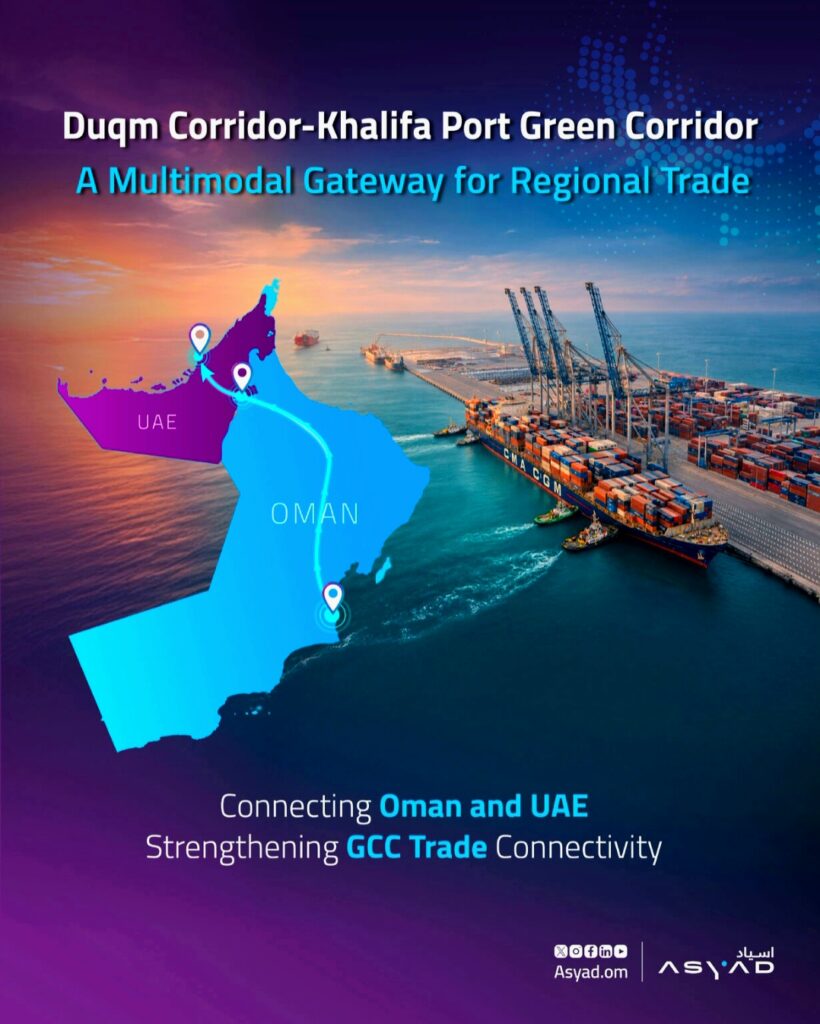
    Shipping Arabia, November 18, 2026 – Oman’s Asyad Group has commenced operations along the Duqm–Khalifa Port Green Corridor, establishing an integrated logistics route connecting the Port of Duqm with Khalifa Port in Abu Dhabi. The corridor combines container handling, road transportation and coordinated customs procedures to facilitate cargo movements between Oman, the United Arab Emirates and wider Gulf Cooperation Council (GCC) markets.

    The new corridor is already handling regular weekly shipments through the Asyad Container Terminal at the Port of Duqm. Asyad expects cargo volumes to increase as demand for the service grows, reinforcing Duqm’s position as a regional logistics gateway.

    The initiative aims to strengthen commercial connectivity between Oman and neighboring Gulf markets while providing cargo owners with more flexible transport and distribution options. It also forms part of Asyad’s wider efforts to integrate maritime infrastructure with regional road transport and logistics networks.

    Duqm–Khalifa Port Green Corridor Integrates Maritime and Road Transport

    The Duqm–Khalifa Port Green Corridor operates through a coordinated logistics framework that connects port handling operations with cross-border road transportation and customs services.

    Under the arrangement, cargo arriving at the Port of Duqm is transported by road through the Khatm Al Shiklah border crossing to Al Ain Dry Port in the UAE. Shipments then continue to Khalifa Port in Abu Dhabi, where they connect with distribution networks serving markets throughout the GCC.

    The corridor integrates different stages of cargo movement into a coordinated operational structure. Cross-border customs arrangements support the process by simplifying transit procedures and reducing the time shipments spend at handling facilities and border points.

    According to Asyad, this approach is designed to improve cargo flow efficiency, optimize the use of transport and handling resources, and facilitate trade between regional markets. It also gives cargo owners greater flexibility when planning shipments and managing distribution operations.

    With weekly cargo movements already established, the corridor provides an operational connection between Oman’s maritime infrastructure and the UAE’s logistics and distribution networks. Asyad expects increasing cargo volumes to strengthen the route’s role in regional trade.

    Growing Demand for Integrated Regional Logistics Solutions

    Al Khattab bin Salim Al Ma’ani, Vice President of Commercial Affairs at Asyad Ports and Freezones, said changes in global trade are increasing demand for resilient supply chains, closer operational coordination and faster access to markets.

    He explained that the Duqm–Khalifa Port Green Corridor responds to these requirements by combining port capabilities, road transport networks and cross-border logistics services within an integrated offering.

    Al Ma’ani also highlighted growing demand for the route among cargo owners and logistics partners. He said this reflected the increasing importance of flexible, end-to-end transport solutions that can respond to changing commercial requirements.

    The corridor is intended to strengthen connections between Omani ports and regional distribution networks while supporting more efficient movement of goods. Through its coordinated operating arrangements, Asyad aims to provide businesses with additional options for managing cargo flows between Gulf markets.

    The Port of Duqm’s geographical position along international shipping routes supports this development. According to Asyad, the port’s infrastructure and operational capabilities enable it to accommodate large vessels and handle container traffic efficiently.

    Furthermore, its connections to inland transport and distribution networks allow cargo arriving by sea to reach regional markets through integrated logistics services. These capabilities underpin Asyad’s plans to expand Duqm’s role as a gateway for regional trade.

    Asyad Expands Trade Corridors Across GCC Markets

    The Duqm–Khalifa Port Green Corridor forms part of Asyad Group’s expanding network of integrated trade corridors connecting Omani ports with regional markets.

    According to Al Ma’ani, the network includes corridors linking the Port of Duqm with Qatar and Saudi Arabia. Asyad has also developed corridors from the Port of Sohar to strengthen Oman’s commercial connectivity with other Gulf markets.

    Together, these routes combine maritime infrastructure, road transportation, logistics services and customs arrangements. The integrated network is designed to offer businesses a broader range of options for transporting goods between regional markets.

    By developing connections between Omani ports and inland distribution networks, Asyad aims to strengthen the integration of transport services across the GCC. The corridors also support the group’s efforts to provide coordinated logistics solutions that respond to changing cargo movement requirements.

    Al Ma’ani confirmed that Asyad will continue expanding its integrated trade corridor network, linking Omani ports with international maritime shipping routes, regional road networks and distribution markets.

    The initiative aligns with Oman Vision 2040, which seeks to increase the logistics sector’s contribution to economic diversification and strengthen the country’s ability to respond to changes in global trade flows.

    Through the operational Duqm–Khalifa connection and its wider regional corridor network, Asyad is pursuing greater integration between Oman’s maritime gateways and Gulf logistics markets, with a focus on improving trade connectivity and supply chain flexibility.

    Source: Oman Observer
  • Khalifa Port Climbs to 34th Globally as Container Throughput Reaches 6.6 Million TEUs

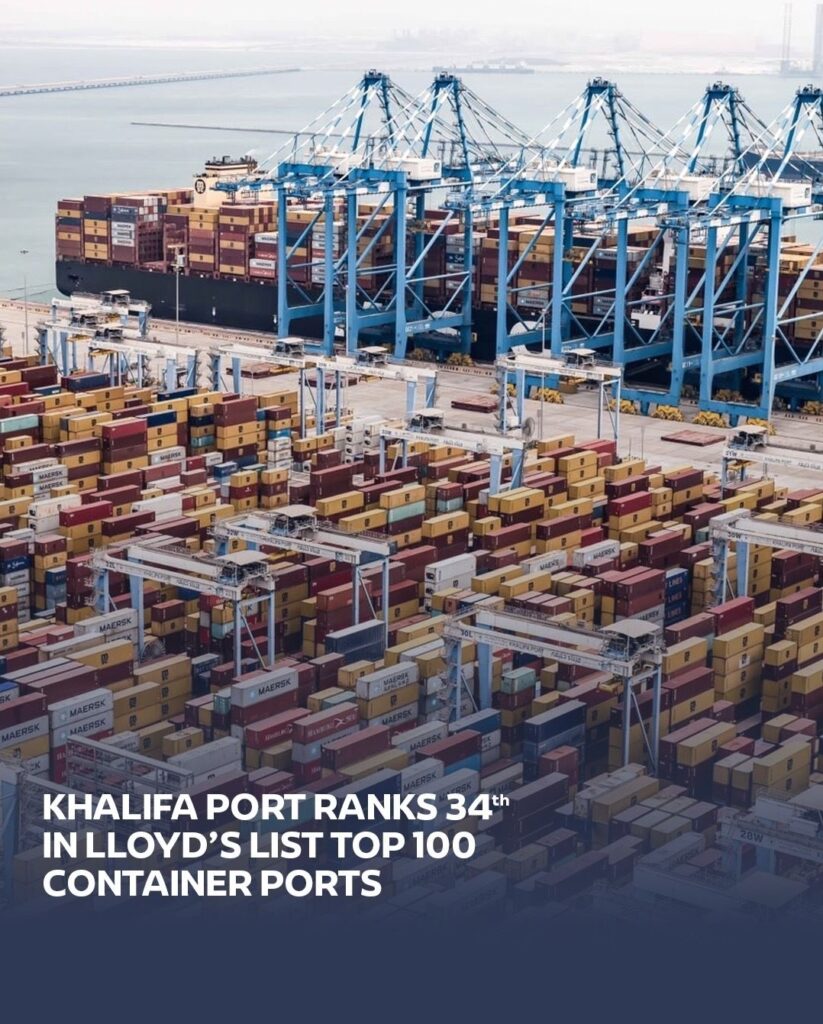
    Shipping Arabia, October 29, 2026 – Khalifa Port in Abu Dhabi has climbed five positions to rank 34th globally in the Lloyd’s List Top 100 Container Ports 2026, following a 21.6% increase in container throughput during 2025. The port handled 6.6 million TEUs, recording the highest year-on-year percentage growth among the world’s top 40 container ports in the latest ranking.

    According to AD Ports Group, Khalifa Port’s container throughput increased from 5.42 million TEUs in 2024 to 6.6 million TEUs in 2025. The latest results reflect the combined performance of three container terminals operated through partnerships with major international shipping lines CMA CGM, COSCO and MSC.

    Khalifa Port Container Throughput Drives Global Ranking

    Khalifa Port advanced from 39th position in the previous Lloyd’s List ranking to 34th in the 2026 edition. The ranking evaluates the world’s leading container ports based on their annual container throughput.

    Since entering the global top 100 in 95th position in 2019, Khalifa Port has climbed 61 places. AD Ports Group attributed this progress to sustained investments in port infrastructure, additional handling capacity, advanced technology and operational efficiency.

    The company also highlighted the importance of expanding international shipping connections and maintaining long-term partnerships with global terminal operators.

    Strong market demand, increased terminal utilization and newly added capacity contributed to the port’s performance in 2025.

    A major contributor was CMA Terminals Khalifa Port, developed through a partnership between AD Ports Group and CMA CGM. The terminal handled more than 1.3 million TEUs during its first full year of operations following its inauguration in January 2025.

    Three Container Terminals Support Growing Capacity

    Khalifa Port operates three advanced container terminals through partnerships with leading global shipping companies. These include Abu Dhabi Terminals with MSC, CSP Abu Dhabi Terminal with COSCO, and CMA Terminals Khalifa Port.

    Together, the terminals provide shipping customers with connectivity to major international markets, scalable handling capacity and access to AD Ports Group’s integrated logistics network.

    Further expansion is underway at CMA Terminals Khalifa Port. The development will increase the terminal’s annual container-handling capacity by almost 50%, bringing it to 2.7 million TEUs.

    Once the expansion is completed, Khalifa Port’s total annual container-handling capacity will reach 10.5 million TEUs, further strengthening its ability to accommodate container traffic.

    The additional capacity forms part of AD Ports Group’s continued investments in port infrastructure and international maritime connectivity.

    AD Ports Group Emphasizes Infrastructure and Connectivity Investments

    Saif Al Mazrouei, Chief Executive Officer of the Ports Cluster at AD Ports Group, described Khalifa Port’s rise in the Lloyd’s List ranking as a reflection of the group’s long-term development strategy and commitment to operational excellence.

    He emphasized that the 21.6% increase in container throughput and five-position improvement in the global ranking demonstrate the results of investments in infrastructure, capacity, technology and connectivity.

    Al Mazrouei also acknowledged the contribution of the group’s workforce, customer confidence and strategic partnerships to the port’s performance.

    Looking ahead, he reaffirmed AD Ports Group’s commitment to further investments in handling capacity, maritime connectivity and innovative solutions. These investments aim to strengthen Khalifa Port’s role as an international trade gateway and support the UAE’s position within global supply chains.

    Integrated Logistics Network Strengthens Trade Connectivity

    Beyond its container terminals, Khalifa Port serves as an integrated logistics gateway connecting maritime transport with road and rail networks.

    The port also connects with AD Ports Group’s inland logistics network, dry ports, cargo-handling facilities and industrial zones. This integrated infrastructure supports cargo movements within the UAE while providing businesses with greater flexibility across regional and international supply chains.

    AD Ports Group considers these connections an important element of its strategy to improve logistics efficiency and strengthen the competitiveness of its port operations.

    With container throughput reaching 6.6 million TEUs in 2025 and additional terminal capacity under development, Khalifa Port continues to expand its role in international container shipping.

    The group reaffirmed its commitment to infrastructure investment, strategic partnerships and integrated trade and logistics solutions as part of its efforts to strengthen global competitiveness and support the UAE’s long-term economic diversification.

    Source: AD Ports Group

  • CMA Terminals Khalifa Port Achieves Three ISO Certifications

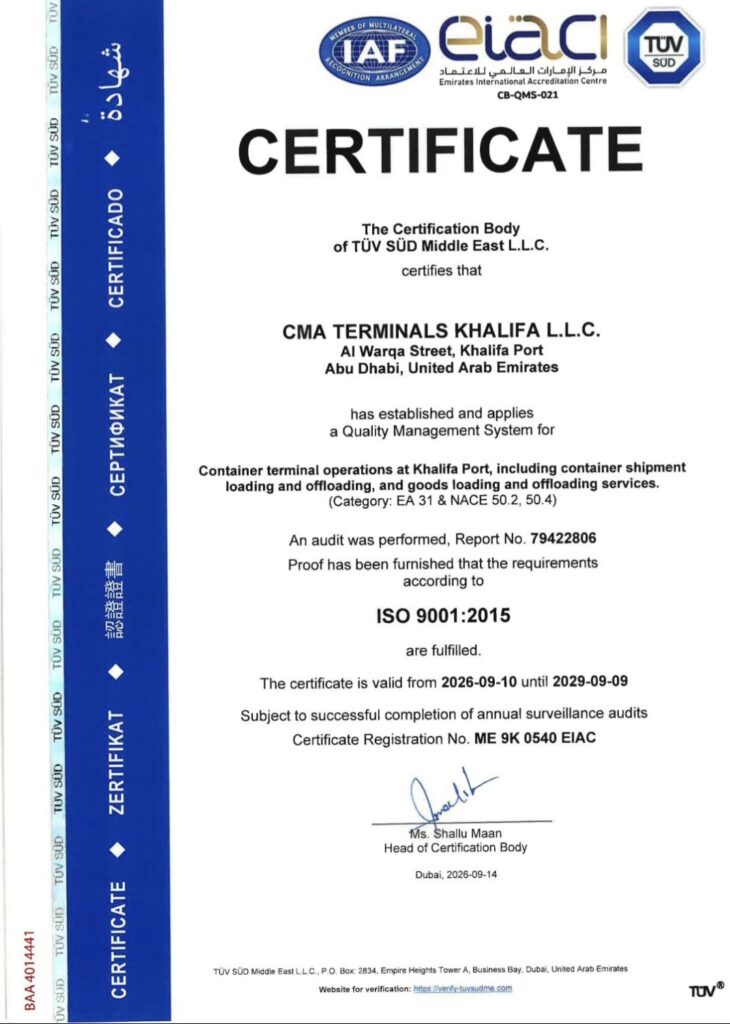
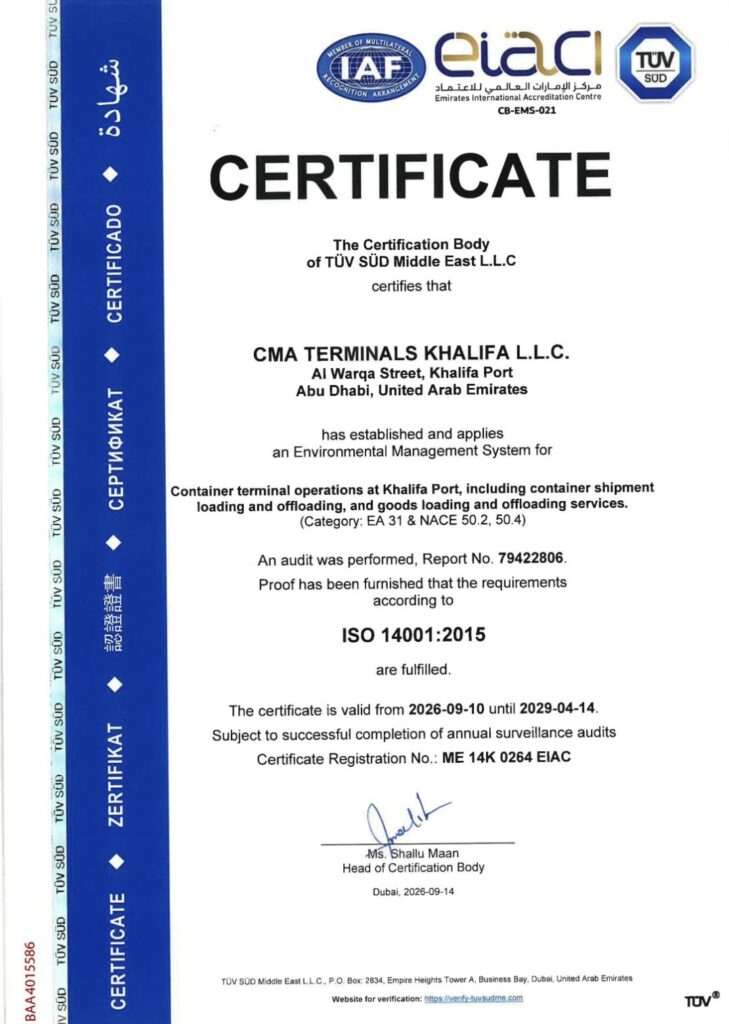
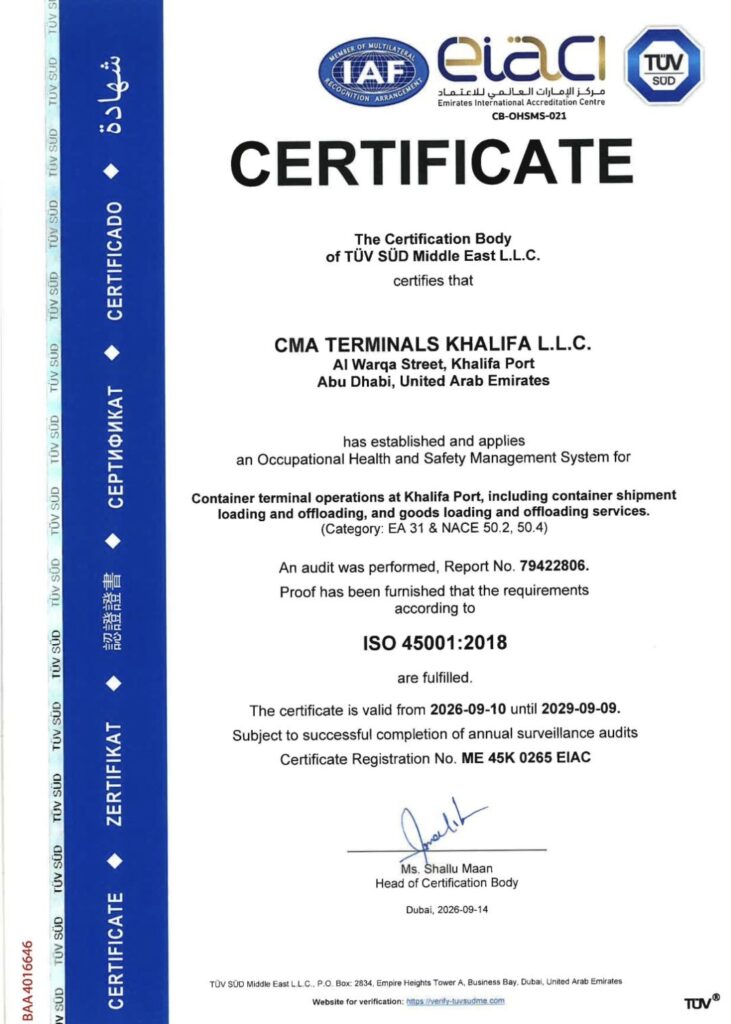
    Shipping Arabia, September 22, 2026 – CMA Terminals Khalifa Port in Abu Dhabi has achieved three international ISO certifications covering quality management, environmental management, and occupational health and safety across its container terminal operations.

    The terminal has been certified to ISO 9001:2015 for Quality Management Systems, ISO 14001:2015 for Environmental Management Systems, and ISO 45001:2018 for Occupational Health and Safety Management Systems.

    The certifications were issued by TÜV SÜD Middle East following an audit of CMA Terminals Khalifa L.L.C. and cover container terminal operations at Khalifa Port, including container shipment loading and offloading as well as goods loading and offloading services.

    The three standards address key areas of terminal management and operations. ISO 9001 establishes requirements for quality management and consistent service delivery, while ISO 14001 provides a framework for managing environmental responsibilities. ISO 45001 focuses on occupational health and safety management and the control of workplace risks.

    According to the certificates, the ISO 9001 and ISO 45001 certifications are valid from September 10, 2026, until September 9, 2029. The ISO 14001 certification is valid from September 10, 2026, until April 14, 2029. The certifications are subject to successful completion of annual surveillance audits.

    CMA Terminals Khalifa Port said the achievement reflects its commitment to quality, environmental responsibility, employee health and safety, and continuous improvement across its operations.

    The milestone further strengthens the management framework supporting the terminal’s container handling operations at Khalifa Port and its focus on internationally recognised operational standards.

    Source: CMA Terminals Khalifa Port

Back to top button