Mawani

  • Saudi Ports Authority Introduces Temporary Storage Charges for Transit Cargo and Empty Containers

    Shipping Arabia, November 1, 2026 – The Saudi Ports Authority (Mawani) has approved temporary storage charges and free-storage periods for transit cargo and empty containers at Saudi ports. The measures will remain in effect for 60 days and aim to address exceptional circumstances and operational challenges affecting maritime traffic, supply chains and logistics services.

    The decision introduces temporary schedules governing storage charges and exemption periods for the specified cargo categories. Mawani said the arrangements aim to maintain business continuity, facilitate port operations and reduce the impact of current disruptions on maritime transport and logistics activities.

    Temporary Storage Charges and Free Periods at Saudi Ports

    Under the new circular, Saudi ports storage charges and free-storage periods for transit cargo and empty containers will follow the schedules attached to the directive.

    The applicable charges and exemption periods will depend on the individual port, cargo classification, storage duration, tariff bracket and calculation unit. Each port and cargo category will therefore be subject to the provisions specified in the relevant schedules.

    Mawani confirmed that the temporary arrangements will remain effective for 60 days from the circular’s implementation date.

    Following this period, the storage charges and free periods established under the Port Services Fees and Charges Regulations (Fourth Edition), including subsequent amendments, will automatically resume. However, Mawani may issue another circular modifying or terminating the temporary arrangements.

    The authority described the decision as a temporary regulatory measure introduced in response to the exceptional circumstances and operational challenges currently affecting the maritime and logistics sectors.

    Supporting Port Operations and Supply Chain Continuity

    Mawani explained that the temporary storage arrangements aim to maintain uninterrupted business activity and facilitate the movement of cargo through Saudi ports.

    The measures also seek to strengthen the ability of ports to accommodate cargo movements while maintaining the efficiency of services provided to port users.

    According to the authority, the decision forms part of its efforts to mitigate the effects of current operational challenges on maritime traffic, supply chains and logistics services.

    By establishing temporary storage schedules for transit cargo and empty containers, Mawani aims to support operational continuity and preserve the flow of goods through Saudi Arabia’s port network.

    Implementation Requirements and Previous Storage Charges

    The circular also introduces requirements for stakeholders responsible for applying storage charges and administering free-storage periods.

    From its effective date, the new directive supersedes provisions relating to storage charges and exemption periods for the covered cargo categories contained in previous circulars. Those earlier provisions will no longer apply to cargo covered by the temporary arrangements.

    All relevant parties must implement the attached schedules and update their operational systems accordingly. This includes adjustments to the systems used to calculate, invoice and collect storage charges.

    However, the circular explicitly preserves storage charges accrued during previous periods. Any amounts already payable under the earlier arrangements will remain due.

    The temporary framework will apply for the designated 60-day period unless Mawani issues further instructions changing or ending the measures.

    Source: Maaal
  • Saudi Ports Authority Tightens Empty Container Return Rules, Warns of SAR 50,000 Fines

    Shipping Arabia, October 30, 2026 – The Saudi Ports Authority (Mawani) has introduced stricter empty container return rules, requiring shipping agents and shipping lines to address disruptions in container returns and prevent unjustified detention charges imposed on importers. The authority also warned that violations could result in financial penalties of up to SAR 50,000 per case.

    The measures aim to protect customers’ rights, improve operational coordination and strengthen logistics efficiency across Saudi ports. They address situations in which importers cannot return empty containers because designated yards are full, have suspended acceptance or cannot provide suitable return appointments.

    According to a circular reported by Maaal, Mawani has received complaints and observations concerning these disruptions. In some cases, importers have incurred detention charges for periods when circumstances beyond their control prevented them from returning containers.

    The authority has therefore established regulatory requirements covering yard availability, documentation of unsuccessful return attempts, detention charge disputes and compliance monitoring.

    Shipping Agents Required to Ensure Empty Container Yard Availability

    Under the new empty container return rules, shipping agents and shipping lines must ensure that designated container return facilities remain operationally ready and have sufficient capacity to receive empty containers.

    They must also maintain coordination with relevant parties to arrange alternative return locations when designated facilities cannot accommodate containers. Customers must receive written notification of these alternative arrangements.

    Mawani reiterated the requirements of Circular No. 36 of 2026, which obliges shipping agents to clearly identify the designated empty container return location when issuing delivery orders.

    Importantly, shipping agents must verify that the designated facility has the operational capacity to accept containers. Simply specifying a return location without confirming its availability does not satisfy the requirements outlined by the authority.

    These obligations seek to address recurring problems involving unavailable yard capacity, suspended container acceptance and difficulties securing return appointments.

    Documenting Unsuccessful Returns and Reviewing Detention Charges

    Mawani has introduced a standardized documentation form to record incidents in which importers cannot return empty containers to their designated locations.

    The form records the relevant incident details and reasons preventing the return. It is intended to provide documented evidence when container yards cannot accept equipment.

    Where a yard operator refuses to issue the required documentation, the authority will allow alternative verifiable evidence. This may include appointment booking records, rejection notices and correspondence demonstrating that the attempted container return could not be completed.

    The documentation requirements are directly linked to the treatment of detention charges incurred during periods when container returns were impossible.

    Shipping agents must review detention charge claims associated with documented periods of unsuccessful returns. They are also required to settle or cancel the relevant charges in accordance with applicable regulatory frameworks.

    The measures are intended to prevent importers from bearing detention costs arising from operational circumstances outside their control, while establishing clearer procedures for documenting and resolving disputes.

    Mawani Introduces 15-Day Compliance Monitoring Period

    The Saudi Ports Authority has established an intensified monitoring period covering all shipping agents and shipping lines for 15 days from the circular’s issuance.

    During this period, the authority will monitor compliance with the requirements governing empty container returns and the handling of related detention charges.

    Each shipping agent must also submit a detailed compliance report within the same 15-day period. Reports must be delivered through the designated email address or by formal written correspondence.

    The reporting obligation forms part of Mawani’s regulatory oversight framework and seeks to ensure that shipping agents address the identified operational and administrative shortcomings.

    Fines of Up to SAR 50,000 for Regulatory Violations

    Mawani warned that it would not tolerate practices resulting in importers being charged unjustified detention fees.

    The authority stated that continued noncompliance could trigger additional regulatory measures, including further corrective requirements and intensified supervision.

    Other potential measures include extending the free-time allowances established under the regulations governing shipping agency activities. Mawani may also publicly disclose the names of entities that fail to comply with its requirements.

    Financial penalties could reach the maximum legally prescribed amount of SAR 50,000 for each violation.

    The authority further prohibited any retaliatory or arbitrary measures against parties submitting complaints, reinforcing protections for customers seeking to challenge improper charges or report difficulties returning containers.

    Through the new empty container return rules, Mawani aims to strengthen accountability among shipping agents and shipping lines, improve the management of container return facilities and protect importers from detention charges arising from documented operational disruptions.

    Source: Maaal

  • Saudi Ports Cargo Throughput Falls 25% to 16.5 Million Tons in September 2026

    Shipping Arabia, October 23, 2026 – Saudi ports cargo throughput declined by 25% in September 2026, with total handled volumes exceeding 16.5 million tons, compared with 22.1 million tons during the same month in 2025, according to the Saudi Ports Authority (Mawani).

    The decline was accompanied by a reduction in container throughput across the Kingdom’s ports. However, inbound container volumes increased, while outbound container movements recorded a slight decrease.

    Saudi Ports Container Throughput Declines 4.46%

    Saudi Arabia’s ports handled approximately 625,300 twenty-foot equivalent units (TEUs) in September 2026, representing a reported 4.46% decrease compared with the corresponding period last year.

    During September 2025, total container throughput reached approximately 655,700 TEUs, according to Mawani’s figures.

    The reduction in container handling accompanied the sharper decline in overall cargo tonnage, which fell by 25% year-on-year.

    Inbound Container Volumes Increase as Exports Decline

    Despite the overall reduction in container throughput, Saudi ports recorded an increase in inbound container movements during September 2026.

    Inbound container volumes reached approximately 367,700 TEUs, compared with 251,100 TEUs during the same month in 2025.

    The published report described this as a 6.58% increase, although the two reported volume figures indicate a larger percentage rise.

    Meanwhile, outbound container throughput declined by 0.61%, reaching approximately 236,000 TEUs compared with 237,500 TEUs in September 2025.

    The figures show contrasting trends in Saudi Arabia’s container traffic, with inbound movements increasing while outbound volumes declined slightly.

    Overall, Mawani’s September results indicate lower cargo tonnage and total container throughput across Saudi ports, despite growth in inbound container handling.

    Source: Maaal

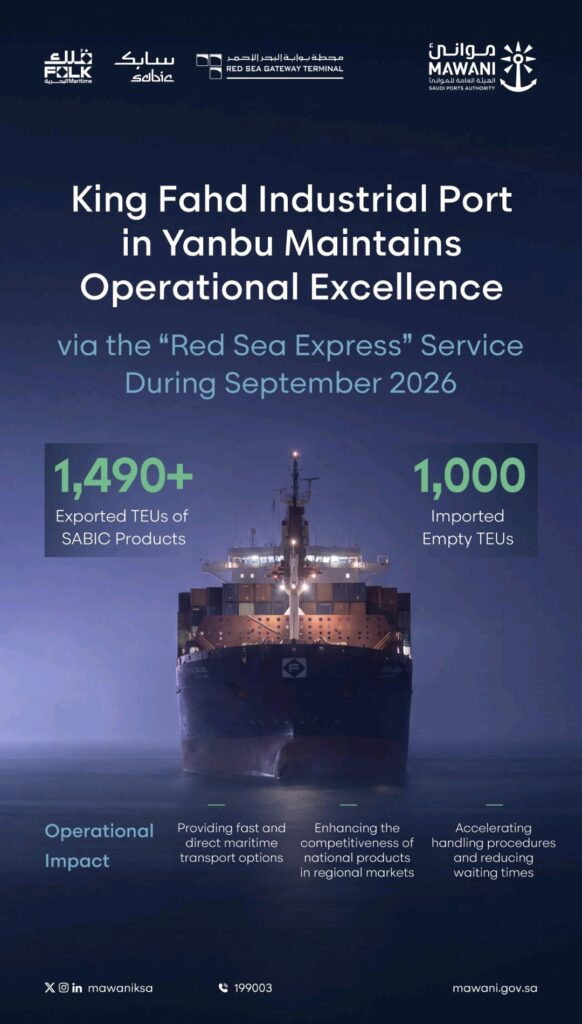
  • King Fahd Industrial Port in Yanbu Exports Over 1,490 TEUs of SABIC Products via Red Sea Express

    Shipping Arabia, October 12, 2026 – King Fahd Industrial Port in Yanbu, Saudi Arabia, exported more than 1,490 TEUs of SABIC products through the Red Sea Express shipping service in September 2026, according to the Saudi Ports Authority (Mawani). The port also handled the import of 1,000 TEUs of empty containers through the service during the same period.

    The figures highlight container activity at King Fahd Industrial Port in Yanbu, with the Red Sea Express service supporting the maritime transportation of Saudi industrial products to regional markets.

    Red Sea Express Supports SABIC Exports

    The Red Sea Express service facilitated the export of more than 1,490 TEUs of SABIC products during September, alongside the inbound movement of 1,000 TEUs of empty containers.

    According to Mawani, the service provides fast and direct maritime transport options, supporting the movement of Saudi products through King Fahd Industrial Port in Yanbu. The authority also highlighted its contribution to enhancing the competitiveness of national products in regional markets.

    The combination of export cargo and imported empty containers reflects the service’s role in facilitating container movements through the industrial port.

    Improving Cargo Handling and Operational Efficiency

    Beyond container volumes, Mawani emphasized the operational benefits associated with the Red Sea Express service. These include accelerating cargo handling procedures and reducing waiting times at the port.

    The authority identified improved operational efficiency and direct maritime transport options as important elements in supporting Saudi exports and strengthening their competitiveness in regional markets.

    The September performance demonstrates the Red Sea Express service’s contribution to handling SABIC export shipments and supporting containerized maritime trade through King Fahd Industrial Port in Yanbu.

    Source: Saudi Ports Authority (Mawani)

    King Fahd Industrial Port in Yanbu Red Sea Express infographic highlighting over 1,490 TEUs of SABIC exports and 1,000 TEUs of empty container imports in September 2026.
  • Saudi Ports Authority Introduces Port Community System Enhancements to Streamline Cargo Operations

    Shipping Arabia, October 10, 2026 – The Saudi Ports Authority (Mawani) has introduced new Port Community System enhancements aimed at improving service efficiency, simplifying cargo clearance procedures, and increasing transparency in container storage charge calculations. The updates form part of the authority’s ongoing efforts to develop digital services and facilitate procedures for port users.

    Announced on October 4, the improvements cover three operational areas: inbound container storage charges, cargo exit permit validity, and electronic shipment readiness verification.

    Through these changes, Mawani aims to provide more accurate storage charge calculations, greater flexibility in cargo exit procedures, and easier access to shipment information through its digital platform.

    Improving Container Storage Charge Calculations

    One of the key Port Community System enhancements focuses on improving the calculation of storage charges for inbound containers.

    Mawani has updated the timestamp calculation mechanism used to determine container storage fees. The improvement aims to increase the accuracy and transparency of calculations, providing port users with clearer information about applicable charges.

    The enhancement addresses an important administrative component of container handling by improving how storage periods are calculated within the digital system.

    By refining this process, the authority seeks to make storage charge calculations more reliable and transparent for businesses and other stakeholders using Saudi Arabia’s ports.

    Extending Cargo Exit Permit Validity

    Mawani has also extended the validity period for cargo exit permits to 24 hours from the time a permit request is submitted.

    The change provides port users with greater flexibility to complete the procedures required for cargo to leave the port. It is intended to facilitate cargo release arrangements and simplify the administrative process.

    The extended validity period forms part of the authority’s efforts to improve the efficiency of port services and make cargo handling procedures more convenient for beneficiaries.

    Introducing Digital Shipment Readiness Verification

    Another improvement involves a digital service that allows users to verify shipment readiness through the Port Community System.

    The service enables beneficiaries to check shipment status electronically and confirm whether cargo is ready to leave the port.

    This functionality provides users with direct access to shipment readiness information, supporting clearer coordination of cargo exit procedures.

    Alongside the improvements to storage charge calculations and exit permit validity, the service strengthens the range of digital functions available to port stakeholders.

    Supporting Digital Transformation Across Saudi Ports

    The latest Port Community System enhancements reflect Mawani’s continued focus on improving its digital services and simplifying procedures for businesses operating through Saudi Arabia’s ports.

    By addressing storage fee calculations, cargo exit permits, and shipment readiness verification, the authority is targeting administrative processes that directly affect port users.

    The improvements aim to increase service efficiency, enhance transparency, and provide greater flexibility when completing cargo-related procedures.

    Through the continued development of its Port Community System, Mawani is working to strengthen the accessibility and efficiency of digital port services while facilitating day-to-day operations for stakeholders across the maritime and logistics sectors.

    Source: Saudi Ports Authority (Mawani)

  • King Fahd Industrial Port Storage Exemption Extended Until December 5, 2026

    Shipping Arabia, October 9, 2026 – The Saudi Ports Authority (Mawani) has extended the King Fahd Industrial Port storage exemption in Yanbu until December 5, 2026, providing a 20-day storage fee waiver for eligible loaded export cargo and empty import units. The measure aims to facilitate cargo movements and improve operational efficiency at the Red Sea port.

    The extension applies to several categories of cargo and transport equipment, including containers, flat racks and trailers. Dangerous goods classified under the International Maritime Dangerous Goods (IMDG) Code are also included in the exemption for loaded exports.

    According to Mawani, the extended free storage period is intended to support smoother cargo flows and strengthen the efficiency of port operations.

    King Fahd Industrial Port Storage Exemption Covers Multiple Cargo Categories

    Under the extended arrangement, eligible loaded export cargo will benefit from a 20-day exemption from storage charges.

    The exemption covers containers, flat racks, trailers and dangerous goods classified under the IMDG Code. Including these categories provides storage flexibility for different types of export cargo handled at the port.

    For empty import units, Mawani has also established a 20-day free storage period. This applies to containers, flat racks and trailers.

    The distinction between loaded exports and empty imports defines the scope of the exemption. While dangerous goods are explicitly included in the loaded export category, the announcement does not separately list them under empty imports.

    The exemption will remain in effect until December 5, 2026, according to the authority’s announcement.

    Supporting Cargo Flow and Operational Efficiency at Yanbu

    Mawani stated that extending the storage fee exemption will support the smooth movement of goods and enhance operational efficiency at King Fahd Industrial Port.

    The measure provides eligible exporters, shipping lines and logistics operators with additional flexibility in managing cargo storage and equipment movements.

    A 20-day free storage period can provide more time to coordinate export shipments and manage the movement of empty transport equipment without incurring storage charges during the eligible period.

    The inclusion of containers, flat racks and trailers also reflects the range of cargo transport equipment covered by the arrangement.

    For businesses using King Fahd Industrial Port, the extension provides a defined period of storage cost relief for qualifying exports and empty imports.

    The initiative is consistent with Mawani’s stated objective of improving cargo movement and operational efficiency at the port.

    By maintaining the exemption until December 5, 2026, the authority is continuing a measure designed to facilitate port operations and support the movement of goods through Yanbu.

    Source: Saudi Ports Authority (Mawani)

  • Saudi Empty Container Return Procedures Set by Mawani

    Shipping Arabia, October 7, 2026 – Saudi empty container return procedures have been standardized by the Saudi Ports Authority (Mawani) for designated storage yards at the Kingdom’s ports, with the measures aimed at improving operational efficiency, clarifying responsibilities and limiting additional costs resulting from changes to container return locations.

    The procedures set out requirements for informing beneficiaries of where empty containers must be returned, documenting that information and managing any subsequent change to the designated location. They also define responsibility for additional costs when a return location differs from the location previously agreed.

    Beneficiaries Must Receive Return Location in Advance

    Under the Saudi empty container return procedures, the location and address for returning an empty container must be clearly specified when the delivery order is issued and before the beneficiary receives the container.

    Mawani also requires clear and accurate information on the designated empty container return location and the storage yard assigned for the return. This is intended to give beneficiaries clear information before arranging the movement of the container.

    For transit containers, the return location and city must be identified before the container is collected. According to the authority, providing this information in advance allows the beneficiary to arrange the required transportation beforehand.

    Written Notice Required for Location Changes

    If the designated container return location or storage yard changes, the beneficiary must be notified in writing before the scheduled return date.

    Shipping agents are also required to retain documentation showing that the beneficiary was informed of the empty container return location. The same requirement applies to any subsequent update or change to that location.

    These documentation requirements form part of Mawani’s effort to make the process clearer and establish a record of the information communicated to the beneficiary.

    Shipping Agents Responsible for Additional Costs

    The procedures also address additional costs that may arise when a previously agreed container return location changes.

    Mawani stated that the shipping agent will bear additional costs resulting from changing the agreed location for the delivery or collection of the container. The measure is intended to limit the financial impact on beneficiaries when return arrangements are altered after the original location has been established.

    The Saudi Ports Authority said the overall objective of the new procedures is to improve the efficiency of empty container returns, enhance clarity across the process and reduce additional costs caused by changes to designated return locations.

    The measures form part of Mawani’s wider efforts to improve operational efficiency at Saudi ports by organizing the return of empty containers to designated storage yards and defining the responsibilities associated with those movements.

    Source: Saudi Ports Authority (Mawani)

  • Saudi Port Investments Top $1.46 Billion as Jeddah Handles Surge in Regional Cargo

    Shipping Arabia, September 19, 2026 – Saudi Arabia has invested more than SAR 5.5 billion ($1.46 billion) in its ports during the regional disruption, as Jeddah Islamic Port and the Kingdom’s western coast absorb sharply higher vessel, truck and cargo volumes and take on a wider role in regional supply chains.

    Saudi Ports Authority (Mawani) President Suliman bin Khalid Al-Mazroua said Jeddah and the western coast had developed into a major logistics platform serving Saudi Arabia and Gulf markets during the disruption.

    Truck traffic at Jeddah Islamic Port has risen from around 2,000–2,500 vehicles per day to more than 10,000, alongside increased vessel activity. More than 34 shipping services operated by major global carriers, including Maersk and MSC, now call at the port.

    Mawani has implemented 16 operational initiatives with government and customs authorities to increase the port’s readiness, while more than SAR 640 million has been invested in Jeddah over the past three months to strengthen its capacity to receive and handle containers moving by both sea and land.

    Al-Mazroua said the western coast is increasingly operating as an integrated port network. Yanbu supports food-security cargo flows, King Abdullah Port contributes additional container and logistics capacity, while NEOM Port supports traffic arriving from Egypt, expanding the ability of Saudi ports to respond to changing regional trade patterns.

    Transshipment activity has also increased, with volumes exceeding 370,000 containers over five months, while general and bulk cargo surpassed one million units. Mawani expects volumes to rise further by the end of the year as demand for port and logistics services continues to grow.

    The next phase will include further port investment alongside the development of special economic zones and logistics zones across Saudi Arabia’s eastern and western ports, strengthening the Kingdom’s maritime and logistics infrastructure and its role in regional supply chains.

    Source: Argaam

Back to top button