Saudi Arabia

  • New Taicang–Jeddah Shipping Service to Cut Transit Times by Up to Three Weeks

    Shipping Arabia, October 18, 2026 – A new direct shipping service has been launched between Taicang Port in China’s eastern Jiangsu province and Jeddah Islamic Port in Saudi Arabia, with the operator expecting to reduce cargo transit times by two to three weeks. The Taicang–Jeddah shipping service eliminates intermediate transshipment operations, offering a more direct maritime connection between eastern China and the Middle East.

    The new route was inaugurated with the departure of a cargo vessel carrying approximately 1,000 containers from Taicang Port to Jeddah. Operated by Hai Son Shipping, the service aims to improve transportation efficiency, provide more reliable sailing schedules and reduce logistics costs for cargo moving between China and Saudi Arabia.

    Direct Taicang–Jeddah Shipping Service Targets Faster Cargo Deliveries

    The introduction of the new service establishes a direct maritime connection between Taicang Port, located in Jiangsu province, and Saudi Arabia’s Red Sea gateway at Jeddah.

    Xu Dapeng, chairman of Hai Son Shipping, said the route could shorten cargo transportation times by two to three weeks by eliminating the need for container transshipment at intermediate ports.

    According to Xu, the direct connection also offers more predictable sailing schedules, helping improve transportation efficiency and reduce logistics costs for customers.

    The company intends to monitor market demand as the service develops. Based on future cargo requirements, Hai Son Shipping will consider increasing sailing frequency, optimizing available vessel capacity and continuously improving its integrated logistics services.

    The new Taicang–Jeddah shipping service responds to growing demand among international trading companies for direct and efficient maritime logistics connections between the two countries.

    Expanding China–Saudi Arabia Trade Drives Demand for Maritime Connectivity

    The launch comes amid continued growth in economic and commercial relations between China and Saudi Arabia.

    Trade between the two countries covers a wide range of energy resources, industrial materials, machinery and manufactured products, creating demand for maritime transportation services.

    China’s imports from Saudi Arabia include crude oil, petrochemical products and minerals. Meanwhile, Saudi Arabia continues to generate demand for Chinese engineering machinery, steel structural components, industrial electrical equipment and photovoltaic products.

    Other products moving within the bilateral trading relationship include household electrical appliances and light industrial goods manufactured in China.

    As commercial exchanges expand, trading companies are increasingly seeking efficient direct shipping routes that can improve cargo transportation and reduce dependence on intermediate logistics hubs.

    The new direct service between Taicang and Jeddah is intended to address these requirements by providing an additional maritime transportation option between the two markets.

    Bilateral Trade Reached $108.2 Billion in 2025

    Official figures published by China’s Ministry of Foreign Affairs show that bilateral trade between China and Saudi Arabia reached approximately $108.2 billion in 2025.

    During the first quarter of 2026, trade between the two countries amounted to approximately $24.15 billion, reflecting the substantial volume of commercial exchanges between the two economies.

    Energy trade remains an important component of the relationship. China imported approximately 80.76 million tonnes of crude oil from Saudi Arabia during 2025.

    In the first quarter of 2026, Chinese imports of Saudi crude oil reached approximately 17.9 million tonnes.

    Against this backdrop of substantial bilateral trade, the new Taicang–Jeddah shipping service provides another direct connection between China’s manufacturing and export markets and Saudi Arabia’s maritime gateways.

    By reducing the need for intermediate transshipment and offering more predictable sailing schedules, Hai Son Shipping aims to improve freight transportation efficiency while responding to demand for stronger maritime logistics links between China and Saudi Arabia.

    Source: Al Mal
  • Saudi Global Ports Handles FATIMA-2 Bulk Salt Loading at Dammam Port

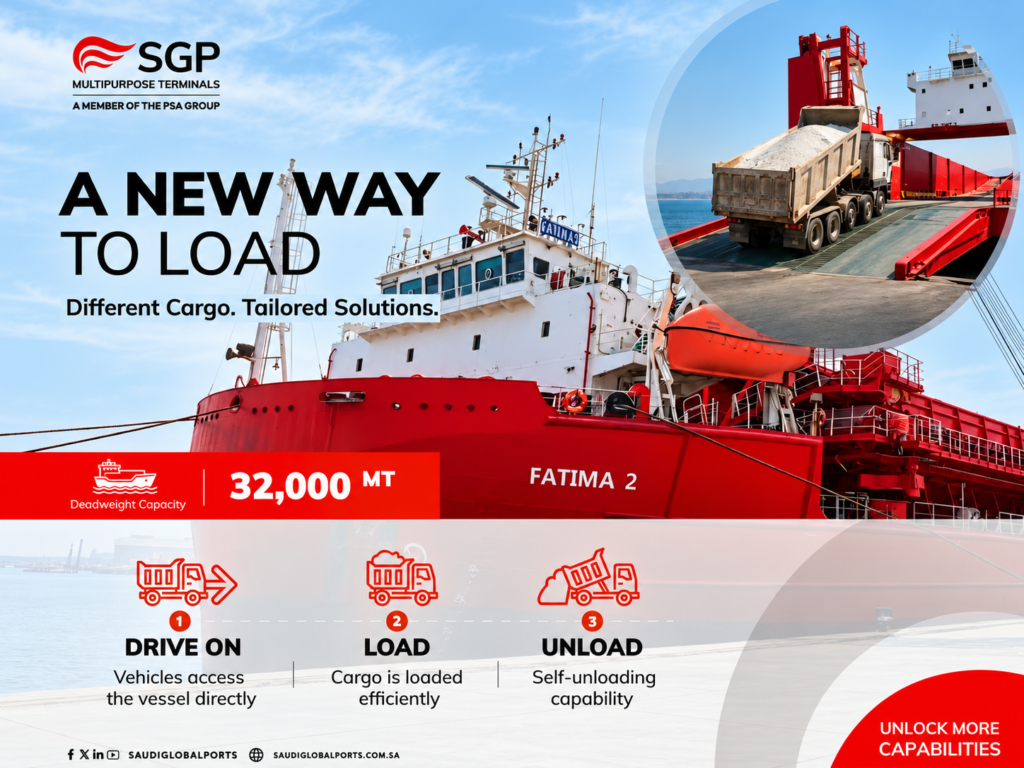
    Shipping Arabia, October 18, 2026 – Saudi Global Ports (SGP) Multipurpose Terminals has welcomed the 32,000-dwt vessel FATIMA-2 on its first call at King Abdulaziz Port in Dammam, conducting a tailored bulk salt loading operation that allows trucks to access the vessel directly through its side ramp. The operation demonstrates the terminal’s ability to adapt cargo handling methods to different vessel configurations while supporting bulk cargo exports from Saudi Arabia’s eastern ports to Gulf Cooperation Council (GCC) markets.

    The operation involved coordinating the loading arrangements to accommodate the specific requirements of bulk salt cargo and the vessel’s side ramp configuration. This approach enabled trucks to drive directly onto the vessel’s deck for loading, providing a practical solution suited to the shipment and the vessel’s design.

    Direct Truck-to-Vessel Loading for Bulk Salt Cargo

    Saudi Global Ports coordinated the FATIMA-2 bulk salt loading operation through its multipurpose terminal facilities at King Abdulaziz Port.

    The handling method was tailored to the vessel’s configuration, allowing trucks to access the deck directly through its side ramp. This arrangement provided a loading solution that accommodated the cargo requirements without relying exclusively on conventional quayside cargo transfer arrangements.

    According to SGP, the operation reflects the flexibility of its multipurpose terminals in developing practical handling solutions for different cargo types and vessel requirements.

    The company also highlighted the vessel’s operational capabilities through a three-stage cargo handling concept. This involves vehicles driving directly onto the vessel, loading cargo and utilizing the vessel’s self-unloading capability when required.

    The 32,000-dwt FATIMA-2 combines direct vehicle access with cargo handling features that can accommodate different operational requirements.

    Supporting Bulk Cargo Exports Through Dammam

    The vessel’s first call forms part of Saudi Global Ports’ activities supporting continued and efficient exports to GCC markets through Saudi Arabia’s eastern ports.

    King Abdulaziz Port in Dammam serves as the location for the operation, with SGP Multipurpose Terminals coordinating the cargo handling arrangements.

    The operation illustrates how terminal handling procedures can be adapted to individual vessel designs and cargo characteristics. In this case, the combination of bulk salt cargo, truck transportation and direct access through the vessel’s side ramp determined the loading approach.

    Saudi Global Ports, a member of PSA Group, emphasized its ability to provide tailored solutions for different cargo handling needs.

    The FATIMA-2 bulk salt loading operation highlights the practical application of flexible cargo handling arrangements at King Abdulaziz Port, supporting the movement of bulk commodities through Saudi Arabia’s eastern maritime gateways.

    Source: Saudi Global Ports

    FATIMA-2 bulk salt loading operation showing a truck accessing the vessel through its side ramp at King Abdulaziz Port in Dammam.
  • Folk Maritime CEO Highlights Shift Toward Regional Trade and Greater Shipping Resilience

    Shipping Arabia, September 22, 2026 – Global trade is moving toward a more regional and resilient structure as geopolitical risks, sanctions and changing shipping patterns increasingly influence maritime investment and operations, according to Folk Maritime CEO Poul Hestbaek.

    Hestbaek discussed the changing trade environment during a panel at the 18th Annual Capital Link Shipping & Marine Services Forum in London, addressing the theme of global trade in a changing world, including sanctions, risks, maritime corridors and the reshaping of trade routes.

    He highlighted what Folk Maritime described as a strategic transition away from unrestricted globalisation toward a more sustainable and regional trading environment, with geopolitical considerations playing a growing role in shipping routes and investment decisions.

    The discussion also addressed the pricing of risk. Hestbaek highlighted the importance of clearly incorporating risks associated with international sanctions into freight rates and chartering terms as shipping companies navigate an increasingly complex regulatory and geopolitical environment.

    Another area of focus was supply chain security. The sector is moving beyond a traditional emphasis on just-in-time delivery toward greater operational flexibility and an increased ability to respond to disruptions, according to the discussion.

    Hestbaek also pointed to the emergence of new regional maritime alliances as a development that will require shipping companies to take a more proactive approach to risk management and prepare for further changes across the industry.

    The discussion reflects the broader challenges facing maritime transport as shipping companies adapt their networks, commercial strategies and operational models to changing trade patterns and increasingly complex global risks.

    Saudi Arabia-based Folk Maritime operates regional liner services and is backed by the Public Investment Fund.

    Source: Folk Maritime

  • Saudi Port Investments Top $1.46 Billion as Jeddah Handles Surge in Regional Cargo

    Shipping Arabia, September 19, 2026 – Saudi Arabia has invested more than SAR 5.5 billion ($1.46 billion) in its ports during the regional disruption, as Jeddah Islamic Port and the Kingdom’s western coast absorb sharply higher vessel, truck and cargo volumes and take on a wider role in regional supply chains.

    Saudi Ports Authority (Mawani) President Suliman bin Khalid Al-Mazroua said Jeddah and the western coast had developed into a major logistics platform serving Saudi Arabia and Gulf markets during the disruption.

    Truck traffic at Jeddah Islamic Port has risen from around 2,000–2,500 vehicles per day to more than 10,000, alongside increased vessel activity. More than 34 shipping services operated by major global carriers, including Maersk and MSC, now call at the port.

    Mawani has implemented 16 operational initiatives with government and customs authorities to increase the port’s readiness, while more than SAR 640 million has been invested in Jeddah over the past three months to strengthen its capacity to receive and handle containers moving by both sea and land.

    Al-Mazroua said the western coast is increasingly operating as an integrated port network. Yanbu supports food-security cargo flows, King Abdullah Port contributes additional container and logistics capacity, while NEOM Port supports traffic arriving from Egypt, expanding the ability of Saudi ports to respond to changing regional trade patterns.

    Transshipment activity has also increased, with volumes exceeding 370,000 containers over five months, while general and bulk cargo surpassed one million units. Mawani expects volumes to rise further by the end of the year as demand for port and logistics services continues to grow.

    The next phase will include further port investment alongside the development of special economic zones and logistics zones across Saudi Arabia’s eastern and western ports, strengthening the Kingdom’s maritime and logistics infrastructure and its role in regional supply chains.

    Source: Argaam

Back to top button