
Aqaba Port Capacity Measures Expand Through Customs, Trucking and Storage Reforms
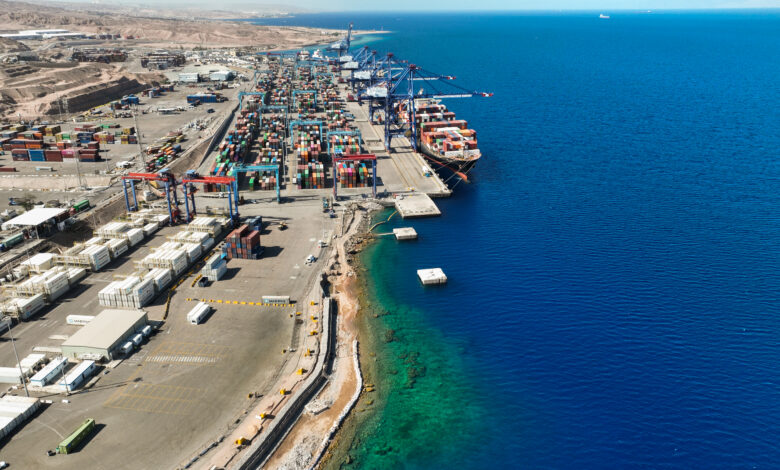
Shipping Arabia, September 28, 2026 – Aqaba port capacity measures are being expanded through a coordinated package of government and operational actions aimed at increasing cargo-handling efficiency, reducing container dwell times, improving truck circulation and adding storage capacity across the port and logistics system.
The measures form part of a package proposed by the Aqaba Special Economic Zone Authority (ASEZA) and approved by the government to address transit cargo movements, maintain the efficiency of supply chains in Jordan, facilitate trade flows and support national food security.
They also follow the Council of Ministers’ recent approval of measures to strengthen the operational capacity of Jordan’s ports and supply chains. The latest actions build on work already carried out by the government, ASEZA, Aqaba Development Corporation, Jordan Customs Department, relevant government entities and port operators to improve the readiness of Aqaba’s port and logistics system.
Dr. Mohammad Abu Omar, commissioner for economic affairs and investment at ASEZA, told the Jordan News Agency (Petra) that the measures are designed to address operational challenges across the logistics system rather than focusing on congestion at a single point.
Longer export free period and lower disposal charges
One of the main measures approved by the Council of Ministers increases the free period granted to national exports at ports from seven days to 14 days. The measure will remain in effect for six months from the date of the decision.
According to Abu Omar, the extension gives exporters more time to complete their procedures while reducing costs associated with storage and delays.
The government also reduced the charge for disposing of goods from JOD 500 to JOD 50 per tonne, or part thereof, effectively exempting liable parties from JOD 450 of the previous charge. The reduction will apply for three months under the conditions set by the Council of Ministers.
The measure is intended to encourage parties responsible for accumulated cargo to address those shipments more quickly, accelerate the clearance of storage areas and make better use of available storage capacity.
The wider package also includes measures to accelerate customs clearance, reduce cargo dwell times, organize truck movements, improve yard efficiency and increase capacity at ports and logistics centers.
Customs procedures and Aqaba port capacity measures
As part of efforts to accelerate clearance, customs inspections are being carried out at arrival centers wherever possible. Some inspection work involving refrigerated containers has also been moved to Customs Yard No. 4.
Authorities have meanwhile allowed clearance procedures for certain cargoes to be completed at the Amman Customs Center/Madouna. Customs targeting ratios have also been reviewed, with greater reliance placed on risk-management procedures to balance faster processing with regulatory requirements.
ASEZA said work is continuing to maintain customs operations and transaction processing at the highest possible capacity. This includes working during holidays when required.
The customs measures form a key part of the Aqaba port capacity measures because they address cargo movement beyond the quay and terminal, reducing delays during inspection and clearance stages before containers leave the port system.
Truck measures target shorter turnaround times
ASEZA has also coordinated with relevant entities on measures designed to reduce truck turnaround times and increase fleet productivity across the logistics chain.
The maximum number of monthly trips permitted for trucks carrying containers has been increased from eight to nine. In addition, the minimum interval between loads for trucks operating in the container transport segment has been reduced from 48 hours to 30 hours.
The validity period for permits issued under the truck entry and exit regulation project has also been reduced from eight hours to six hours. The change is intended to improve truck availability for cargo that is ready for transport.
Transit trips operating through border crossings have been exempted from the existing trip limits for three months. Authorities are also allowing technically equipped trucks that meet public safety requirements to carry two 20-foot containers on a single truck.
ASEZA said the measure should improve the use of the trucking fleet and increase the system’s ability to move containers out of the port.
Work is continuing to improve procedures for truck entry and load allocation. The authority said these measures are intended to improve truck availability, reduce waiting times and increase the efficiency of the truck cycle across the logistics system.
150 dunums added for empty-container storage
Storage capacity is also being expanded to ease pressure on port and logistics facilities.
ASEZA has allocated an additional 150 dunums for empty-container storage across several locations. This includes Yard No. 10, covering 70 dunums, a 20-dunum yard allocated to CTL and a further 60 dunums at other locations designated for the same purpose.
These areas are in addition to existing port yards and other facilities used for empty-container storage within the Aqaba Special Economic Zone.
Authorities are also working to open additional yards at the multipurpose port for vehicle reception and storage. The planned areas will provide additional capacity for up to 6,000 vehicles, while further yards are also being considered.
ASEZA is also expanding Yard No. 4 and addressing conditions at the storage facilities used for detained cargo and dangerous goods.
Abu Omar said the combined measures are intended to distribute pressure across different parts of the logistics system, increasing its overall capacity to receive, handle, store and dispatch cargo.
Container dwell times fall as gate capacity rises
ASEZA said the measures have already produced measurable operational improvements.
Average dwell time for transit containers has declined from around 14–15 days to approximately 12 days. At the same time, the average dwell time for containers imported for the local market has remained at around eight days.
Daily capacity at container exit gates has also increased from 900 containers to 1,200 containers.
According to Abu Omar, the figures indicate an improvement in the system’s ability to handle cargo and truck movements. The newly approved government measures are intended to build on that progress, particularly by supporting national exports, releasing additional logistics-yard capacity and encouraging the processing of accumulated cargoes.
Up to 2,000 unclaimed containers being relocated
Authorities are also addressing containers and cargoes that have not been claimed within the applicable legal periods.
ASEZA is applying Article 27 of the Customs Regulation in the Aqaba Special Economic Zone to unclaimed goods, in coordination with Jordan Customs Department, relevant government entities and port operators.
The authorities have agreed on a unified mechanism to identify containers for which no customs declaration or document has been processed within the statutory periods. These periods are 21 days for local imports and five days for transit cargo.
Containers subject to detention or to judicial or administrative procedures are excluded from the process.
ASEZA is currently working to transfer between 1,500 and 2,000 containers to storage and logistics facilities operated by the authority. The facilities cover 280 dunums.
The transfer will take place under the applicable legal procedures and at the carrier’s or agent’s expense and responsibility. ASEZA said the move will release space within the port system and return that capacity to operational use.
Reefer capacity strengthened with 120 additional power points
Aqaba is also strengthening its capacity to handle refrigerated containers.
The port has added 120 electrical connections for reefer containers while authorities are addressing a shortage of refrigerated transport trucks.
Priority in handling, clearance and gate-out operations is also being given to food supplies, imports destined for the local market and national exports.
According to ASEZA, a large portion of the overall package is already in effect, while remaining operational and infrastructure measures are being completed under defined implementation plans.
The measures included in the Council of Ministers’ latest decision have entered into force according to the time periods set in the decision. Other operational actions are continuing in parallel, including yard expansion, the transfer of unclaimed containers under legal procedures and additional capacity for refrigerated containers.
Authorities are also monitoring the performance of ports, yards and trucks on a daily basis.
Coordination meetings continue between the government, ASEZA, Aqaba Development Corporation, Jordan Customs Department, relevant government entities and port operators to monitor implementation, measure results and introduce corrective measures where necessary.
ASEZA said the objective is to develop a logistics system with greater capacity to respond to demand and greater flexibility in dealing with pressures or changes in trade flows and supply chains.
Source: Jordan News Agency (Petra)