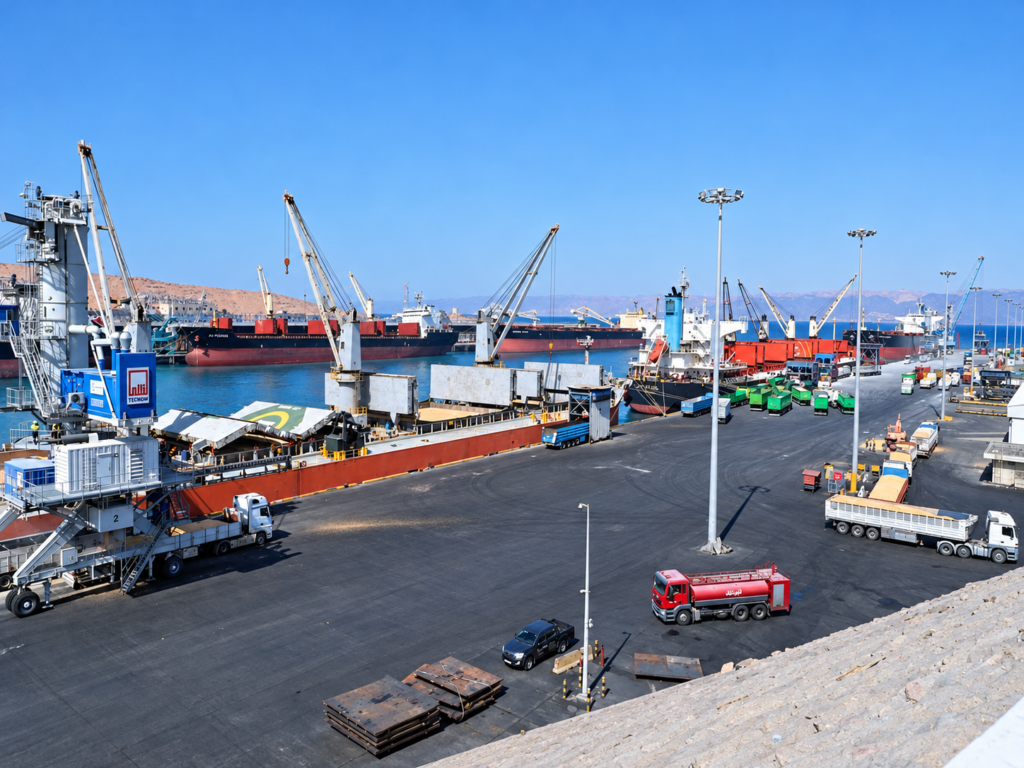
Shipping Arabia, November 12, 2026 – Aqaba ports cargo throughput increased by 46% during the first 10 months of 2026, reaching 12.386 million tonnes compared with 8.494 million tonnes during the same period in 2025. Meanwhile, Aqaba Container Terminal (ACT) recorded an 8% increase in container volumes, highlighting growth in Jordan’s maritime cargo operations.
The figures were released by Jordan’s customs clearance and freight transport companies’ syndicate, based on official statistics covering port operations, customs declarations and freight movements between January and October 2026.
The data also showed increased vessel arrivals at Aqaba’s main ports, alongside substantial customs and transit activity across Jordan’s border crossings. Syndicate President Dhaifallah Abu Aqoula highlighted Aqaba’s growing role as a logistics gateway serving Jordan and neighboring regional markets.
Aqaba Ports Cargo Throughput Reaches 12.386 Million Tonnes
Total cargo throughput across Aqaba’s main ports reached 12.386 million tonnes during the reporting period, compared with 8.494 million tonnes a year earlier. The 46% increase covered cargo handled through the main port, oil and gas port, and passenger port.
Vessel traffic also increased during the first 10 months of 2026. A total of 1,430 vessels arrived at Aqaba’s main ports and completed their discharge operations, compared with 1,333 vessels during the corresponding period of 2025.
The increase of 97 vessels was distributed across the three port facilities.
Aqaba’s main port received 350 vessels, compared with 334 during the previous year, representing an increase of 16 vessels. Meanwhile, the oil and gas port handled 142 vessels, up from 104, an increase of 38 vessels.
The passenger port recorded 938 vessel arrivals, compared with 895 during the same period in 2025, representing an increase of 43 vessels.
These figures reflect higher vessel activity across Aqaba’s port facilities, alongside the significant increase in overall cargo volumes.
Aqaba Container Terminal Handles 896,290 TEUs
Aqaba Container Terminal also reported growth in container handling volumes during the January–October 2026 period.
According to the syndicate’s figures, the terminal handled 896,290 TEUs, compared with 827,140 TEUs during the corresponding period in 2025. This represented an increase of approximately 8%.
Loaded import containers reached 466,875 TEUs, up from 416,211 TEUs a year earlier, representing growth of 12%.
However, loaded export containers declined to 87,535 TEUs, compared with 94,600 TEUs during the first 10 months of 2025.
Despite the increase in total container throughput, vessel arrivals at the container terminal remained largely unchanged. ACT received 497 container vessels during the reporting period, compared with 496 vessels a year earlier.
The figures show that container handling volumes increased while the number of container vessel calls remained relatively stable.
Jordan Records More Than 919,000 Customs Declarations
Beyond port operations, the syndicate reported significant customs clearance activity across Jordan’s customs centers and border crossings.
Companies operating in the customs clearance and freight transport sector processed 919,470 customs declarations during the first 10 months of 2026.
The reported declarations included 319,027 import declarations for the domestic market, 159,960 export declarations and 18,356 re-export declarations. The figures also included 29,650 temporary admission declarations and 318,128 transit declarations covering cargo movements through Jordanian territory.
Aqaba Customs Directorate recorded the highest number of declarations among the listed customs locations, processing 208,778 declarations. This total covered Aqaba Customs, passenger vessel customs operations, Durra and Wadi Araba.
Omari Customs, which connects Jordan with Saudi Arabia, followed with 197,262 declarations.
The airport clearance customs center at Zizya and the Mashta Airport Free Zone recorded 143,000 declarations, while the Amman, Sahab and Raqeem customs facilities processed 119,558 declarations.
Jaber Customs, serving the border crossing with Syria, handled 80,239 declarations. The Zarqa Free Zone recorded 56,384 declarations, followed by the e-commerce customs center with 39,531 declarations.
Karameh Customs processed 18,304 declarations, while Mudawara Customs handled 12,429 declarations. The remaining declarations were distributed among other customs and border facilities across Jordan.
Aqaba Leads Reported Freight Movements
The syndicate’s statistics also highlighted substantial freight movements through Jordan’s border crossings and customs facilities.
The Aqaba corridor recorded 790,400 freight movements, the highest total among the corridors identified in the report.
Omari Customs followed with 508,381 movements, while Jaber Customs recorded 417,724 movements. Karameh Customs accounted for another 379,296 movements.
Separately, the Zarqa Free Zone handled 68,333 vehicles during the reporting period.
Of these, 27,185 vehicles entered the domestic market, comprising 6,737 gasoline-powered vehicles, 4,622 diesel vehicles, 6,724 hybrid vehicles and 9,102 electric vehicles.
Another 41,148 vehicles were exported outside Jordan through the free zone.
These figures illustrate the scale of freight clearance, transit movements and vehicle trade handled through Jordan’s customs and logistics network.
Aqaba’s Role as a Regional Logistics Gateway
Commenting on the figures, syndicate President Dhaifallah Abu Aqoula emphasized Aqaba’s importance as a logistics gateway for Jordan and regional markets.
He said the port increasingly serves not only Jordan’s domestic import requirements but also cargo destined for Gulf Cooperation Council countries, Iraq, Syria and Lebanon.
Abu Aqoula described this role as supporting Jordan’s development into a regional distribution center, with Aqaba serving as a key entry point for goods moving into neighboring markets.
He also welcomed government decisions to reduce fees and facilitate cargo movements through customs centers and border crossings.
According to Abu Aqoula, measures affecting port operations, freight transport and customs procedures have helped reduce costs for traders and importers while improving the competitiveness of Jordan’s logistics corridor against alternative regional routes.
He attributed the sector’s performance to cooperation among customs authorities, port operators, logistics companies and other public and private stakeholders.
Customs Modernization and Port Infrastructure Improvements
Abu Aqoula praised the Jordan Customs Department for its role in facilitating cargo clearance and managing the movement of goods through the country’s customs facilities.
He highlighted efforts to simplify administrative procedures, automate customs transactions, reduce clearance times and develop unified single-window processes.
The syndicate president also emphasized the importance of completing customs procedures accurately and efficiently while maintaining coordination among the relevant authorities.
In addition, he acknowledged the role of security agencies operating at ports and border crossings. He said their cooperation with customs clearance and transport companies had helped facilitate inspection procedures and improve cargo movements while maintaining security and safety requirements.
Abu Aqoula also recognized the contributions of the Aqaba Special Economic Zone Authority (ASEZA), Aqaba Development Corporation (ADC), and the management of Aqaba’s main port and container terminal.
He highlighted infrastructure development, modernization of cargo handling systems, berth efficiency improvements and simplified port entry and exit procedures among the measures supporting Aqaba’s logistics operations.
According to Abu Aqoula, these initiatives have contributed to reducing operating costs and improving the overall efficiency of Aqaba’s port system.
Logistics Sector Supports Jordan’s Economic Modernization
The syndicate president emphasized that customs clearance, freight transport and logistics companies play an important role in handling goods arriving through Jordan’s ports and border crossings.
Their activities cover cargo entering the domestic market as well as shipments moving under transit arrangements to neighboring countries.
He linked the sector’s contribution to the objectives of Jordan’s Economic Modernization Vision, particularly its focus on facilitating trade and strengthening the movement of goods between Jordan and regional markets.
Abu Aqoula also stressed the need for continued public-private coordination to address challenges affecting customs procedures, border operations and port activities.
The customs clearance and freight transport companies’ syndicate, established in 1982 and registered with Jordan’s Ministry of Labour, represents businesses operating across the country’s customs clearance sector.
According to the syndicate, Jordan has 467 licensed customs clearance companies operating approximately 2,000 branches across customs centers and border crossings. Together, these businesses provide around 10,000 employment opportunities for Jordanians.
The latest statistics place Aqaba’s maritime performance within a broader picture of cargo handling, customs activity and regional freight movements.
With Aqaba ports cargo throughput rising by 46% and container volumes increasing by 8%, the figures highlight the scale of activity passing through Jordan’s maritime gateway during the first 10 months of 2026.
Source: Al Mamlaka