AD Ports Group

  • AD Ports Group Appoints Dr. Afif Saif Al Yafei as New Group CEO

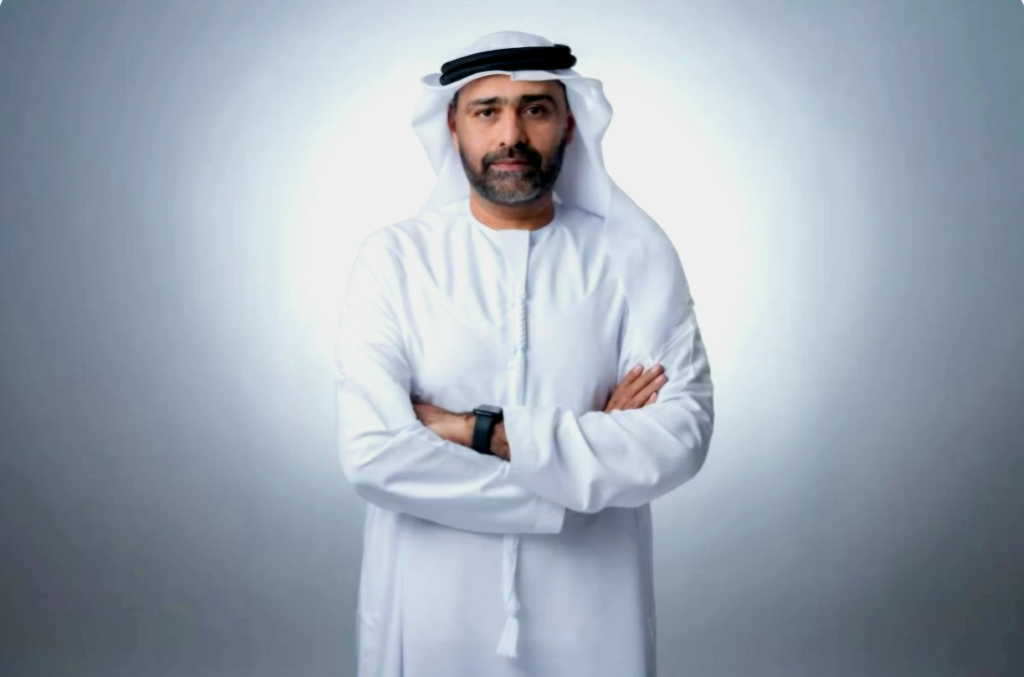
    Shipping Arabia, November 3, 2026 – AD Ports Group has appointed Dr. Afif Saif Al Yafei as Group Chief Executive Officer, succeeding Captain Mohamed Juma Al Shamisi, who has led the Abu Dhabi-based ports and logistics group since 2014.

    The leadership transition comes as AD Ports Group continues its development as an integrated global trade and logistics business, with operations spanning more than 50 countries across five continents and a portfolio of 40 terminals.

    Dr. Al Yafei brings more than two decades of executive experience across infrastructure, utilities and industrial sectors. His expertise includes corporate transformation, operational excellence, investment, international expansion and corporate governance.

    Afif Al Yafei Brings Extensive Infrastructure Leadership Experience

    Before joining AD Ports Group, Dr. Al Yafei served as Chief Executive Officer of TAQA Transmission, where he oversaw one of the UAE’s major national infrastructure businesses.

    During his tenure, he supervised significant growth in the company’s asset base and capital investment programs, drawing on his experience in managing large-scale infrastructure operations.

    His previous leadership positions include senior executive roles at Tabreed and ADNOC Gas. He also serves on several corporate boards, bringing additional experience in corporate strategy, governance and institutional development.

    Beyond operational management, his professional background covers digital transformation, investment planning, international business growth and the development of national talent.

    These capabilities form part of the leadership experience he brings to AD Ports Group as the company enters its next phase of development.

    Leadership Transition Following Mohamed Al Shamisi’s Tenure

    Dr. Al Yafei succeeds Captain Mohamed Juma Al Shamisi, who has led AD Ports Group since 2014.

    During Al Shamisi’s leadership, the company evolved from a local port operator into an integrated global group operating across international trade and logistics.

    The appointment represents a transition in the group’s executive leadership following this period of expansion and organizational development.

    Shadi Malak, Chairman of AD Ports Group, welcomed the appointment and highlighted Dr. Al Yafei’s extensive experience in leading major infrastructure and industrial companies.

    Malak emphasized that the new CEO combines a strong understanding of strategic and operational requirements with expertise in growth, investment, governance and institutional development.

    He stated that these capabilities would help AD Ports Group build on its established foundations and advance into the next stage of its development.

    AD Ports Group to Continue Global Trade and Logistics Growth

    Under Dr. Al Yafei’s leadership, AD Ports Group intends to continue its development as an integrated global trade and logistics business.

    The group currently maintains a presence in more than 50 countries across five continents, supported by a portfolio comprising 40 terminals.

    Its international footprint reflects the company’s transformation into a diversified organization serving global trade and logistics markets.

    As part of its next phase, AD Ports Group has reaffirmed its commitment to customers and stakeholders while continuing to implement its strategic priorities.

    The company also intends to maintain its contribution to the UAE’s economic development, in line with the country’s broader national vision and leadership directives.

    The appointment places Dr. Al Yafei at the head of the group’s international operations as AD Ports Group continues pursuing growth and institutional development across its global trade and logistics portfolio.

    Source: Al Khaleej
  • Khalifa Port Climbs to 34th Globally as Container Throughput Reaches 6.6 Million TEUs

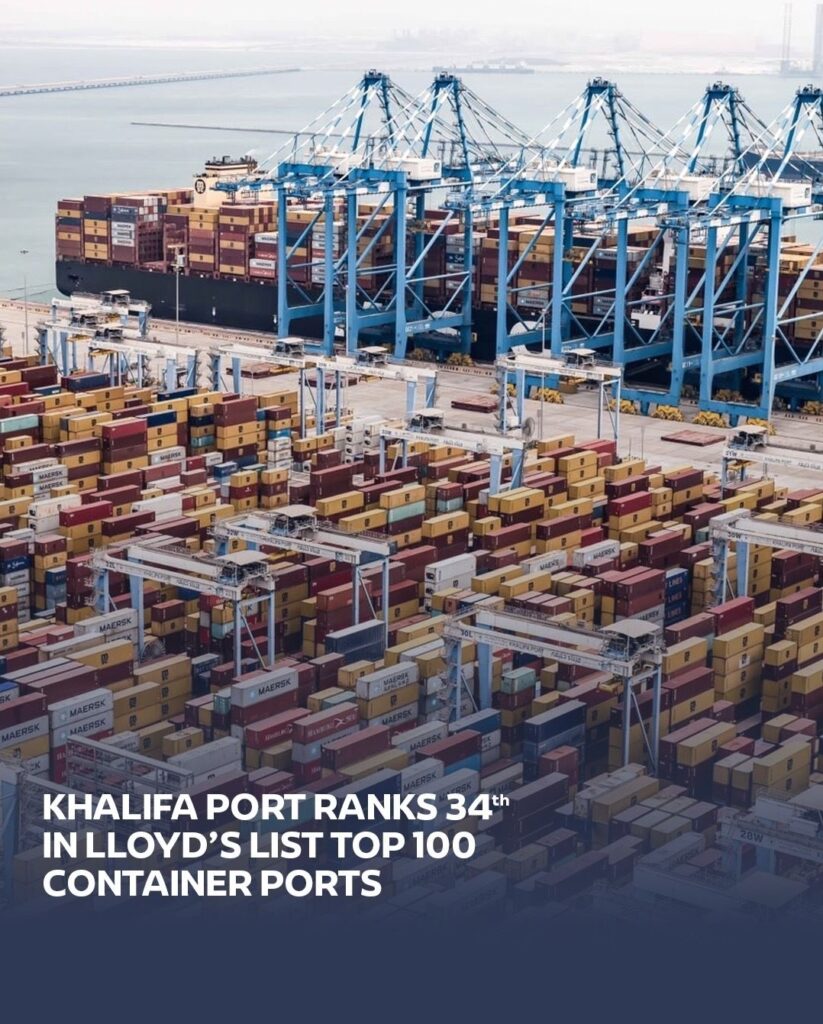
    Shipping Arabia, October 29, 2026 – Khalifa Port in Abu Dhabi has climbed five positions to rank 34th globally in the Lloyd’s List Top 100 Container Ports 2026, following a 21.6% increase in container throughput during 2025. The port handled 6.6 million TEUs, recording the highest year-on-year percentage growth among the world’s top 40 container ports in the latest ranking.

    According to AD Ports Group, Khalifa Port’s container throughput increased from 5.42 million TEUs in 2024 to 6.6 million TEUs in 2025. The latest results reflect the combined performance of three container terminals operated through partnerships with major international shipping lines CMA CGM, COSCO and MSC.

    Khalifa Port Container Throughput Drives Global Ranking

    Khalifa Port advanced from 39th position in the previous Lloyd’s List ranking to 34th in the 2026 edition. The ranking evaluates the world’s leading container ports based on their annual container throughput.

    Since entering the global top 100 in 95th position in 2019, Khalifa Port has climbed 61 places. AD Ports Group attributed this progress to sustained investments in port infrastructure, additional handling capacity, advanced technology and operational efficiency.

    The company also highlighted the importance of expanding international shipping connections and maintaining long-term partnerships with global terminal operators.

    Strong market demand, increased terminal utilization and newly added capacity contributed to the port’s performance in 2025.

    A major contributor was CMA Terminals Khalifa Port, developed through a partnership between AD Ports Group and CMA CGM. The terminal handled more than 1.3 million TEUs during its first full year of operations following its inauguration in January 2025.

    Three Container Terminals Support Growing Capacity

    Khalifa Port operates three advanced container terminals through partnerships with leading global shipping companies. These include Abu Dhabi Terminals with MSC, CSP Abu Dhabi Terminal with COSCO, and CMA Terminals Khalifa Port.

    Together, the terminals provide shipping customers with connectivity to major international markets, scalable handling capacity and access to AD Ports Group’s integrated logistics network.

    Further expansion is underway at CMA Terminals Khalifa Port. The development will increase the terminal’s annual container-handling capacity by almost 50%, bringing it to 2.7 million TEUs.

    Once the expansion is completed, Khalifa Port’s total annual container-handling capacity will reach 10.5 million TEUs, further strengthening its ability to accommodate container traffic.

    The additional capacity forms part of AD Ports Group’s continued investments in port infrastructure and international maritime connectivity.

    AD Ports Group Emphasizes Infrastructure and Connectivity Investments

    Saif Al Mazrouei, Chief Executive Officer of the Ports Cluster at AD Ports Group, described Khalifa Port’s rise in the Lloyd’s List ranking as a reflection of the group’s long-term development strategy and commitment to operational excellence.

    He emphasized that the 21.6% increase in container throughput and five-position improvement in the global ranking demonstrate the results of investments in infrastructure, capacity, technology and connectivity.

    Al Mazrouei also acknowledged the contribution of the group’s workforce, customer confidence and strategic partnerships to the port’s performance.

    Looking ahead, he reaffirmed AD Ports Group’s commitment to further investments in handling capacity, maritime connectivity and innovative solutions. These investments aim to strengthen Khalifa Port’s role as an international trade gateway and support the UAE’s position within global supply chains.

    Integrated Logistics Network Strengthens Trade Connectivity

    Beyond its container terminals, Khalifa Port serves as an integrated logistics gateway connecting maritime transport with road and rail networks.

    The port also connects with AD Ports Group’s inland logistics network, dry ports, cargo-handling facilities and industrial zones. This integrated infrastructure supports cargo movements within the UAE while providing businesses with greater flexibility across regional and international supply chains.

    AD Ports Group considers these connections an important element of its strategy to improve logistics efficiency and strengthen the competitiveness of its port operations.

    With container throughput reaching 6.6 million TEUs in 2025 and additional terminal capacity under development, Khalifa Port continues to expand its role in international container shipping.

    The group reaffirmed its commitment to infrastructure investment, strategic partnerships and integrated trade and logistics solutions as part of its efforts to strengthen global competitiveness and support the UAE’s long-term economic diversification.

    Source: AD Ports Group

  • GFS Feeder Capacity Growth Narrows Gap With DP World as X-Press Feeders Retains Global Lead

    Shipping Arabia, October 24, 2026 – Global Feeder Shipping (GFS) has increased its deployed container capacity by 30.9% year on year, narrowing the gap with DP World to fewer than 2,700 TEU. Meanwhile, X-Press Feeders has retained its position as the world’s largest feeder operator despite a decline in capacity, according to Alphaliner data as of September 21.

    The latest figures highlight contrasting developments among the three leading feeder operators as the Middle East conflict continues to affect regional shipping networks. While X-Press Feeders and DP World reduced their exposure to certain regional services, GFS expanded its operations across the Middle East and Indian subcontinent.

    Singapore-based X-Press Feeders remained the largest operator, with deployed capacity of 182,776 TEU. However, its fleet capacity declined by 7.1%, or approximately 13,987 TEU, compared with September 2025. The company ranked 14th in Alphaliner’s global Top 100 container carrier rankings.

    DP World’s Shipping Solutions division retained second place with 147,807 TEU, down 2.5% year on year. The division, previously operating under the Unifeeder name, was rebranded as Shipping Solutions at the end of 2025.

    Dubai-based GFS, in which AD Ports Group holds an 81% stake, reached 145,116 TEU. This reduced its capacity gap with DP World to just 2,691 TEU, compared with more than 40,000 TEU a year earlier.

    Middle East Disruptions Reshape X-Press Feeders’ Network

    X-Press Feeders recorded its largest capacity reductions on routes serving the Middle East and Indian subcontinent. Deployed capacity in these markets declined by approximately 38,000 TEU, representing a 34.2% contraction.

    Alphaliner attributed much of the decline to the consequences of the Middle East conflict, which forced the company to reduce several regional services.

    Among the affected operations was the suspension of the Jebel Ali–Far East JFX service. The service had operated jointly with Heung-A, Sinokor and TS Lines, with X-Press Feeders contributing approximately 16,700 TEU.

    Following the suspension, the company redeployed part of that capacity to a loop connecting the Far East and Indian subcontinent.

    Despite these reductions, X-Press Feeders expanded its operations in other regions. Its intra-European capacity increased by 7.4%, equivalent to approximately 2,900 TEU. In Latin America, deployed capacity rose by 17.7%, adding around 5,100 TEU.

    The Latin American expansion included the launch of the NCX service connecting northern Colombia and Panama. The new service added approximately 2,600 TEU.

    Additionally, X-Press Feeders became the sole operator of the Caribbean TGX feeder service. The service expanded from one vessel contributed by the company a year earlier to three vessels, adding another 2,600 TEU.

    The carrier also entered the Far East–Europe trade during 2026 through the deployment of the 4,785-TEU X-PRESS Odyssey. The vessel operates on a Mediterranean service jointly with China United Lines and GFS.

    DP World Reduces Regional Capacity While Deploying Larger Vessels

    DP World’s Shipping Solutions division also adjusted its feeder network in response to the Middle East conflict.

    Its deployed capacity on routes serving the Middle East and Indian subcontinent declined by approximately 7,500 TEU. Meanwhile, capacity across other regions remained relatively stable.

    The operator withdrew several services associated with the Arabian Gulf. However, it partially offset these reductions by introducing new vessels and deploying larger ships across its network.

    The Shipping Solutions fleet currently comprises 85 vessels, compared with 94 in 2025. Despite the reduction in vessel numbers, average vessel capacity increased from 1,613 TEU to 1,739 TEU.

    These changes reflect a reduction in the number of vessels deployed alongside an increase in average vessel size.

    GFS Feeder Capacity Growth Strengthens Regional Leadership

    In contrast to its two main competitors, GFS expanded its deployed capacity across the Middle East and Indian subcontinent.

    The company’s regional capacity increased by 26.9%, equivalent to approximately 21,600 TEU, reaching slightly more than 100,000 TEU. This represented nearly 70% of its total deployed fleet capacity.

    Four newly introduced services contributed a combined 28,000 TEU to the company’s network expansion.

    According to Alphaliner, GFS maintained its regional network largely intact while its principal competitors reduced their presence.

    The company also modified its service coverage by replacing some Arabian Gulf port calls with Red Sea ports. At the same time, it expanded its network to include adjacent trade routes.

    Consequently, GFS overtook both X-Press Feeders and DP World in deployed capacity across the Middle East and Indian subcontinent.

    X-Press Feeders deployed approximately 73,500 TEU in the region, while DP World’s corresponding capacity stood at around 70,500 TEU.

    GFS therefore established the largest regional capacity among the three operators, even as it remained third in their overall global feeder rankings.

    Africa Records GFS’ Strongest Percentage Growth

    Beyond the Middle East and Indian subcontinent, GFS also expanded its operations in Africa.

    Although Africa represents a smaller portion of the company’s overall network, it recorded the highest percentage growth among its regional operations.

    Deployed capacity in Africa increased by 74.9%, equivalent to approximately 6,480 TEU, reaching around 15,100 TEU.

    This expansion added to GFS’ overall capacity growth and helped narrow its global ranking gap with DP World’s Shipping Solutions division.

    The latest Alphaliner figures show three distinct capacity trends among the leading feeder operators. X-Press Feeders remains the global market leader despite regional reductions, DP World retains second place with a smaller fleet, and GFS continues to expand its deployed capacity.

    With only 2,691 TEU separating GFS and DP World, the two operators now hold closely matched fleet capacities, compared with a substantially wider gap in September 2025.

    Source: Al Mal

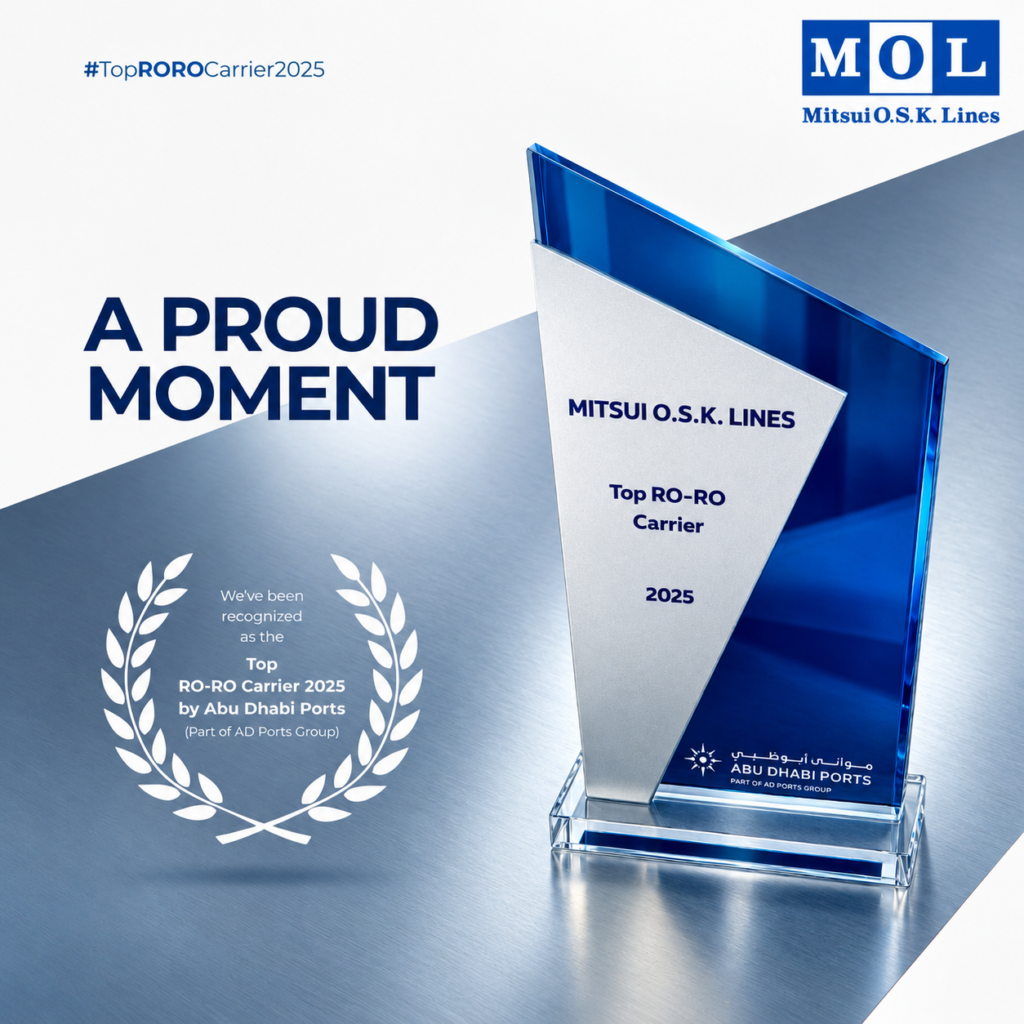
  • MOL Receives Top Ro-Ro Carrier 2025 Award from Abu Dhabi Ports

    Shipping Arabia, October 21, 2026 – Mitsui O.S.K. Lines (MOL) has received the Top Ro-Ro Carrier 2025 award from Abu Dhabi Ports, part of AD Ports Group. The recognition highlights MOL’s contribution to automotive and project cargo transportation across the region, emphasizing the importance of reliability, port connectivity, and operational efficiency in maritime logistics.

    The award recognizes MOL’s role in supporting the movement of vehicles and project cargo through its Roll-on/Roll-off (Ro-Ro) shipping services. These operations require dependable maritime transportation and coordination with ports to maintain efficient cargo flows and support customer supply chains.

    MOL Recognized for Ro-Ro Shipping and Automotive Logistics

    The MOL Ro-Ro carrier award reflects the company’s established presence in vehicle logistics and its contribution to regional maritime transportation.

    MOL operates a global Ro-Ro shipping network backed by decades of experience in automotive logistics. Through this network, the company provides transportation solutions that support customers moving vehicles and other cargo across international markets.

    In announcing the recognition, MOL highlighted the importance of reliable shipping services, strong port connectivity, and operational efficiency for customers involved in automotive and project cargo transportation.

    The company also emphasized its continued commitment to dependable maritime transportation solutions that help maintain supply chain continuity.

    Strengthening Cooperation with Abu Dhabi Ports

    Following the award announcement, MOL expressed appreciation to Abu Dhabi Ports for recognizing its contribution to regional Ro-Ro shipping operations.

    The company also reaffirmed its intention to strengthen its partnership with Abu Dhabi Ports in the coming years.

    The recognition underscores the role of cooperation between Ro-Ro shipping carriers and port operators in supporting automotive and project cargo movements. Such partnerships are particularly important for maintaining reliable transportation services and efficient cargo handling across regional maritime networks.

    For MOL, the Top Ro-Ro Carrier 2025 award acknowledges its contribution to the region’s automotive and project cargo logistics sector while reinforcing its commitment to reliable maritime transportation and continued cooperation with Abu Dhabi Ports.

    Source: Mitsui O.S.K. Lines, Ltd. (MOL)

  • SAFEEN Drydocks Vessel Construction Contracts Reach AED 1.3 Billion

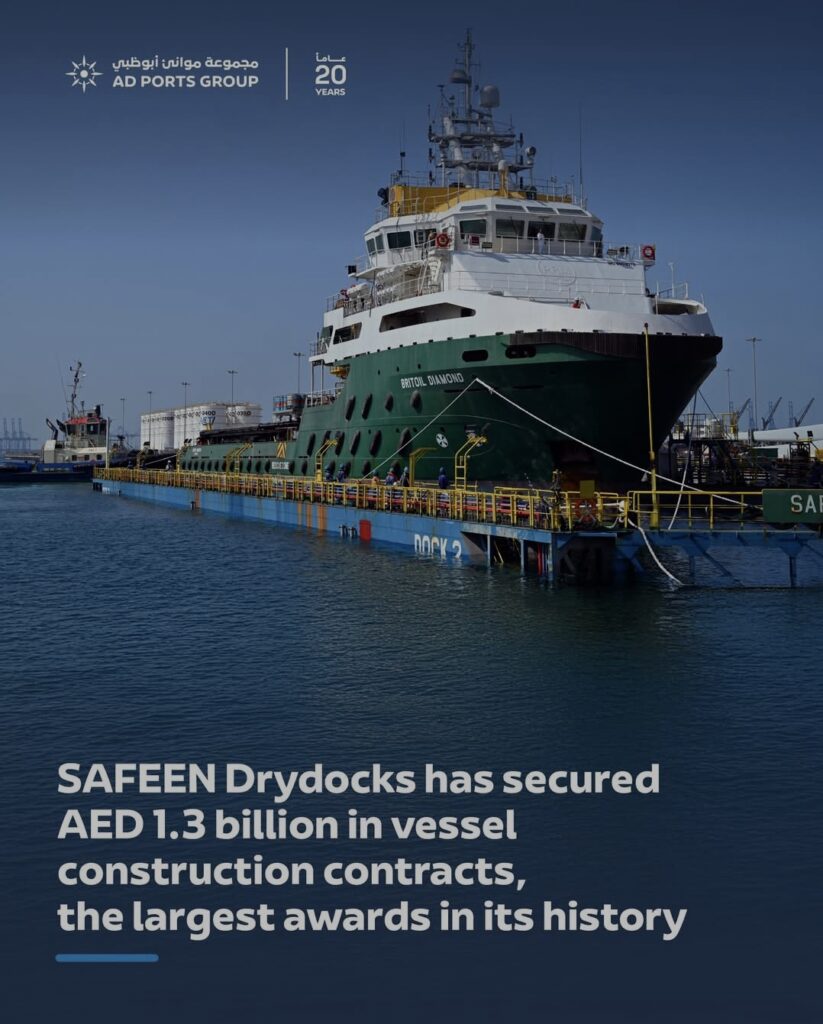
    Shipping Arabia, October 5, 2026 – SAFEEN Drydocks has secured two vessel construction contracts with a combined value of AED 1.3 billion, representing the largest vessel construction awards in its history. The SAFEEN Drydocks vessel construction contracts cover four multipurpose vessels for AD Ports Group and 18 specialised marine support units for Oilbank Logistics Services in Nigeria.

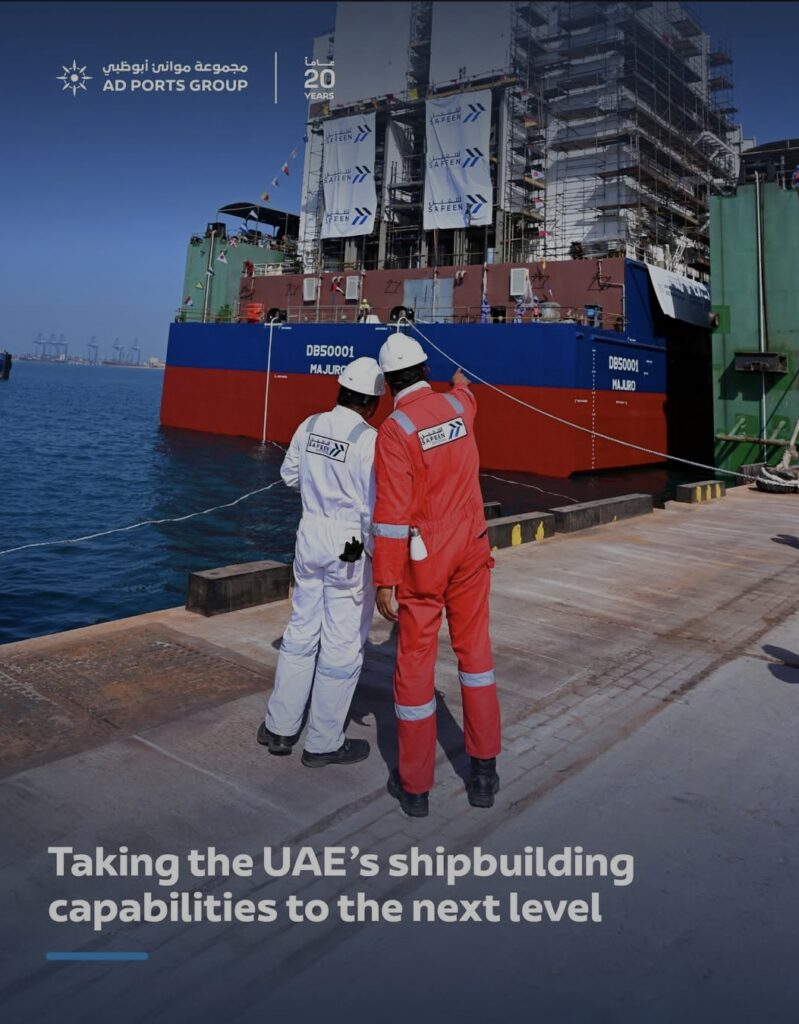
    The awards mark a significant expansion of SAFEEN Drydocks’ shipbuilding workload and demonstrate the scale and versatility of its growing vessel construction capabilities.

    Four 140-Metre Multipurpose Vessels for AD Ports Group

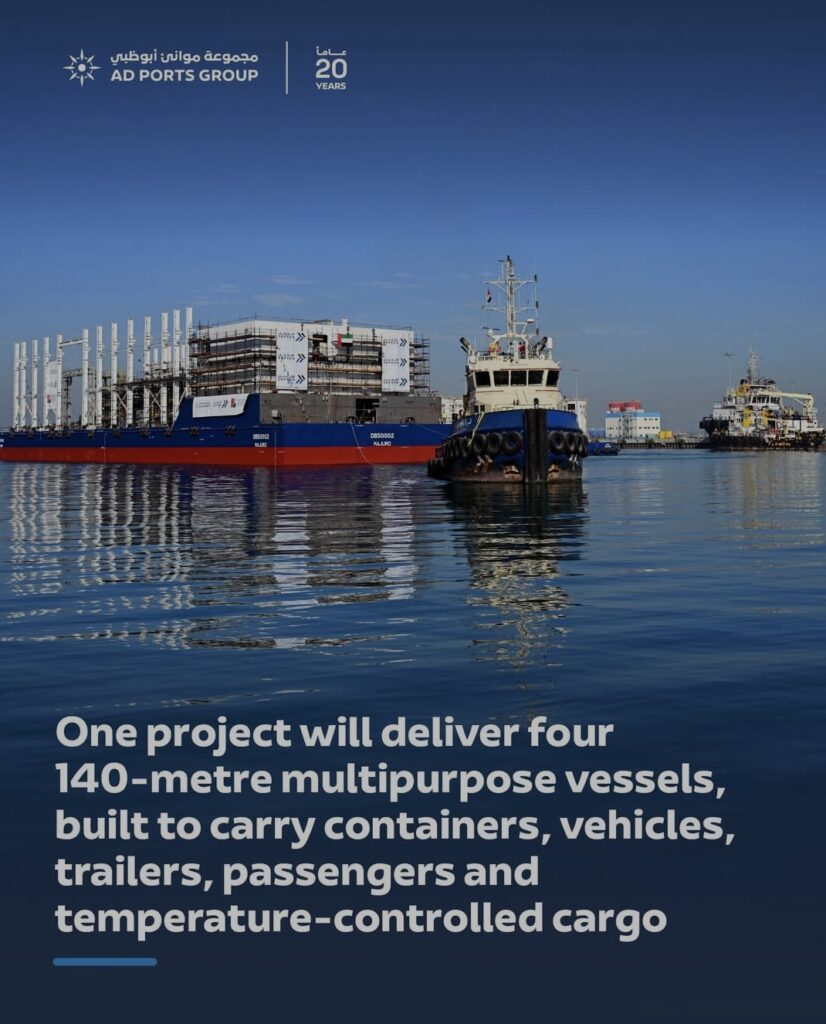
    Under one of the projects, SAFEEN Drydocks will build four 140-metre multipurpose vessels for AD Ports Group.

    The vessels will be designed to carry a broad range of cargo and traffic. Their capabilities will include transporting containers, vehicles, trailers, passengers and temperature-controlled cargo.

    The multipurpose design reflects the range of operational requirements covered by the first of the two SAFEEN Drydocks vessel construction contracts.

    18 Marine Support Units for Nigeria

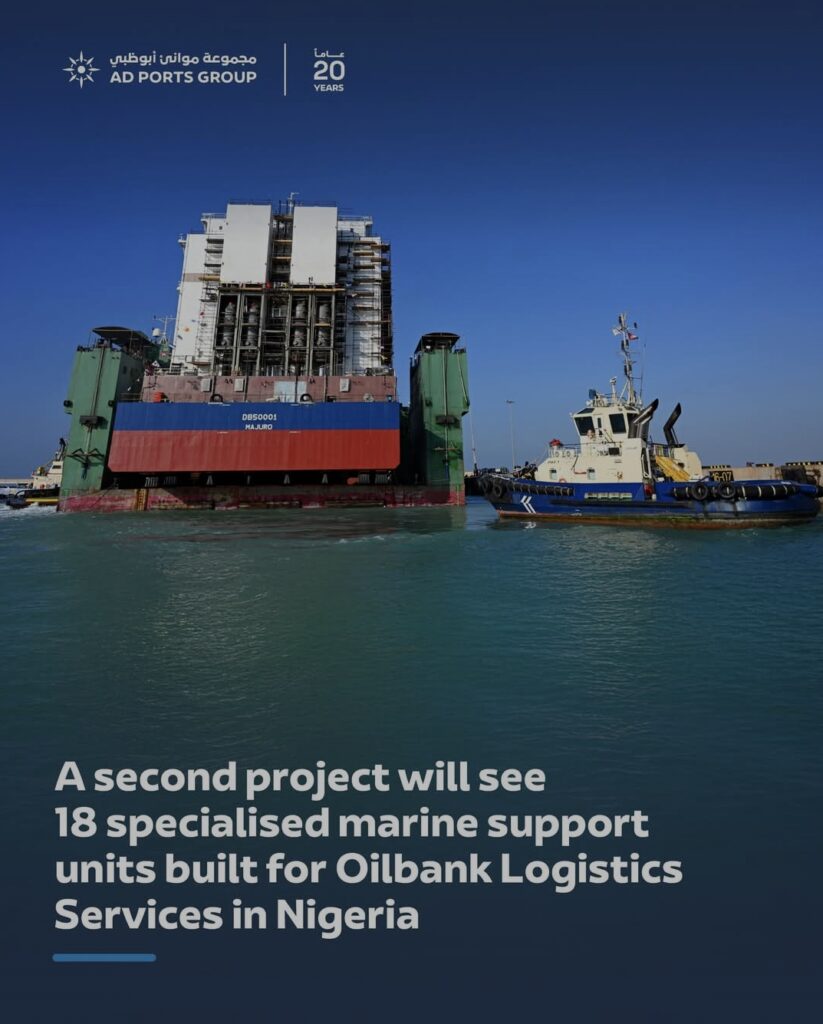
    The second project will see SAFEEN Drydocks build 18 specialised marine support units for Oilbank Logistics Services in Nigeria.

    Together, the two contracts bring the total value of the awards to AED 1.3 billion. AD Ports Group described them as the largest vessel construction awards secured by SAFEEN Drydocks to date.

    The Group said the contracts demonstrate the scale and versatility of SAFEEN Drydocks’ growing shipbuilding capabilities, covering both multipurpose commercial vessels and specialised marine support units.

    Source: AD Ports Group

  • Etihad Rail and AD Ports Group Launch Fujairah–ICAD Rail Freight Service

    Shipping Arabia, September 27, 2026 – Etihad Rail and AD Ports Group have launched a direct rail freight service connecting Fujairah Terminals with the Industrial City of Abu Dhabi (ICAD), creating an integrated inland logistics solution that links the UAE’s East Coast maritime gateway with Abu Dhabi’s industrial heartland through the UAE National Rail Network.

    The new solution combines a dedicated rail freight service with a customs-enabled inland cargo gateway. It extends the reach of Fujairah Terminals beyond the port by allowing cargo arriving in Fujairah to travel approximately 200 kilometers by rail directly to ICAD, where customers can access customs clearance, inspection and cargo release services.

    The partners said the service brings port-related logistics services closer to customers in Abu Dhabi while simplifying cargo movements between the UAE’s East Coast and major industrial areas in the capital.

    ICAD becomes direct cargo destination and clearance point

    A key element supporting the new service is the assignment of the United Nations Code for Trade and Transport Locations, or UN/LOCODE, “AECAD” to ICAD. The designation establishes the industrial city as a recognized international logistics location within global shipping and trade systems.

    For the first time, shipping lines, freight forwarders and cargo owners can book cargo directly to ICAD as both the destination and customs clearance point.

    Containers arriving at Fujairah Terminals can therefore move directly by rail to ICAD, where dedicated customs and inspection infrastructure enables inspection, clearance and cargo release. According to the partners, the arrangement will simplify customs procedures, reduce handling requirements and accelerate cargo movement across Abu Dhabi.

    The service is designed for importers, exporters, manufacturers, distributors and logistics providers operating throughout the emirate. It allows businesses to receive cargo closer to warehouses, production facilities and final markets, reducing the need for additional road transport and shortening the distance between imported cargo and its ultimate destination.

    Dedicated rail service to operate three times a week

    Etihad Rail will operate the dedicated Fujairah Terminals–ICAD service three times per week, strengthening multimodal cargo flows between the UAE’s East Coast and industrial centers in Abu Dhabi.

    The service is designed to provide regular and reliable schedules while supporting larger-volume cargo movements. The partners also expect the rail connection to reduce road congestion and lower carbon emissions compared with traditional long-haul trucking.

    Omar Alsebeyi, Chief Executive Officer of Etihad Rail Freight, said the Fujairah–ICAD connection represents another step toward using the full potential of the UAE National Rail Network for freight customers.

    He said the partnership with AD Ports Group has created a logistics solution that goes beyond transportation by bringing key port services closer to where cargo is ultimately required. Combining rail connectivity, customs-enabled inland cargo handling and the ability to book cargo directly to ICAD is intended to improve cargo efficiency, simplify logistics processes and reduce the time between vessel arrival and final delivery.

    Linking ports, rail and Abu Dhabi’s industrial ecosystem

    Saif Al Mazrouei, Chief Executive Officer, Ports Cluster at AD Ports Group, said strong trade corridors depend on connecting maritime gateways with the industrial and commercial ecosystems they serve.

    He said the integrated service connects Fujairah Terminals, the UAE National Rail Network and ICAD within a more connected logistics system. It also extends the reach of the group’s port infrastructure beyond the terminal while bringing essential services closer to customers.

    According to Al Mazrouei, the partnership is intended to support seamless, reliable and resilient cargo flows while giving businesses greater flexibility in accessing markets and managing supply chains. The approach also supports greater connectivity across the trade ecosystem and Abu Dhabi’s position as a gateway for trade and industry.

    Etihad Rail and AD Ports Group said the launch reflects their shared commitment to strengthening the UAE’s logistics and trade infrastructure through greater connectivity, innovation and customer-focused supply chain solutions.

    By combining Fujairah Terminals with the UAE National Rail Network and an inland gateway providing customs and cargo handling services, the partnership aims to create a more efficient and resilient logistics ecosystem for businesses across the country.

    Fujairah Terminals forms part of the wider AD Ports Group ecosystem and provides integrated supply chain links between ports, industrial and free zones, logistics platforms and digital services. Its location and service offering also support trade and logistics connectivity between the UAE and markets across the GCC, India, the Red Sea and East Africa.

    Source: Emirates News Agency (WAM)

  • ADQ Clears Conditions for Takeover of Remaining AD Ports Group Shares

    Shipping Arabia, September 24, 2026 – Abu Dhabi sovereign investor ADQ has satisfied the conditions attached to its cash offer for the remaining shares of AD Ports Group, advancing a transaction that would bring the global ports, maritime and logistics group under full ownership.

    ADQ, a wholly owned subsidiary of L’IMAD Holding, already holds 75.42% of AD Ports Group. The offer targets all shares not currently held by ADQ at AED 6.25 per share.

    The offer represented a 23% premium to AD Ports Group’s closing share price of AED 5.10 on August 14 and a 95% premium to the AED 3.20 price at which the company listed on the Abu Dhabi Securities Exchange in February 2022.

    AD Ports Group’s Board of Directors recommended on August 26 that shareholders accept the offer following a fairness opinion from independent financial adviser HSBC Bank Middle East. The offer period had opened on August 18.

    Under the transaction timetable, consideration is to be paid to participating shareholders within three business days after the offer becomes unconditional, with the acquired shares subsequently registered in ADQ’s name.

    AD Ports Group has developed into an international integrated trade and logistics business spanning ports, economic cities and free zones, maritime and shipping, logistics and digital services, with operations across more than 50 countries. Its Ports Cluster oversees 38 ports and terminals globally.

    The acquisition represents a significant ownership development for one of the Middle East’s fastest-expanding maritime and logistics groups, which has built an increasingly international portfolio across the Middle East, Africa, Europe and Asia.

    Source: CNBC Arabia

Back to top button