
GFS Feeder Capacity Growth Narrows Gap With DP World as X-Press Feeders Retains Global Lead
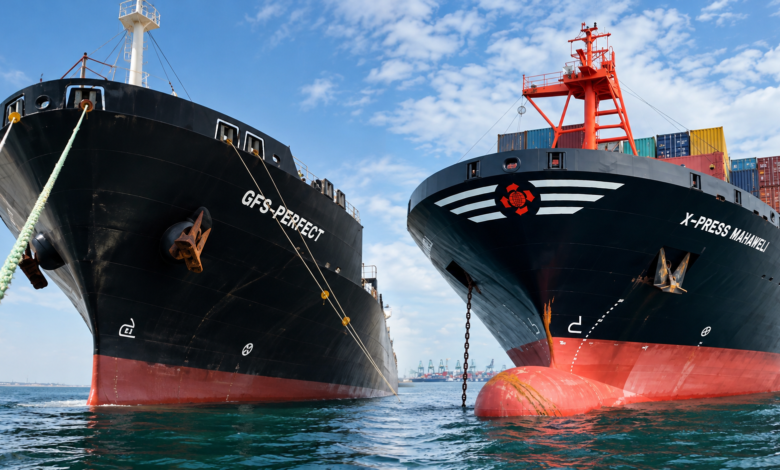
Shipping Arabia, October 24, 2026 – Global Feeder Shipping (GFS) has increased its deployed container capacity by 30.9% year on year, narrowing the gap with DP World to fewer than 2,700 TEU. Meanwhile, X-Press Feeders has retained its position as the world’s largest feeder operator despite a decline in capacity, according to Alphaliner data as of September 21.
The latest figures highlight contrasting developments among the three leading feeder operators as the Middle East conflict continues to affect regional shipping networks. While X-Press Feeders and DP World reduced their exposure to certain regional services, GFS expanded its operations across the Middle East and Indian subcontinent.
Singapore-based X-Press Feeders remained the largest operator, with deployed capacity of 182,776 TEU. However, its fleet capacity declined by 7.1%, or approximately 13,987 TEU, compared with September 2025. The company ranked 14th in Alphaliner’s global Top 100 container carrier rankings.
DP World’s Shipping Solutions division retained second place with 147,807 TEU, down 2.5% year on year. The division, previously operating under the Unifeeder name, was rebranded as Shipping Solutions at the end of 2025.
Dubai-based GFS, in which AD Ports Group holds an 81% stake, reached 145,116 TEU. This reduced its capacity gap with DP World to just 2,691 TEU, compared with more than 40,000 TEU a year earlier.
Middle East Disruptions Reshape X-Press Feeders’ Network
X-Press Feeders recorded its largest capacity reductions on routes serving the Middle East and Indian subcontinent. Deployed capacity in these markets declined by approximately 38,000 TEU, representing a 34.2% contraction.
Alphaliner attributed much of the decline to the consequences of the Middle East conflict, which forced the company to reduce several regional services.
Among the affected operations was the suspension of the Jebel Ali–Far East JFX service. The service had operated jointly with Heung-A, Sinokor and TS Lines, with X-Press Feeders contributing approximately 16,700 TEU.
Following the suspension, the company redeployed part of that capacity to a loop connecting the Far East and Indian subcontinent.
Despite these reductions, X-Press Feeders expanded its operations in other regions. Its intra-European capacity increased by 7.4%, equivalent to approximately 2,900 TEU. In Latin America, deployed capacity rose by 17.7%, adding around 5,100 TEU.
The Latin American expansion included the launch of the NCX service connecting northern Colombia and Panama. The new service added approximately 2,600 TEU.
Additionally, X-Press Feeders became the sole operator of the Caribbean TGX feeder service. The service expanded from one vessel contributed by the company a year earlier to three vessels, adding another 2,600 TEU.
The carrier also entered the Far East–Europe trade during 2026 through the deployment of the 4,785-TEU X-PRESS Odyssey. The vessel operates on a Mediterranean service jointly with China United Lines and GFS.
DP World Reduces Regional Capacity While Deploying Larger Vessels
DP World’s Shipping Solutions division also adjusted its feeder network in response to the Middle East conflict.
Its deployed capacity on routes serving the Middle East and Indian subcontinent declined by approximately 7,500 TEU. Meanwhile, capacity across other regions remained relatively stable.
The operator withdrew several services associated with the Arabian Gulf. However, it partially offset these reductions by introducing new vessels and deploying larger ships across its network.
The Shipping Solutions fleet currently comprises 85 vessels, compared with 94 in 2025. Despite the reduction in vessel numbers, average vessel capacity increased from 1,613 TEU to 1,739 TEU.
These changes reflect a reduction in the number of vessels deployed alongside an increase in average vessel size.
GFS Feeder Capacity Growth Strengthens Regional Leadership
In contrast to its two main competitors, GFS expanded its deployed capacity across the Middle East and Indian subcontinent.
The company’s regional capacity increased by 26.9%, equivalent to approximately 21,600 TEU, reaching slightly more than 100,000 TEU. This represented nearly 70% of its total deployed fleet capacity.
Four newly introduced services contributed a combined 28,000 TEU to the company’s network expansion.
According to Alphaliner, GFS maintained its regional network largely intact while its principal competitors reduced their presence.
The company also modified its service coverage by replacing some Arabian Gulf port calls with Red Sea ports. At the same time, it expanded its network to include adjacent trade routes.
Consequently, GFS overtook both X-Press Feeders and DP World in deployed capacity across the Middle East and Indian subcontinent.
X-Press Feeders deployed approximately 73,500 TEU in the region, while DP World’s corresponding capacity stood at around 70,500 TEU.
GFS therefore established the largest regional capacity among the three operators, even as it remained third in their overall global feeder rankings.
Africa Records GFS’ Strongest Percentage Growth
Beyond the Middle East and Indian subcontinent, GFS also expanded its operations in Africa.
Although Africa represents a smaller portion of the company’s overall network, it recorded the highest percentage growth among its regional operations.
Deployed capacity in Africa increased by 74.9%, equivalent to approximately 6,480 TEU, reaching around 15,100 TEU.
This expansion added to GFS’ overall capacity growth and helped narrow its global ranking gap with DP World’s Shipping Solutions division.
The latest Alphaliner figures show three distinct capacity trends among the leading feeder operators. X-Press Feeders remains the global market leader despite regional reductions, DP World retains second place with a smaller fleet, and GFS continues to expand its deployed capacity.
With only 2,691 TEU separating GFS and DP World, the two operators now hold closely matched fleet capacities, compared with a substantially wider gap in September 2025.
Source: Al Mal