Container Throughput

  • DP World Sokhna Container Throughput Rises 45% to Record High

    Shipping Arabia, October 13, 2026 – DP World Sokhna in Egypt recorded its highest-ever monthly container throughput in August 2026, handling 141,041 TEUs, a 45% increase year-on-year. The performance exceeded the terminal’s previous monthly record of 103,752 TEUs, set in January 2026, by approximately 36%.

    Alongside the container handling milestone, the terminal established a new daily discharge productivity record for iron ore pellet feed. The achievement reduced the discharge time of a bulk carrier by approximately 58 hours, highlighting the terminal’s operational capabilities across containerized and dry bulk cargo.

    Transshipment Drives DP World Sokhna Container Throughput Growth

    Transshipment operations played a major role in the terminal’s record container volumes during August. According to terminal data reported by Al Mal, transshipment throughput reached 87,149 TEUs, accounting for 61.9% of total monthly container handling.

    The figures reflect growing demand for transshipment services through DP World Sokhna amid changes in international trade patterns. According to the company, the performance demonstrates the terminal’s ability to respond to changing cargo flows and customer requirements while maintaining operational efficiency.

    To accommodate higher container volumes and changing traffic patterns, operational teams continued adapting yard management strategies based on occupancy levels and cargo movements. The terminal also redistributed equipment and operational resources to match fluctuations in container flows.

    Additionally, DP World Sokhna used its digital systems to improve truck movements and support cargo handling efficiency. Equipment reliability and coordination between operations, engineering, commercial and customer teams helped maintain smooth operations as transshipment activity increased.

    These operational adjustments supported the terminal’s ability to handle higher cargo volumes while responding to changes in the composition and movement of container traffic.

    Iron Ore Discharge Operations Set New Productivity Record

    In a separate operational achievement, DP World Sokhna established a new daily discharge productivity record for iron ore pellet feed during cargo handling operations involving the bulk carrier MV SEA PUMA.

    The terminal discharged a total of 152,602 metric tons from the vessel, achieving a gross discharge rate of 41,619 metric tons per day. The net discharge rate reached 42,097 metric tons per day.

    The new gross discharge rate represented a record for the terminal’s iron ore discharge operations involving this vessel category.

    Higher productivity enabled the terminal to complete the vessel’s discharge operations in just 88 hours, reducing the unloading time by approximately 58 hours.

    The achievement demonstrated the terminal’s capacity to maintain high productivity in dry bulk cargo handling alongside its growing container operations.

    DP World Egypt Highlights Operational Flexibility

    Mohammad Shehab, CEO of DP World Egypt, said the terminal’s August performance reflected the company’s ability to respond flexibly to changing trade patterns and customer requirements.

    He emphasized that achieving the highest monthly container throughput in the terminal’s history, with transshipment accounting for 61.9% of total volumes, demonstrated the company’s ability to adapt its operations and management strategies to meet customer needs.

    Shehab also highlighted the iron ore discharge productivity record as evidence of the terminal’s diverse operational capabilities and effective coordination between its teams.

    He reaffirmed the company’s continued focus on operational efficiency, reliability and technology to support smoother trade flows and improve the customer experience at DP World Sokhna.

    Container Growth and Bulk Cargo Performance

    The two operational records illustrate the scale and diversity of cargo handling activities at DP World Sokhna.

    The terminal’s record container volumes demonstrate its capacity to accommodate substantial throughput growth while adjusting to changes in transshipment patterns. Meanwhile, the iron ore discharge achievement reflects its ability to deliver high productivity in dry bulk cargo operations.

    Together, the results highlight the terminal’s ability to serve different cargo categories and customer requirements while supporting efficient cargo movements through Sokhna Port.

    Source: Al Mal
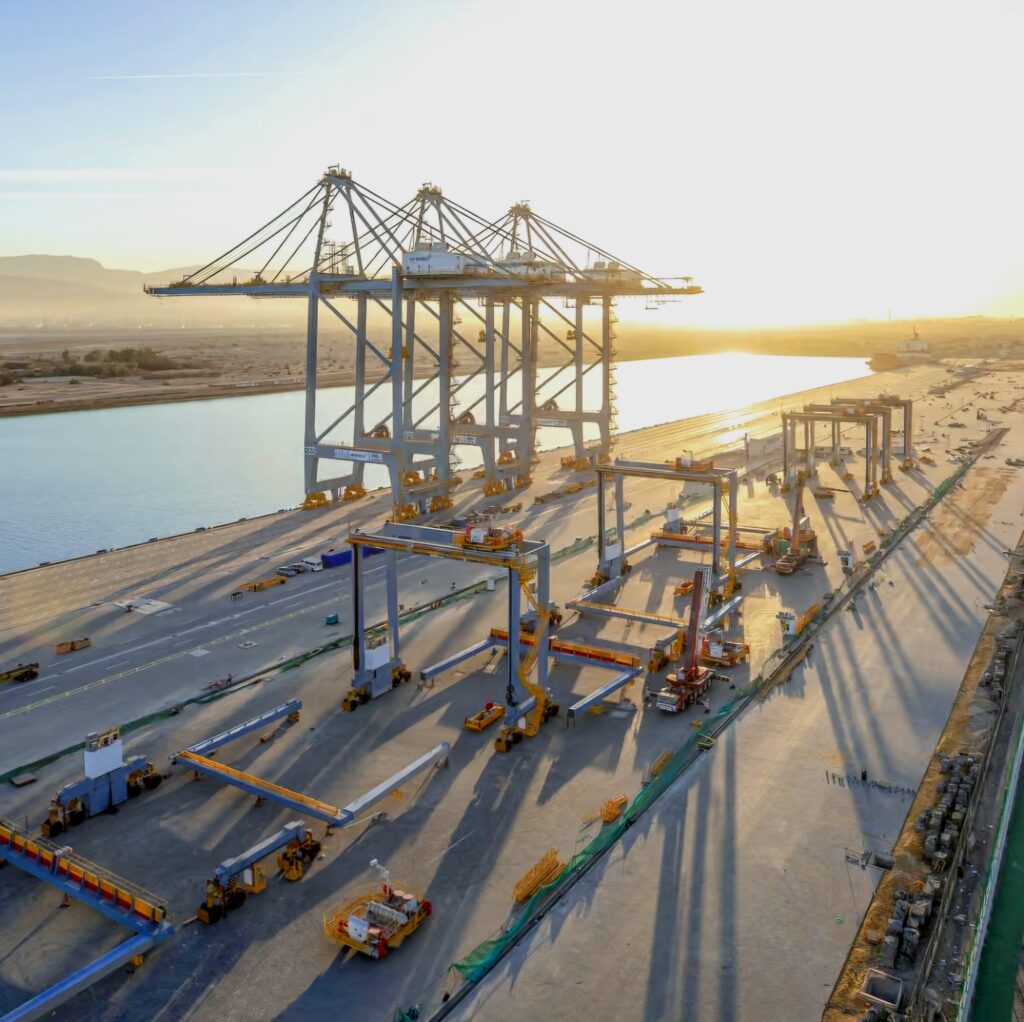
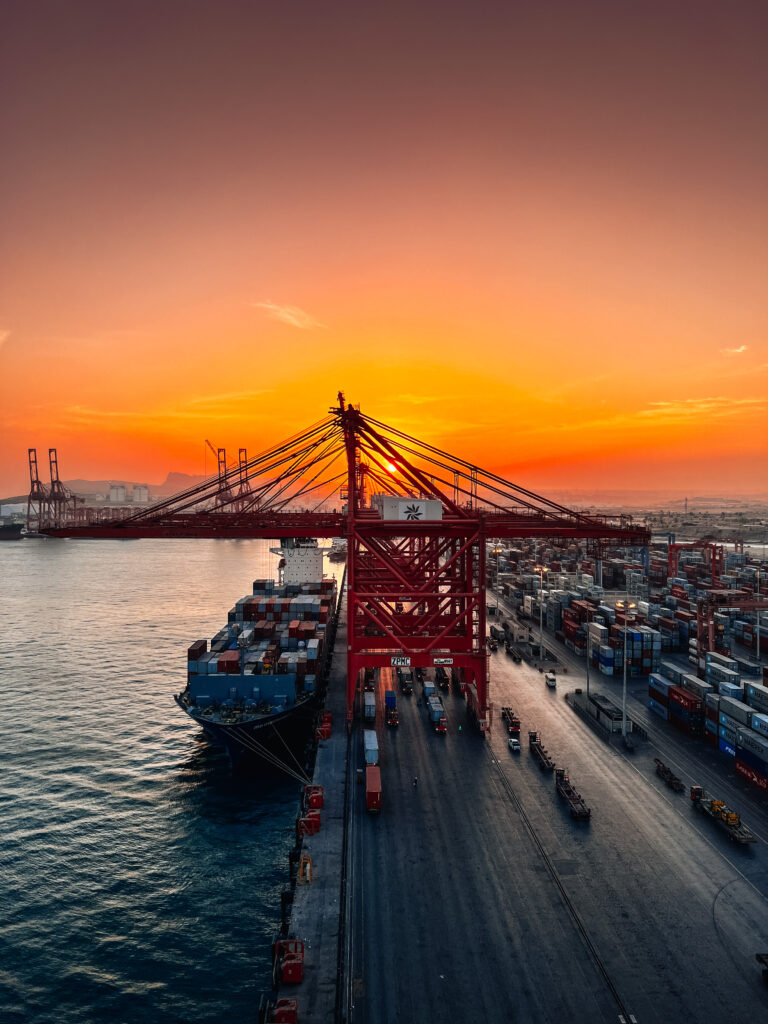
    DP World Sokhna container terminal in Egypt, where monthly container throughput reached a record high.
  • Aqaba Container Terminal Sets Third Consecutive Monthly Record with 107,803 TEUs in September 2026

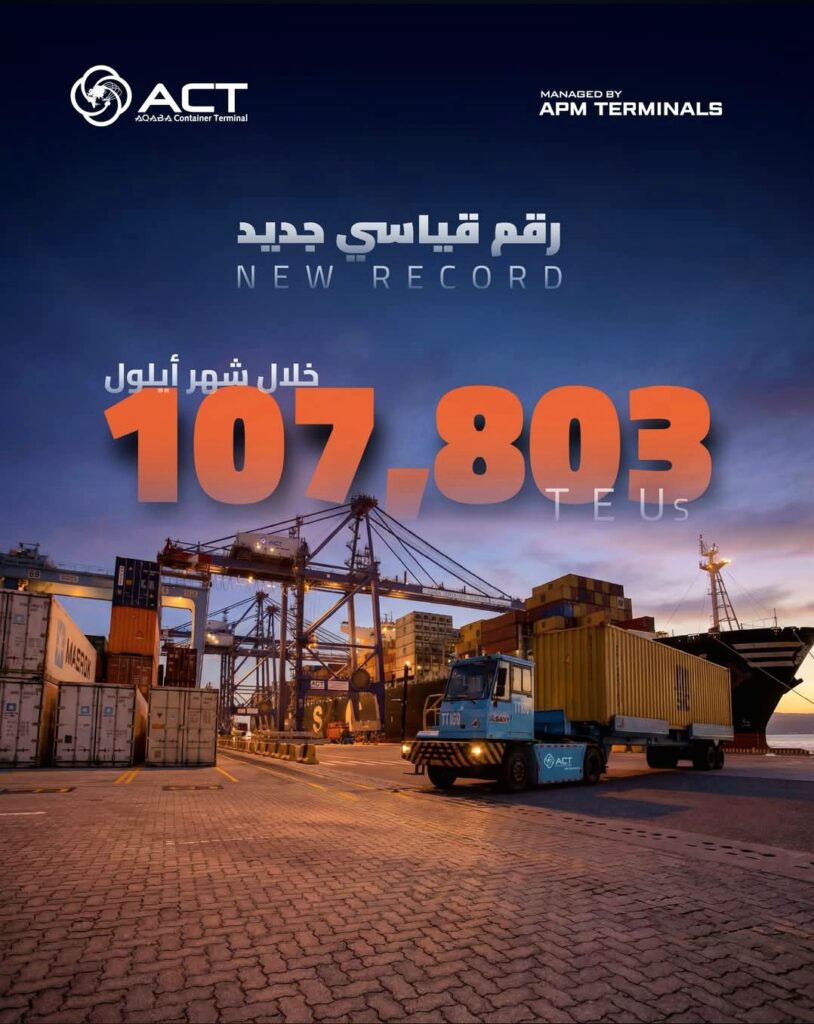
    Shipping Arabia, October 12, 2026 – Aqaba Container Terminal (ACT) in Jordan achieved its third consecutive monthly throughput record in September 2026, handling 107,803 twenty-foot equivalent units (TEUs) across 53 vessels. The milestone marked the third straight month in which container volumes exceeded 100,000 TEUs, highlighting sustained operational momentum at Jordan’s principal container terminal.

    The September performance followed record throughput levels in July and August, extending ACT’s run of consecutive monthly records. The results reflect the terminal’s continued role in facilitating Jordan’s international trade and supporting cargo movements between the country and regional markets.

    Aqaba Container Terminal Throughput Maintains Record Levels

    ACT’s September container throughput of 107,803 TEUs represented another milestone in a period of sustained high-volume operations. The terminal surpassed the 100,000-TEU threshold for the third consecutive month, maintaining the momentum established during July and August.

    The latest figures also highlight the scale of marine activity at the terminal, with 53 vessels handled during September. ACT maintained its focus on accommodating sustained container volumes while delivering efficient and reliable services to shipping customers and supply chain partners.

    The sequence of monthly records reflects the continued importance of Aqaba within regional maritime trade flows. It also demonstrates the terminal’s capacity to handle significant container volumes as it serves Jordan and the wider regional market.

    Transit Cargo Reaches 14,712 TEUs as Truck Activity Remains Strong

    Transit cargo continued to represent an important component of ACT’s operations during September. The terminal handled 14,712 TEUs of transit shipments, reinforcing its role in facilitating the movement of goods between Jordan and regional markets.

    The transit figures highlight the importance of Aqaba’s connectivity to surrounding markets and its function as a maritime gateway for cargo moving beyond Jordan’s domestic market.

    Meanwhile, landside operations maintained high activity levels. ACT recorded 45,901 truck visits at its terminal gates during September, reflecting the substantial flow of containers between the port and inland transport networks.

    The combination of strong vessel activity, high container throughput and sustained truck movements demonstrated the terminal’s ability to manage cargo volumes across both marine and landside operations.

    According to ACT, maintaining efficient and reliable services remains essential to supporting customers and supply chain partners as the terminal handles sustained operational demand.

    ACT Reinforces Its Position as a Regional Logistics Gateway

    Commenting on the September performance, José Rueda, Chief Executive Officer of Aqaba Container Terminal, said the three consecutive months of record throughput reflected the strength and resilience of Aqaba’s position within regional trade flows.

    He emphasized that the terminal’s performance demonstrated its ability to accommodate those trade flows at scale, while maintaining the operational standards required by its customers and partners.

    Rueda also highlighted ACT’s focus on strengthening its position as a trusted regional gateway as the logistics landscape continues to evolve.

    The terminal aims to combine strong operational performance with improved connectivity, service reliability and consistent customer service standards. These priorities remain central to supporting the needs of shipping lines, logistics providers and other supply chain partners.

    According to Rueda, the sustained performance provides a strong foundation for ACT to continue contributing to the growth and competitiveness of Jordan’s logistics sector.

    The September results consolidate three consecutive months of record container throughput, reinforcing Aqaba Container Terminal’s role in facilitating regional trade and supporting Jordan’s maritime and logistics activities.

    Source: APM Terminals

    Aqaba Container Terminal in Jordan, which achieved its third consecutive monthly container throughput record in September 2026.
  • Qatar Ports Container Throughput Reaches 648,164 TEUs in First Nine Months of 2026

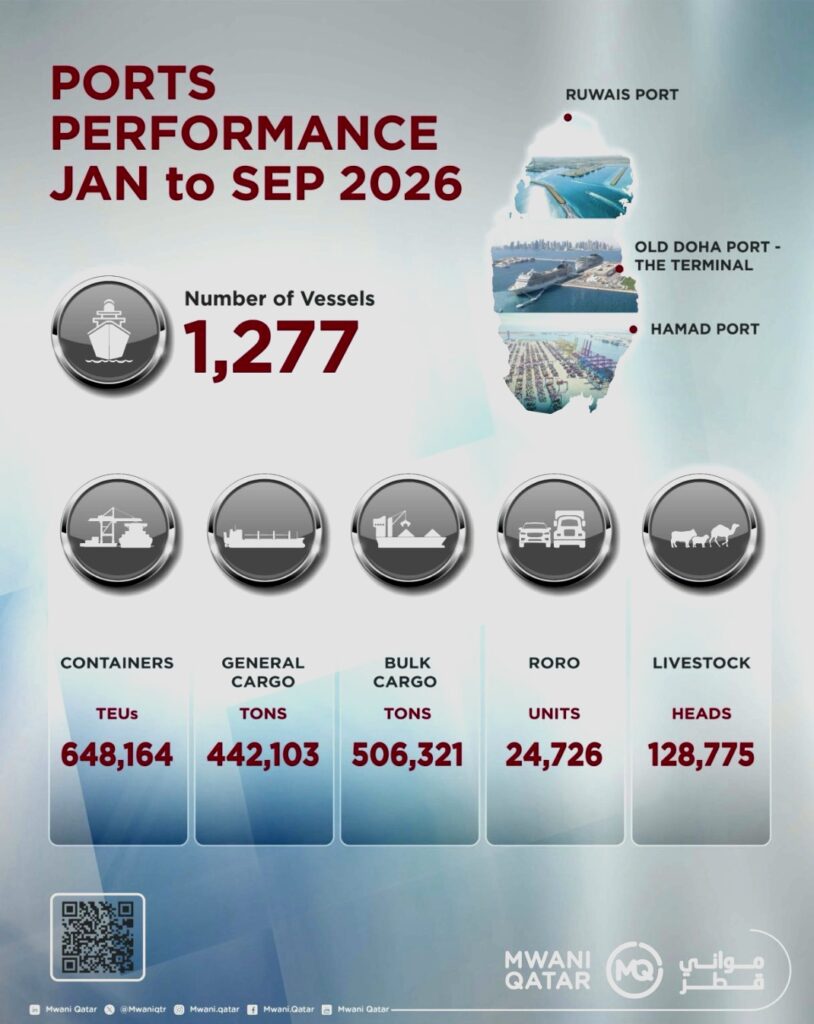
    Shipping Arabia, October 11, 2026 – Qatar ports container throughput reached 648,164 TEUs during the first nine months of 2026, according to official performance figures released by Mwani Qatar. The country’s ports also received 1,277 vessels between January and September, while handling general cargo, bulk commodities, RORO shipments and livestock.

    The figures cover port operations during the nine-month period ending September 30, 2026. Mwani Qatar’s performance report identifies Hamad Port, Ruwais Port and Old Doha Port – The Terminal.

    Qatar Ports Container Throughput and Cargo Performance

    Container traffic accounted for 648,164 TEUs during the reporting period, while general cargo volumes reached 442,103 tons.

    Bulk cargo operations contributed another 506,321 tons, bringing the combined volume of general and bulk cargo handled during the nine months to 948,424 tons.

    These figures reflect the range of cargo handled through Qatar’s ports, including containerized shipments and non-containerized general and bulk cargo.

    The performance report provides aggregate figures for the reporting period rather than individual throughput statistics for each port.

    RORO and Livestock Handling

    Beyond container and conventional cargo operations, Qatar’s ports handled 24,726 RORO units between January and September 2026. The reported volumes covered vehicles and equipment moving through the country’s port facilities.

    Livestock handling also formed part of the ports’ activities, with 128,775 head of livestock recorded during the nine-month period.

    Together, the container, general cargo, bulk cargo, RORO and livestock figures provide an overview of the different maritime cargo segments covered by Mwani Qatar’s performance report.

    Vessel Traffic Across Qatar’s Ports

    Mwani Qatar reported a total of 1,277 vessel calls during the first nine months of 2026.

    The official report features Hamad Port, Ruwais Port and Old Doha Port – The Terminal, reflecting the port facilities included in Mwani Qatar’s performance overview.

    While the statistics provide cumulative cargo volumes and vessel traffic for January through September, they do not include a comparison with the corresponding period of 2025.

    The latest figures establish the reported level of cargo handling and vessel activity across Qatar’s ports during the first three quarters of 2026.

    Source: Mwani Qatar

  • Port of Salalah Container Throughput Sets Second Consecutive Monthly Record

    Shipping Arabia, October 11, 2026 – Port of Salalah container throughput reached a record 511,209 TEUs in September 2026, marking the second consecutive monthly high at the Omani port. The latest performance pushed combined container volumes for August and September above 1 million TEUs, extending the port’s growth following a major terminal expansion completed in 2025.

    September throughput increased 4.1% from August’s previous record of 491,114 TEUs. Container-handling moves also rose 3.7%, reaching 301,113 compared with 290,418 in August.

    Josh Surdin, Chief Operating Officer of the Port of Salalah Container Terminal, disclosed the September figures in a LinkedIn post. He described the result as the highest monthly container volume recorded in the port’s history.

    Port of Salalah Container Throughput Exceeds 1 Million TEUs in Two Months

    The combined throughput for August and September reached 1,002,323 TEUs, equivalent to approximately 23% of the port’s total container volume for 2025.

    The consecutive monthly records follow significant annual growth in container traffic. In 2025, Port of Salalah handled 4.325 million TEUs, representing a 31% increase from the 3.305 million TEUs recorded in 2024.

    Growth continued into 2026. During the first six months of the year, the port handled 2.331 million TEUs, compared with 2.031 million TEUs during the corresponding period of 2025. This represented a year-on-year increase of approximately 14.8%.

    The September record therefore follows a period of sustained growth in container volumes, with both annual and first-half figures showing increases before the consecutive monthly highs in August and September.

    Transshipment Dominates Container Traffic

    Transshipment remains the largest component of Port of Salalah’s container business. During the first half of 2026, transshipment volumes reached approximately 2.034 million TEUs, accounting for around 87% of total container throughput.

    These volumes reflect the port’s principal role as an international transshipment hub, where containers are transferred between vessels as part of global shipping networks.

    Import and export containers accounted for a smaller share of overall traffic. Combined import and export throughput reached 190,304 TEUs during the first six months of 2026, representing just over 8% of total volume.

    Meanwhile, container restows contributed a further 106,586 TEUs to first-half throughput.

    The breakdown highlights the dominance of international transshipment activity compared with container traffic directly associated with cargo entering or leaving Oman.

    $300 Million Terminal Expansion Supports Container Operations

    The consecutive monthly records follow the completion of a $300 million expansion of the Port of Salalah Container Terminal in 2025.

    The project involved upgrades to all six container berths, expansion of the container yard, and installation of new ship-to-shore cranes and supporting infrastructure.

    The investment expanded the terminal’s infrastructure and was designed partly to accommodate container traffic associated with the Gemini Cooperation shipping network operated by Maersk and Hapag-Lloyd.

    The Gemini Cooperation forms an important part of the port’s operating environment, with the upgraded terminal infrastructure developed in part to serve traffic moving through the network.

    APM Terminals, part of A.P. Moller-Maersk, operates Port of Salalah and holds a 30% ownership stake in Salalah Port Services Company.

    The operator’s parent group is also one of the two shipping companies behind the Gemini Cooperation, alongside Hapag-Lloyd.

    With the terminal expansion completed in 2025, Port of Salalah has recorded growth in first-half 2026 container throughput, followed by successive monthly records in August and September.

    Source: Oman Observer

  • Qatar Ports Container Throughput Rises 10% as Vessel Calls Jump 20% in September 2026

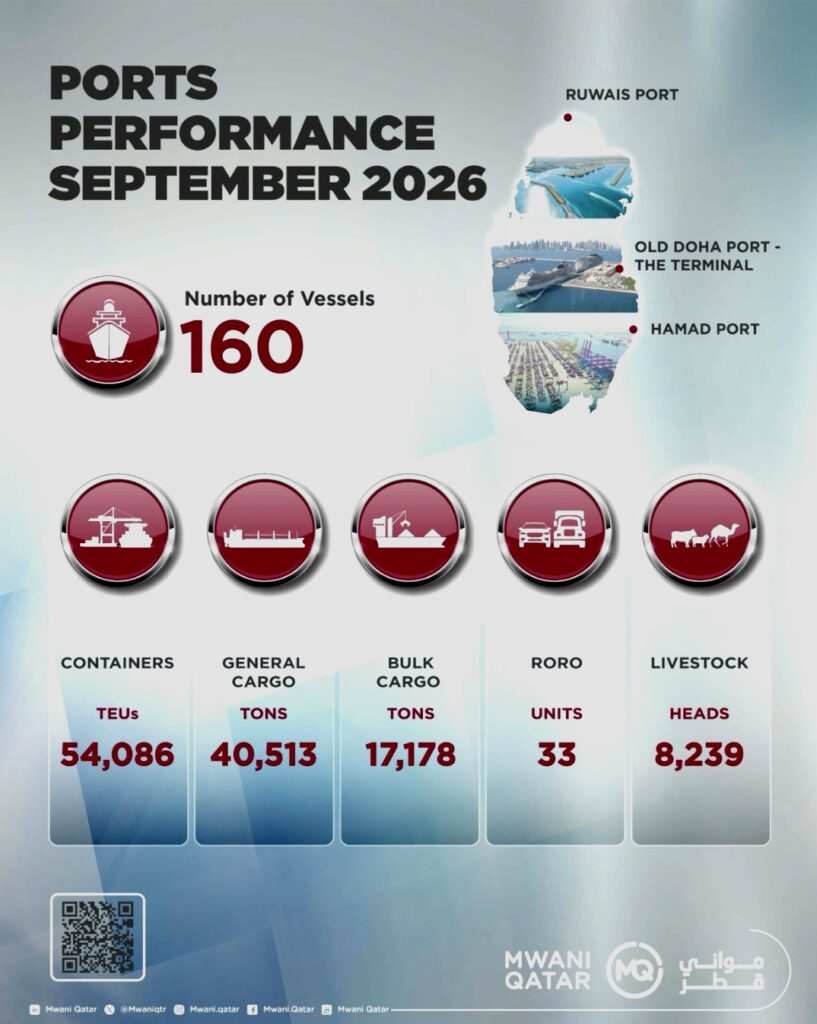
    Shipping Arabia, October 9, 2026 – Qatar ports container throughput reached 54,086 TEUs in September 2026, marking a 10% increase compared with August, while vessel calls rose 20% to 160. The latest figures released by Mwani Qatar highlight stronger maritime activity across the country’s port network, alongside increased livestock handling and continued cargo operations.

    The September performance report covers Hamad Port, Ruwais Port and Old Doha Port – The Terminal. Together, these facilities support Qatar’s maritime trade, domestic supply chains and passenger shipping activities.

    The results reflect the importance of the country’s port infrastructure in facilitating international trade and maintaining maritime connectivity. They also provide an indication of monthly developments across different cargo segments.

    Qatar Ports Container Throughput and Cargo Performance

    According to Mwani Qatar, the country’s ports received 160 vessels during September, representing a 20% increase compared with the previous month. Container throughput also rose by 10%, reaching 54,086 twenty-foot equivalent units (TEUs).

    The increase in vessel calls indicates higher ship traffic during the reporting period. Meanwhile, the growth in container volumes reflects stronger container handling activity compared with August.

    Beyond containers, Qatar’s ports handled 40,513 tons of general cargo and 17,178 tons of bulk cargo during September. These figures demonstrate the range of non-containerized commodities moving through the country’s maritime facilities.

    RoRo operations accounted for 33 units during the month. Although relatively limited in volume compared with other cargo categories, RoRo handling remains part of the services provided within Qatar’s diversified port system.

    Livestock throughput reached 8,239 heads, an increase of 38% compared with August. This represented one of the strongest reported monthly growth rates among the performance indicators released by Mwani Qatar.

    The data confirms month-on-month increases in vessel calls, container throughput and livestock handling. However, the report does not provide comparative growth rates for general cargo, bulk cargo or RoRo traffic.

    Hamad Port, Ruwais Port and Old Doha Port Support Different Maritime Activities

    Qatar’s maritime infrastructure comprises ports with complementary commercial and operational functions. Mwani Qatar manages Hamad Port and Ruwais Port while also supporting the development and operation of Old Doha Port’s maritime facilities.

    Hamad Port serves as Qatar’s principal commercial maritime gateway and plays a central role in the country’s containerized trade. Its facilities support container handling, general cargo, bulk commodities, vehicles and other specialized shipments.

    The port is an important component of Qatar’s international trade connectivity, providing infrastructure for imports, exports and regional transshipment activities. Its development also forms part of the country’s strategy to strengthen logistics capabilities and support economic diversification.

    Ruwais Port, located in northern Qatar, serves as an additional gateway for regional maritime trade. The port handles general cargo, food products and other commodities, supporting commercial activity and supply chains in the northern part of the country.

    Its role complements the larger commercial operations at Hamad Port by providing facilities for regional shipments and smaller maritime trade flows. The development of Ruwais Port has also supported Qatar’s efforts to diversify its maritime access points.

    Old Doha Port – The Terminal has a different operational focus, supporting cruise shipping and maritime tourism. Its passenger facilities accommodate cruise vessels and provide services for international visitors arriving by sea.

    The port contributes to Qatar’s tourism infrastructure and its presence in the Arabian Gulf cruise market. Its role in passenger shipping complements the cargo-oriented activities of Hamad Port and Ruwais Port.

    Together, the three ports provide a diversified maritime network serving commercial cargo, regional trade and cruise tourism.

    September Performance Highlights Qatar’s Maritime Trade Connectivity

    The September 2026 results underline the importance of Qatar’s ports in supporting trade flows and the movement of essential goods.

    The 10% monthly increase in container throughput is particularly relevant to the country’s commercial shipping sector. Containers represent a major component of international maritime trade, carrying goods across established liner shipping networks.

    The 20% rise in vessel calls also points to increased shipping activity during September. However, the combined figures do not identify how the additional calls were distributed among individual ports or vessel categories.

    General cargo and bulk cargo operations remain important components of Qatar’s maritime logistics system. These segments support the movement of commodities and materials that require specialized handling outside conventional container operations.

    Meanwhile, the 38% rise in livestock handling highlights the role of port facilities in accommodating agricultural and food-related imports. Livestock transportation requires dedicated handling arrangements within maritime supply chains.

    The combination of containers, general cargo, bulk cargo, RoRo units and livestock illustrates the variety of cargo segments served by Qatar’s commercial ports.

    Supporting Qatar’s Long-Term Maritime and Logistics Ambitions

    Qatar has continued developing its port infrastructure as part of its broader economic and logistics objectives. Hamad Port, in particular, represents a major investment in strengthening the country’s maritime connectivity and international trade capabilities.

    The development of commercial ports also aligns with Qatar National Vision 2030, which emphasizes economic diversification and the expansion of infrastructure supporting sustainable development.

    Within this framework, Hamad Port provides large-scale commercial cargo capacity, while Ruwais Port supports regional trade and northern Qatar’s commercial activities. Old Doha Port contributes through cruise tourism and maritime passenger services.

    The September performance figures offer a monthly measure of activity across this network. They show increased vessel traffic, higher container throughput and growth in livestock handling compared with August.

    While a single month’s results do not establish a longer-term trend, the reported increases demonstrate stronger activity in several key operational indicators. The figures also reinforce the relevance of Qatar’s diversified port infrastructure to its maritime transport and logistics sectors.

    Source: Mwani Qatar

Back to top button