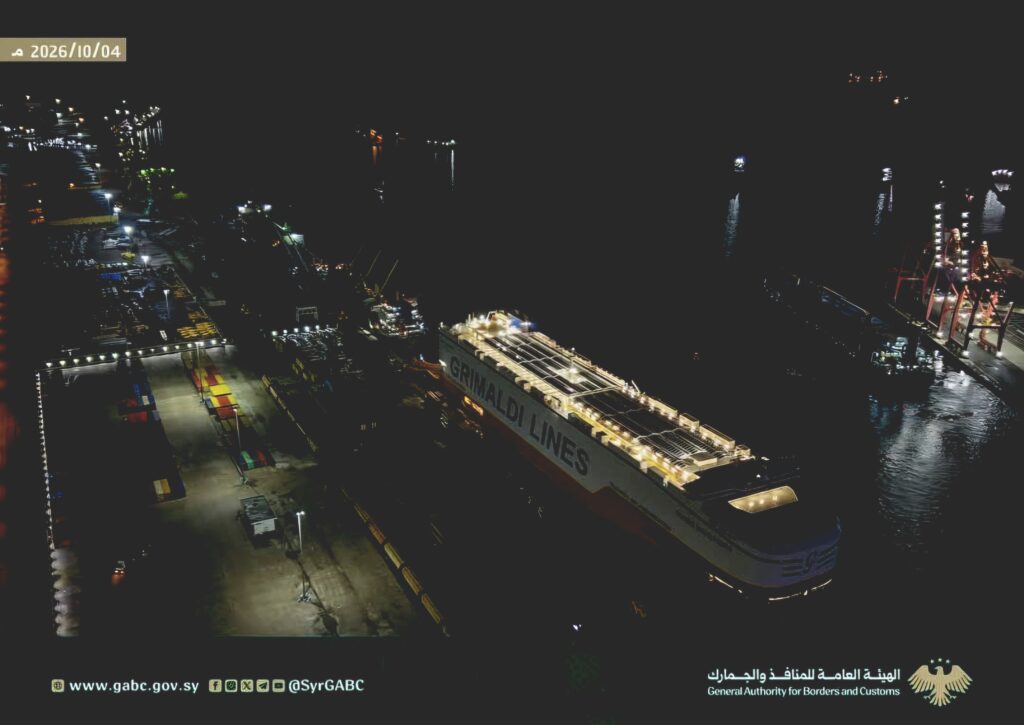
Shipping Arabia, October 11, 2026 – Latakia Port cargo throughput reached approximately 3.8 million tons during the first nine months of 2026, covering general and containerized cargo. The Syrian port also received 532 vessels between January and September, according to figures released by the General Authority for Borders and Customs.
The port continues to maintain round-the-clock maritime and cargo handling operations, with vessels arriving and loading and unloading activities taking place across its berths and storage yards.
Latakia Port Cargo Throughput and Container Volumes
General cargo accounted for approximately 2 million tons of the total volume handled during the reporting period. Meanwhile, container traffic reached around 219,000 containers, carrying nearly 1.8 million tons of cargo.
Together, these figures brought Latakia Port cargo throughput to approximately 3.8 million tons through the end of September 2026.
Containerized cargo and general cargo operations continued throughout the reporting period, supported by ongoing loading and unloading activities at the port’s operational facilities.
Vessel Calls Reach 532 Across Different Maritime Activities
Latakia Port received 532 vessels during the first nine months of 2026, reflecting activity across several maritime service categories.
General cargo vessels accounted for 250 calls, while container ships represented another 247 calls. The remaining traffic included 22 vessels arriving for repair work and 13 passenger ships.
The breakdown highlights the variety of maritime activities taking place at the port, including commercial cargo handling, vessel repair services and passenger vessel operations.
Continuous Operations and Port Efficiency
Alongside its cargo handling and vessel reception activities, Latakia Port continues to focus on maintaining operational efficiency and improving service readiness.
Technical and operational teams are working to ensure the smooth movement of cargo and accelerate handling procedures across the port’s berths and storage areas.
These efforts include maintaining continuous operations, strengthening the port’s operational readiness and improving the efficiency of services provided to vessels and cargo operators.
The ongoing activities aim to support Latakia Port’s role in maritime transportation and commercial trade, while ensuring the continued movement of goods through one of Syria’s maritime gateways.
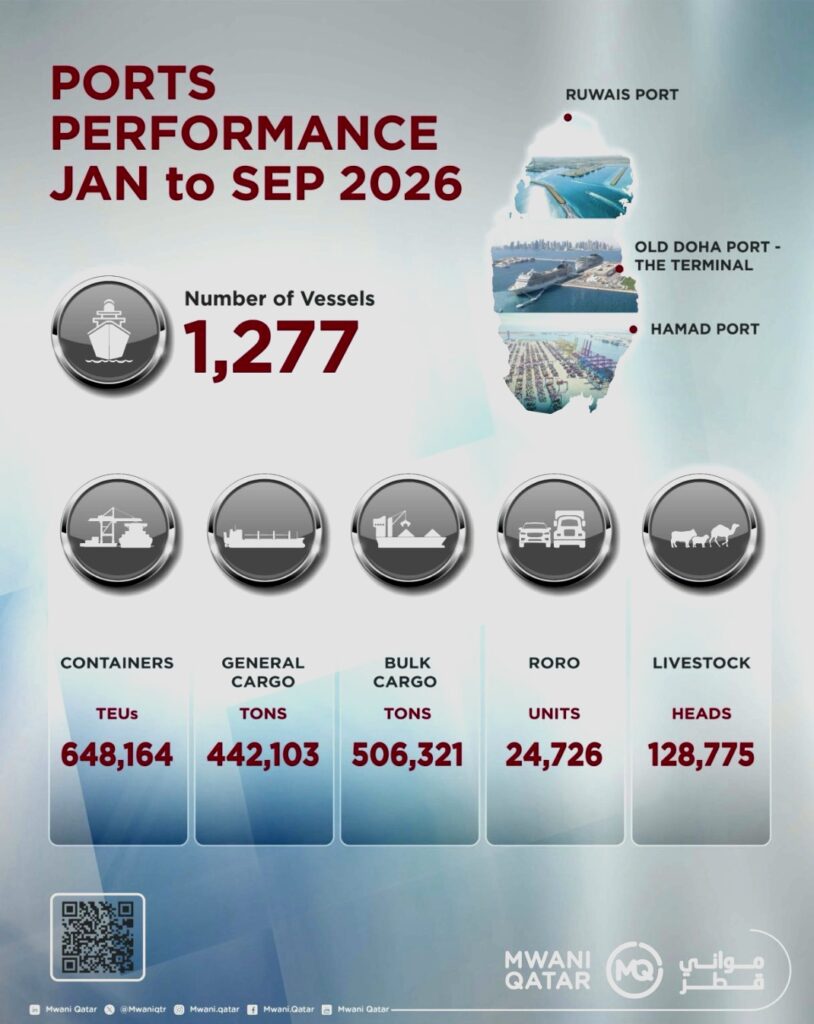
Shipping Arabia, October 11, 2026 – Qatar ports container throughput reached 648,164 TEUs during the first nine months of 2026, according to official performance figures released by Mwani Qatar. The country’s ports also received 1,277 vessels between January and September, while handling general cargo, bulk commodities, RORO shipments and livestock.
The figures cover port operations during the nine-month period ending September 30, 2026. Mwani Qatar’s performance report identifies Hamad Port, Ruwais Port and Old Doha Port – The Terminal.
Qatar Ports Container Throughput and Cargo Performance
Container traffic accounted for 648,164 TEUs during the reporting period, while general cargo volumes reached 442,103 tons.
Bulk cargo operations contributed another 506,321 tons, bringing the combined volume of general and bulk cargo handled during the nine months to 948,424 tons.
These figures reflect the range of cargo handled through Qatar’s ports, including containerized shipments and non-containerized general and bulk cargo.
The performance report provides aggregate figures for the reporting period rather than individual throughput statistics for each port.
RORO and Livestock Handling
Beyond container and conventional cargo operations, Qatar’s ports handled 24,726 RORO units between January and September 2026. The reported volumes covered vehicles and equipment moving through the country’s port facilities.
Livestock handling also formed part of the ports’ activities, with 128,775 head of livestock recorded during the nine-month period.
Together, the container, general cargo, bulk cargo, RORO and livestock figures provide an overview of the different maritime cargo segments covered by Mwani Qatar’s performance report.
Vessel Traffic Across Qatar’s Ports
Mwani Qatar reported a total of 1,277 vessel calls during the first nine months of 2026.
The official report features Hamad Port, Ruwais Port and Old Doha Port – The Terminal, reflecting the port facilities included in Mwani Qatar’s performance overview.
While the statistics provide cumulative cargo volumes and vessel traffic for January through September, they do not include a comparison with the corresponding period of 2025.
The latest figures establish the reported level of cargo handling and vessel activity across Qatar’s ports during the first three quarters of 2026.
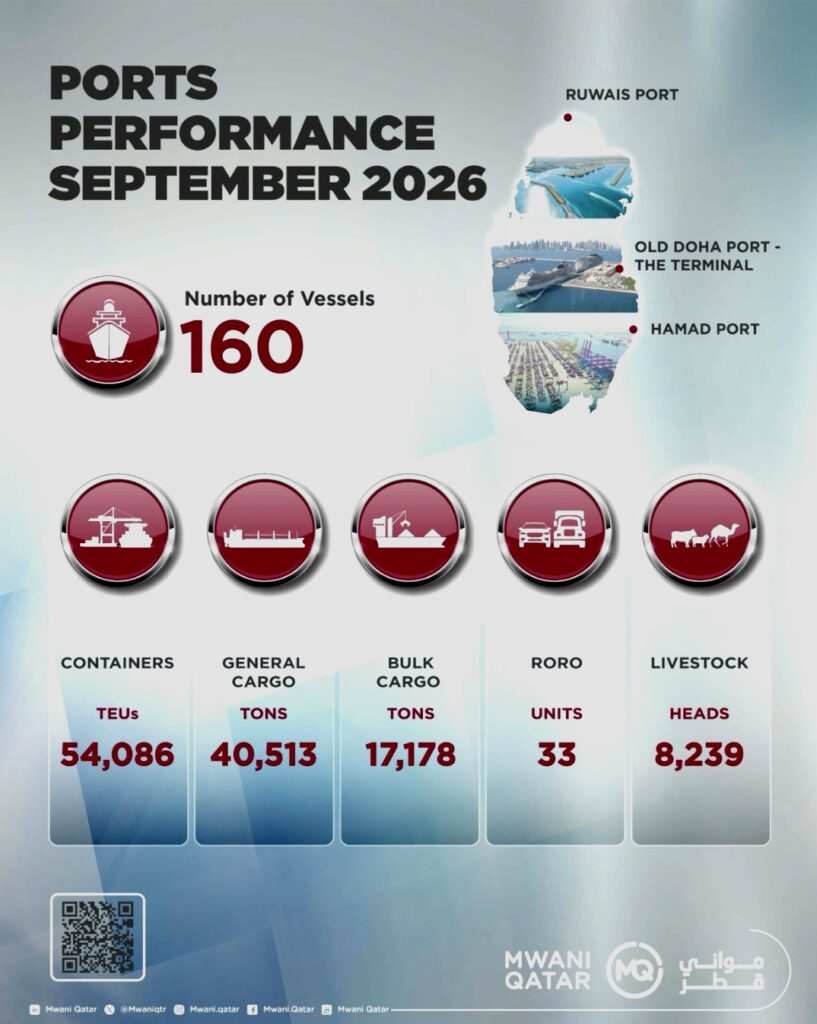
Shipping Arabia, October 9, 2026 – Qatar ports container throughput reached 54,086 TEUs in September 2026, marking a 10% increase compared with August, while vessel calls rose 20% to 160. The latest figures released by Mwani Qatar highlight stronger maritime activity across the country’s port network, alongside increased livestock handling and continued cargo operations.
The September performance report covers Hamad Port, Ruwais Port and Old Doha Port – The Terminal. Together, these facilities support Qatar’s maritime trade, domestic supply chains and passenger shipping activities.
The results reflect the importance of the country’s port infrastructure in facilitating international trade and maintaining maritime connectivity. They also provide an indication of monthly developments across different cargo segments.
Qatar Ports Container Throughput and Cargo Performance
According to Mwani Qatar, the country’s ports received 160 vessels during September, representing a 20% increase compared with the previous month. Container throughput also rose by 10%, reaching 54,086 twenty-foot equivalent units (TEUs).
The increase in vessel calls indicates higher ship traffic during the reporting period. Meanwhile, the growth in container volumes reflects stronger container handling activity compared with August.
Beyond containers, Qatar’s ports handled 40,513 tons of general cargo and 17,178 tons of bulk cargo during September. These figures demonstrate the range of non-containerized commodities moving through the country’s maritime facilities.
RoRo operations accounted for 33 units during the month. Although relatively limited in volume compared with other cargo categories, RoRo handling remains part of the services provided within Qatar’s diversified port system.
Livestock throughput reached 8,239 heads, an increase of 38% compared with August. This represented one of the strongest reported monthly growth rates among the performance indicators released by Mwani Qatar.
The data confirms month-on-month increases in vessel calls, container throughput and livestock handling. However, the report does not provide comparative growth rates for general cargo, bulk cargo or RoRo traffic.
Hamad Port, Ruwais Port and Old Doha Port Support Different Maritime Activities
Qatar’s maritime infrastructure comprises ports with complementary commercial and operational functions. Mwani Qatar manages Hamad Port and Ruwais Port while also supporting the development and operation of Old Doha Port’s maritime facilities.
Hamad Port serves as Qatar’s principal commercial maritime gateway and plays a central role in the country’s containerized trade. Its facilities support container handling, general cargo, bulk commodities, vehicles and other specialized shipments.
The port is an important component of Qatar’s international trade connectivity, providing infrastructure for imports, exports and regional transshipment activities. Its development also forms part of the country’s strategy to strengthen logistics capabilities and support economic diversification.
Ruwais Port, located in northern Qatar, serves as an additional gateway for regional maritime trade. The port handles general cargo, food products and other commodities, supporting commercial activity and supply chains in the northern part of the country.
Its role complements the larger commercial operations at Hamad Port by providing facilities for regional shipments and smaller maritime trade flows. The development of Ruwais Port has also supported Qatar’s efforts to diversify its maritime access points.
Old Doha Port – The Terminal has a different operational focus, supporting cruise shipping and maritime tourism. Its passenger facilities accommodate cruise vessels and provide services for international visitors arriving by sea.
The port contributes to Qatar’s tourism infrastructure and its presence in the Arabian Gulf cruise market. Its role in passenger shipping complements the cargo-oriented activities of Hamad Port and Ruwais Port.
Together, the three ports provide a diversified maritime network serving commercial cargo, regional trade and cruise tourism.
September Performance Highlights Qatar’s Maritime Trade Connectivity
The September 2026 results underline the importance of Qatar’s ports in supporting trade flows and the movement of essential goods.
The 10% monthly increase in container throughput is particularly relevant to the country’s commercial shipping sector. Containers represent a major component of international maritime trade, carrying goods across established liner shipping networks.
The 20% rise in vessel calls also points to increased shipping activity during September. However, the combined figures do not identify how the additional calls were distributed among individual ports or vessel categories.
General cargo and bulk cargo operations remain important components of Qatar’s maritime logistics system. These segments support the movement of commodities and materials that require specialized handling outside conventional container operations.
Meanwhile, the 38% rise in livestock handling highlights the role of port facilities in accommodating agricultural and food-related imports. Livestock transportation requires dedicated handling arrangements within maritime supply chains.
The combination of containers, general cargo, bulk cargo, RoRo units and livestock illustrates the variety of cargo segments served by Qatar’s commercial ports.
Supporting Qatar’s Long-Term Maritime and Logistics Ambitions
Qatar has continued developing its port infrastructure as part of its broader economic and logistics objectives. Hamad Port, in particular, represents a major investment in strengthening the country’s maritime connectivity and international trade capabilities.
The development of commercial ports also aligns with Qatar National Vision 2030, which emphasizes economic diversification and the expansion of infrastructure supporting sustainable development.
Within this framework, Hamad Port provides large-scale commercial cargo capacity, while Ruwais Port supports regional trade and northern Qatar’s commercial activities. Old Doha Port contributes through cruise tourism and maritime passenger services.
The September performance figures offer a monthly measure of activity across this network. They show increased vessel traffic, higher container throughput and growth in livestock handling compared with August.
While a single month’s results do not establish a longer-term trend, the reported increases demonstrate stronger activity in several key operational indicators. The figures also reinforce the relevance of Qatar’s diversified port infrastructure to its maritime transport and logistics sectors.
Shipping Arabia, October 2, 2026 – Damietta Port ship calls increased 18% year on year in August 2026, reaching 316 vessels compared with 267 in the same month of 2025. The increase came alongside a 6% rise in total cargo throughput to about 3.54 million tons, according to Damietta Port Authority data reviewed by Al Mal.
Container vessel calls rose 21% to 104 ships from 86 a year earlier. Dry bulk vessel calls increased 28% to 95 from 74, while general cargo vessel calls declined 17% to 35 from 42.
Liquid bulk vessel calls remained unchanged at 14 ships, while RoRo calls were also stable at four vessels. Meanwhile, the category covering regular and service vessels increased 36% to 64 ships from 47 in August 2025.
Damietta Port Ship Calls Accompany Higher Cargo Volumes
Total cargo handled at Damietta Port reached approximately 3.54 million tons during August, up from 3.34 million tons in the corresponding month last year. Performance varied significantly across individual cargo segments.
Traditional general cargo declined 44% to about 268,000 tons from 480,000 tons. In contrast, dry bulk cargo increased 11% to 1.62 million tons, compared with 1.46 million tons in August 2025.
Liquid bulk recorded the strongest growth among the major cargo categories, rising 113% to approximately 405,000 tons from 190,000 tons. RoRo cargo also increased sharply, reaching about 15,900 tons compared with 6,300 tons a year earlier, representing growth of 152%.
Containerized cargo by weight reached approximately 1.23 million tons, up 3% from 1.19 million tons in August 2025.
Although containerized cargo tonnage increased, the number of containers handled by Damietta Port fell 13% year on year. The port handled about 130,000 containers during August, compared with approximately 148,600 in the same month of 2025.
Import containers declined 26% to about 50,000 from 67,600. Export container volumes moved in the opposite direction, increasing 2% to approximately 74,800 from 73,200 containers.
Other additional container movements totaled about 5,000 containers, compared with 8,700 in August 2025, a decline of 35%.
Regional Shipping Developments Support Vessel Traffic
A Damietta Port Authority official attributed the strong increase in vessel calls to developments around Bab el-Mandeb and the Strait of Hormuz. According to the source, those developments prompted a significant number of vessels carrying cargo from the Arabian Gulf region to pass through Damietta on voyages to and from Europe.
The official said August recorded the port’s highest increase in vessel calls, at 18%, adding that changes affecting international shipping routes had influenced vessel traffic patterns at transshipment ports.
The source also said Hapag-Lloyd and Maersk had recently increased the frequency of their calls at Damietta Port as relative calm returned to the Bab el-Mandeb area.
According to the official, the additional calls contributed to Damietta Port’s inclusion in services operated by the two shipping lines and strengthened maritime connectivity between Asia and Europe through the Suez Canal. The source said this development supports Damietta Port’s position within international trade routes.