Cape of Good Hope

  • Gemini’s Return to the Suez Canal Tests Global Shipping Network Resilience

    Shipping Arabia, November 11, 2026 – Gemini’s return to the Suez Canal is testing the ability of Maersk and Hapag-Lloyd to improve network efficiency while maintaining operational resilience. As the partners gradually restore services through the Red Sea, shorter voyages are creating new opportunities for fleet deployment, port connectivity and schedule optimization.

    On November 2, the two carriers announced plans to reroute their India-Europe service (IOS/ME1) through the Red Sea. The decision adds another connection to the growing number of Gemini services using the Suez Canal instead of the longer route around the Cape of Good Hope.

    However, the operational benefits extend beyond reducing sailing distances. The partners are also adjusting service rotations and connections through key transshipment hubs. These changes will test whether Gemini can achieve greater efficiency without creating new vulnerabilities should regional security conditions deteriorate.

    Shorter Voyages Create New Fleet Deployment Opportunities

    One of the most immediate potential benefits of returning to the Suez Canal is the reduction in sailing distances. For weekly container services, shorter round-trip voyages could also reduce the number of vessels required to maintain regular departures.

    For example, a weekly service with a 70-day round-trip duration would theoretically require 10 vessels. Reducing that duration to 63 days could allow the carriers to maintain the same weekly frequency with nine vessels.

    This example illustrates the potential operational advantages of shorter routes. However, it does not represent a specific forecast for IOS/ME1. Maersk and Hapag-Lloyd have not disclosed the revised round-trip duration, the number of vessels currently allocated to the service or any plans to reduce its fleet requirements.

    The carriers therefore have several options for utilizing any capacity released by shorter voyages. They could redeploy vessels to other trade lanes or retain additional capacity to support schedule recovery. Alternatively, they could adjust sailing speeds and port turnaround times.

    Each option carries different commercial and operational implications. Consequently, Gemini’s return to the Suez Canal could provide additional flexibility without necessarily resulting in an immediate reduction in vessel deployment.

    Salalah and Tanger Med Retain Key Roles in Gemini’s Network

    The rerouting of IOS/ME1 forms part of a broader restructuring of Gemini’s service network.

    On October 19, Maersk announced additional network enhancements, including the introduction of the AE18 service and adjustments to AE2, AE11 and AE19. These changes involve more than route optimization, as they also redistribute port calls and transshipment functions across the network.

    Under the revised arrangements, AE2 will replace its westbound call at Tanger Med with Rotterdam. Meanwhile, AE11 will add a westbound call at Salalah and replace Tanger Med with Port Said. The new AE18 service will cover certain calls at Tanger Med and Algeciras previously served by other services.

    These adjustments are particularly relevant to IOS/ME1, which retains Salalah and Tanger Med in its updated rotation. Both ports will therefore continue to play important roles in connecting India and Europe, even as Gemini reorganizes its wider network.

    Salalah gains an additional role through AE11 while maintaining its existing IOS/ME1 connection. Conversely, Tanger Med will lose calls from AE2 and AE11 but remain part of the network through IOS/ME1 and AE18.

    The changes reflect a redistribution of network functions rather than a comprehensive shift toward or away from individual ports. Changes in vessel calls alone cannot determine future cargo volumes, transshipment activity or market shares.

    Instead, the operational significance lies in how the revised network connects mainline services with transshipment hubs. The challenge will be to improve connectivity without making cargo movements increasingly dependent on specific connection windows.

    Feeder Connectivity Will Determine Commercial Benefits

    Gemini’s hub-based operating model relies heavily on coordination between mainline vessels and feeder services. While the Suez Canal can reduce time at sea, the resulting benefits depend on what happens once containers reach transshipment ports.

    A vessel may arrive earlier at a hub without delivering a meaningful improvement in cargo transit times if the onward feeder departure remains unchanged. Similarly, a missed connection or delay at the transshipment port could offset the time saved during the mainline voyage.

    Conversely, even a modest reduction in sailing time could generate significant commercial benefits if containers connect with an earlier onward service.

    This distinction highlights the importance of assessing end-to-end cargo transit times rather than focusing exclusively on vessel sailing times. For customers, the value of a shorter route ultimately depends on whether their shipments reach their destinations faster and more reliably.

    The network adjustments announced in October indicate that Maersk and Hapag-Lloyd are reorganizing these connections alongside their routing decisions. However, sufficient data is not yet available to quantify the resulting improvements.

    A comprehensive assessment would require updated origin-to-destination schedules, connection times between services and actual operational performance following implementation.

    Red Sea Security Remains Central to Contingency Planning

    Security conditions remain a critical factor in Gemini’s return to the Suez Canal. Maersk and Hapag-Lloyd have indicated that further routing decisions will depend on developments in the Red Sea.

    The carriers’ latest statements regarding ME1 emphasize that the safety of vessels, crews and cargo will remain the primary consideration in future operational adjustments.

    This creates a practical challenge for network planning. A service designed around Suez Canal transits has different voyage durations and scheduling requirements from one operating around the Cape of Good Hope.

    Should security conditions require another diversion, the carriers may need to accommodate longer voyages, revise departure schedules or deploy additional vessels to maintain service frequency.

    Retaining reserve vessel capacity could make it easier to switch between the two routes. However, maintaining that flexibility could also limit the immediate efficiency gains associated with shorter voyages.

    Alternatively, redeploying surplus vessels could improve fleet utilization while reducing the capacity available to respond to future disruptions.

    The cost of maintaining alternative routing options, together with continuing security risks, therefore remains an important uncertainty during the transition.

    Measuring the Success of Gemini’s Return to the Suez Canal

    The success of Gemini’s evolving strategy will depend on actual operational performance rather than simply the number of announced Suez Canal transits.

    A key indicator will be the realized transit times and schedule reliability of IOS/ME1 following its rerouting through the Red Sea. The quality of connections through Salalah and Tanger Med will provide another measure as the wider network adjustments take effect.

    Changes in vessel deployment and service frequencies could also reveal how the partners are utilizing the operational flexibility created by shorter routes.

    Meanwhile, developments in port capacity could provide additional context. However, these should be assessed alongside changes affecting other carriers and trade lanes rather than attributed exclusively to Gemini.

    The latest rerouting decision signals continued progress toward a network with a greater reliance on the Suez Canal. Nevertheless, it does not demonstrate that the transition is complete or that Maersk and Hapag-Lloyd have already achieved measurable capacity savings.

    For the two partners, the central operational test remains whether shorter routes, revised transshipment arrangements and effective contingency planning can coexist without compromising the schedule reliability that Gemini was designed to deliver.

    Source: Al Mal
  • Maersk and Hapag-Lloyd Reroute Gemini Indian Ocean Service Through Red Sea and Suez Canal

    Shipping Arabia, November 9, 2026 – Maersk and Hapag-Lloyd have announced plans to reroute their Gemini Indian Ocean Service (IOS) through the Red Sea and Suez Canal, replacing the longer route around the Cape of Good Hope. The decision follows an assessment of regional security conditions and represents another adjustment to the carriers’ Gemini Cooperation network.

    The revised routing will apply to selected sailings during November 2026, subject to operational conditions. According to Hapag-Lloyd, the change aims to provide faster and more efficient maritime connections between Europe and the Middle East.

    The announcement reflects the carriers’ continued evaluation of shipping routes amid evolving regional security developments. However, the adjustment applies specifically to the Gemini Indian Ocean Service and does not represent a complete return of the Gemini Cooperation network to the Red Sea.

    Gemini Indian Ocean Service to Resume Suez Canal Routing

    Under the revised arrangement, the Gemini Indian Ocean Service will transit the Red Sea and Suez Canal instead of following the longer diversion around southern Africa.

    The decision follows a review of the prevailing security situation in the region. Maersk and Hapag-Lloyd identified the Red Sea corridor as a more efficient routing option for cargo transportation between Europe and the Middle East.

    By replacing the Cape of Good Hope diversion, the carriers aim to provide shorter transportation options and improve the efficiency of their container shipping connections.

    The revised routing forms part of the ongoing assessment of operational arrangements within the Gemini Cooperation network. Both carriers continue to evaluate route options in response to regional developments.

    Atlanta Express and Savannah Express Assigned to Initial Sailings

    The first westbound sailing under the revised Gemini Indian Ocean Service routing was scheduled for November 4, 2026.

    The vessel Atlanta Express, operating voyage 644W, was expected to depart Salalah, Oman, on that date as part of the service’s return to the Red Sea corridor.

    Meanwhile, the first eastbound sailing will be operated by Savannah Express, voyage 644E. The vessel is scheduled to depart Tangier, Morocco, on November 12, 2026.

    Both departure dates are provisional and remain subject to operational conditions. The carriers may adjust their schedules depending on developments affecting vessel operations.

    These initial sailings establish the planned implementation of the revised routing in both directions, connecting the service’s existing operations with the Red Sea and Suez Canal corridor.

    Security Conditions Remain Central to Further Routing Decisions

    Despite the announced adjustment, Maersk and Hapag-Lloyd have not indicated that their entire Gemini Cooperation network will resume transits through the Red Sea and Suez Canal.

    The decision concerns the Indian Ocean Service specifically, while other network routing arrangements remain subject to separate operational assessments.

    Hapag-Lloyd emphasized that crew safety, vessel security and the protection of customers’ cargo remain its highest priorities.

    The carrier confirmed that it would continue monitoring developments in the region and communicate any further relevant operational changes to affected customers.

    The decision to reroute the Gemini Indian Ocean Service illustrates the carriers’ approach to balancing shipping efficiency with maritime security considerations.

    While the Red Sea and Suez Canal offer a shorter connection than the Cape of Good Hope route, implementation of the revised service will remain dependent on operational conditions and continued security assessments.

    Source: Al Mal

  • Yang Ming to Resume Red Sea and Suez Canal Routes for MD1 and MS2 Services

    Shipping Arabia, November 6, 2026 – Taiwan’s Yang Ming Marine Transport has announced plans to resume its MD1 and MS2 container shipping services between Asia and the Mediterranean via the Red Sea and Suez Canal. The carrier aims to improve transit time competitiveness and supply chain efficiency by restoring the services to their traditional shipping routes.

    The revised schedules will bring both services back through the Suez Canal, with initial departures from China planned for November 2026. The announcement marks another development in the gradual restoration of container shipping services along the Red Sea and Suez Canal corridor.

    Yang Ming Confirms MD1 and MS2 Sailing Schedules

    Under the revised schedule, the MD1 service is expected to resume its traditional route with a departure from Ningbo, China, on November 10, 2026. The service is scheduled to reach Egypt’s Damietta Port on December 7.

    Meanwhile, the MS2 service is scheduled to depart Qingdao, China, on November 16, with an expected arrival at Greece’s Port of Piraeus on December 28. The service will also operate through the Suez Canal as part of the revised routing arrangements.

    Both services will restore the Red Sea and Suez Canal corridor as a connection between Asian and Mediterranean ports. Yang Ming expects the changes to strengthen transit time competitiveness and improve the efficiency of its shipping network.

    However, the Taiwanese carrier emphasized that actual sailing schedules and transit times remain subject to operational conditions. Further adjustments may follow as shipping schedules and operating circumstances evolve.

    Container Shipping Capacity Returns to the Suez Canal

    Yang Ming’s announcement comes amid a broader shift in container shipping routes between the Far East and Europe.

    According to maritime consultancy data cited by Al Mal, approximately 63% of the capacity deployed by the world’s 10 largest container shipping lines on Far East–Europe services had returned to routes incorporating the Red Sea and Suez Canal by mid-October 2026.

    The figures reflect the gradual restoration of container shipping capacity to the traditional Suez Canal corridor as carriers revise their routing arrangements.

    Industry reports cited in the article indicate that this transition could have significant implications for global shipping operations. In particular, the return to Suez Canal transits offers the potential to shorten sailing distances and transit times compared with the longer route around the Cape of Good Hope.

    For Yang Ming, restoring the MD1 and MS2 services through the Red Sea and Suez Canal forms part of this wider shift toward traditional Asia–Mediterranean shipping routes. Nevertheless, the actual benefits and sailing schedules will depend on operating conditions as the revised services take effect.

    Source: Al Mal News

  • Suez Canal Traffic Recovery Accelerates as Weekly Tonnage Rises 35%

    Shipping Arabia, November 2, 2026 – The Suez Canal traffic recovery has gained momentum, with 305 cargo vessels transiting the waterway during October 19–25, 2026, carrying a combined tonnage of 27.6 million tons. According to Lloyd’s List Intelligence, the latest figures represent a 35% increase over the average weekly tonnage recorded in October 2025.

    The data, released on October 29, indicates a significant improvement in shipping activity through the Egyptian waterway. However, despite the recovery, transit tonnage remained 36% below levels recorded before the Houthi-related Red Sea shipping crisis.

    The figures highlight the progress made in restoring vessel traffic through the Suez Canal while demonstrating that shipping activity has yet to return to pre-crisis levels.

    Ultra-Large Container Ships Lead Suez Canal Traffic Recovery

    One of the most notable developments has been the increase in transits by ultra-large and megamax container ships.

    According to Lloyd’s List Intelligence, more than 100 vessels in these categories have passed through the Suez Canal since the beginning of September 2026.

    This figure has already exceeded the combined 99 transits recorded by ultra-large and megamax container ships throughout 2025 and the first eight months of 2026.

    The increase represents a significant change in the movement of large container vessels through the Canal compared with the preceding 20-month period.

    The latest statistics also suggest that the Suez Canal traffic recovery is becoming more evident in the large container ship segment, although overall transit tonnage remains below pre-crisis levels.

    Europe-to-Asia Shipping Routes Support Recovery

    Lloyd’s List Intelligence reported that much of the shipping traffic currently transiting the Suez Canal consists of vessels traveling from Europe toward Asian ports.

    These vessels pass through the Mediterranean, Suez Canal and Red Sea before continuing toward their Asian destinations.

    This routing offers an alternative to services sailing from Europe around the Cape of Good Hope, across the Indian Ocean and onward to Asian ports.

    For container shipping operators, using the Suez Canal can provide operational advantages when passage through the Red Sea is considered safe.

    A safe return to the Suez route can reduce sailing distances, fuel consumption and voyage durations compared with the longer journey around southern Africa.

    However, Lloyd’s List Intelligence noted that individual shipping companies continue to determine their routing decisions according to their specific services and operational requirements.

    Suez Canal Tonnage Remains Below Pre-Crisis Levels

    Despite the improvement in weekly traffic and the increase in large container ship transits, the latest figures indicate that the Suez Canal has not yet fully recovered from the disruption associated with the Red Sea crisis.

    The 35% increase in weekly tonnage compared with October 2025 demonstrates the scale of the recent improvement. Nevertheless, the remaining 36% shortfall against pre-crisis levels underscores the difference between the current recovery and a complete return to previous traffic volumes.

    Future routing decisions by container shipping companies will remain an important factor in determining how much traffic continues to move through the Suez Canal rather than around the Cape of Good Hope.

    Source: Al Mal News

  • WEC Lines Launches Asia–Europe Shipping Service via Suez Canal

    Shipping Arabia, October 28, 2026 – Dutch shipping company WEC Lines has launched a new Asia–Europe shipping service connecting Pakistan, India and Sri Lanka with major ports in Northwest Europe via the Suez Canal. The service creates additional cargo transportation opportunities between South Asia and European markets as some container shipping lines gradually return to the canal following prolonged diversions around the Cape of Good Hope.

    According to a company announcement reported by Al Mal News, the new service provides connections between Karachi, Pakistan, and several major European ports. It also incorporates ports in India and Sri Lanka, expanding the shipping options available to customers trading between the two regions.

    The development comes amid signs of increasing Asia–Europe container vessel movements through the Suez Canal, despite continuing security concerns in the Middle East and Red Sea.

    WEC Lines Expands Asia–Europe Shipping Connections

    The new WEC Lines Asia–Europe service connects three major South Asian ports with seven ports across Northwest Europe.

    The South Asian ports included in the service are Mundra in India, Karachi in Pakistan and Colombo in Sri Lanka.

    In Europe, the service covers Felixstowe and London Gateway in the United Kingdom, Rotterdam in the Netherlands, Hamburg and Bremerhaven in Germany, Antwerp in Belgium, and Le Havre in France.

    According to WEC Lines, the service aims to create new shipping opportunities between Pakistan and major Northwest European ports.

    By incorporating several South Asian and European gateways, the service provides additional maritime connections across a trade corridor traditionally served by container shipping networks operating through the Suez Canal.

    The announcement comes as the Suez Canal Authority reports an increase in vessels operated by shipping lines serving Asia–Europe routes. This development has continued despite the regional security challenges affecting maritime transportation.

    Suez Canal Sees Gradual Return of Container Shipping Services

    Maritime research and consultancy firm Drewry recently reported that the Suez Canal has begun gradually regaining its position in global container shipping networks.

    According to Drewry, some container services are increasingly returning to the canal rather than continuing their extended voyages around the Cape of Good Hope.

    However, the consultancy cautioned that the return does not indicate that security risks in the Red Sea have disappeared. It also noted that the economic advantages of using the canal are more complex than the potential fuel and voyage distance savings might initially suggest.

    Drewry identified shorter transit times, improved vessel utilization and the need to maintain competitive shipping services as important factors influencing carriers’ routing decisions.

    These operational considerations are particularly relevant to container shipping networks, where vessel deployment and voyage duration influence the efficiency of shipping services.

    Nevertheless, Drewry emphasized that the financial attractiveness of returning to the Suez Canal remains highly sensitive to war-risk insurance premiums and canal transit fees.

    Consequently, the decision to resume canal transits involves balancing operational advantages against the additional costs and security risks associated with navigating the Red Sea.

    Drewry Estimates $1 Million in Round-Voyage Savings

    Drewry’s analysis provides an indication of the potential economic benefits of using the Suez Canal rather than the Cape of Good Hope.

    The consultancy estimates that a container vessel with a nominal capacity of 24,000 twenty-foot equivalent units (TEUs) could save approximately $1 million per round voyage by using the Suez Canal instead of sailing around southern Africa.

    This is equivalent to approximately $43 per TEU of the vessel’s nominal capacity.

    However, Drewry clarified that the figure represents a distribution of the estimated savings across the ship’s total capacity slots. It should not be interpreted as a guaranteed saving for every container actually transported.

    The consultancy’s September 2026 comparison of Asia–North Europe shipping services also highlighted the significant difference in voyage distances between the two routes.

    A round voyage via the Cape of Good Hope covers approximately 29,711 nautical miles, compared with 21,878 nautical miles through the Suez Canal.

    This represents a reduction of 7,833 nautical miles per round voyage when using the canal.

    The shorter distance can provide operational advantages, particularly through reduced voyage duration and improved vessel utilization. However, Drewry stressed that the overall financial benefits remain dependent on prevailing insurance costs and Suez Canal transit charges.

    Red Sea Security Remains a Key Consideration

    Although some container shipping services are returning to the Suez Canal, Drewry emphasized that the recovery remains gradual and does not eliminate the security risks affecting maritime navigation in the Red Sea.

    Shipping lines must continue evaluating the relationship between shorter voyages, operational efficiency, insurance expenses and transit costs when determining their preferred routes.

    The launch of the WEC Lines service adds another Asia–Europe shipping connection operating through the Suez Canal during this period of changing maritime routing decisions.

    Meanwhile, the increase in Asia–Europe vessel movements reported by the Suez Canal Authority provides further evidence of a gradual recovery in canal activity, even as regional security concerns continue to influence shipping operations.

    Source: Al Mal News

  • Maersk Suez Canal Services Expected to Fully Return by March 2027

    Shipping Arabia, October 24, 2026 – A.P. Moller-Maersk is working to accelerate the return of its shipping services to the Suez Canal, with the Group anticipating that all its services could resume transiting the waterway by March 2027. The development follows discussions with the Suez Canal Authority (SCA) on the gradual restoration of Maersk’s shipping network through the Egyptian waterway.

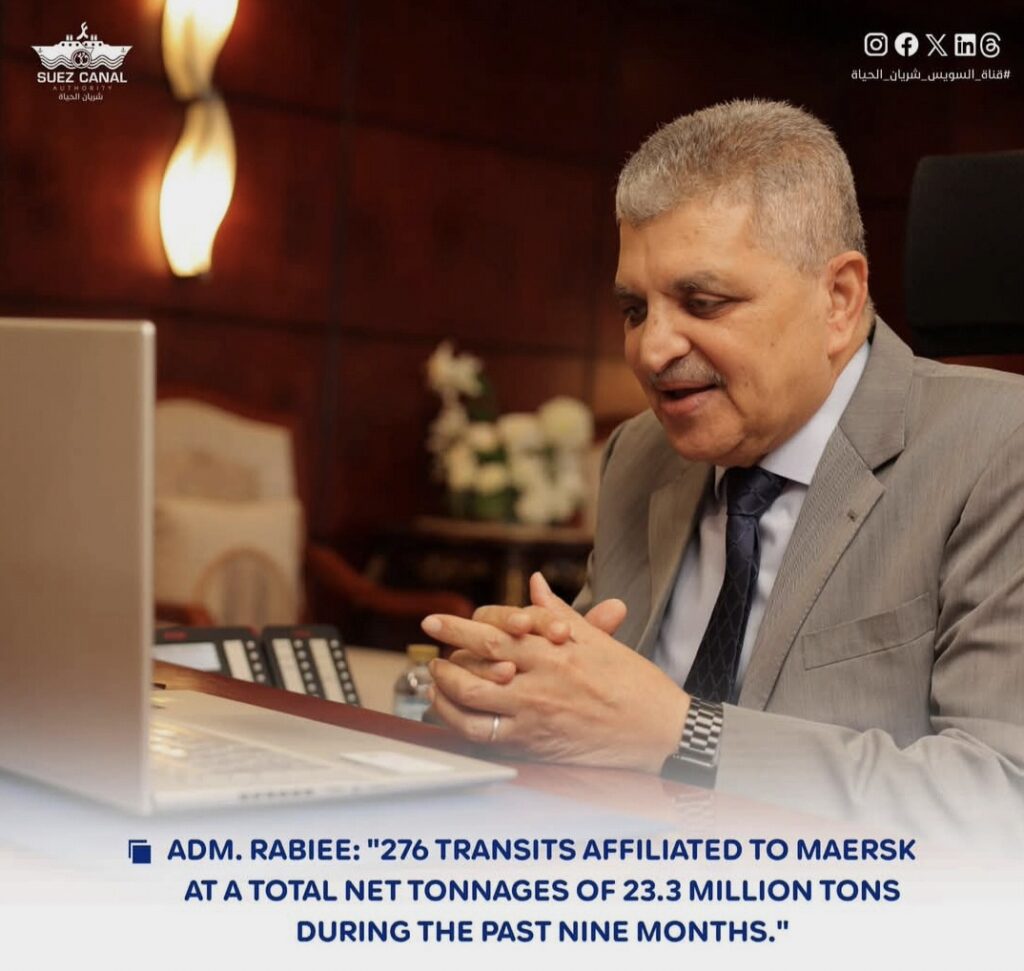
    The discussions took place on October 20 during a video conference between SCA Chairman and Managing Director Adm. Ossama Rabiee and senior Maersk executives. Participants included Rabab Boulos, Chief Operating Officer and Executive Board member of A.P. Moller-Maersk; Ahmed Hassan, Vice President of Operations; and Hani El-Nady, the Group’s representative in the Middle East and North Africa.

    The meeting focused on strengthening cooperation between the two organizations and reviewing Maersk’s navigation plans and sailing schedules through the Suez Canal during the coming months.

    Maersk Suez Canal Transits Rise Sharply in 2026

    According to figures presented by the Suez Canal Authority, Maersk-affiliated vessels completed 276 transits through the waterway between January and September 2026, generating a combined net tonnage of 23.3 million tons.

    During the corresponding period in 2025, the Canal recorded 146 Maersk-affiliated transits, representing a total net tonnage of 7 million tons.

    These figures indicate an approximately 89% year-on-year increase in vessel transits. Meanwhile, the combined net tonnage more than tripled, reflecting a substantial increase in Maersk-affiliated shipping activity through the Canal.

    Rabiee highlighted the increase as evidence of the ongoing return of Maersk’s shipping services. He also emphasized the longstanding strategic partnership between the Suez Canal Authority and the shipping group.

    The figures reflect the progress achieved during the first nine months of 2026, while discussions continue over the return of additional Maersk services in the coming period.

    Maersk Anticipates Full Service Restoration by March 2027

    During the meeting, Boulos praised the longstanding relationship between Maersk and the Suez Canal Authority. She highlighted the return of several shipping services affiliated with the Group to the Suez Canal route.

    Boulos expressed her expectation that all Maersk shipping services could return to the Suez Canal by March 2027. She also reaffirmed that the waterway remains the Group’s preferred navigation route, emphasizing the strategic relationship between both organizations.

    Meanwhile, Hassan confirmed that Maersk continues to update its navigation schedules. These adjustments are intended to accommodate the return of additional shipping services through the Canal in the coming period.

    El-Nady also stressed that Maersk is working to accelerate the restoration of its shipping services to the Suez Canal route.

    The statements underline the Group’s intention to increase its use of the waterway while continuing to review its operational schedules.

    Suez Canal Highlights Economic and Navigational Advantages

    Rabiee also addressed the impact of current geopolitical developments on international shipping, particularly their influence on fuel prices and freight rates.

    He emphasized that these developments reinforce the strategic importance of the Suez Canal for global maritime transportation.

    According to Rabiee, the Canal offers significant savings for large container vessels compared with navigating around the Cape of Good Hope. He also highlighted the navigational safety advantages associated with using the Suez Canal route.

    The SCA chairman presented these factors as important considerations for shipping lines reviewing their route choices amid changing geopolitical and commercial conditions.

    The discussions also reflected the strategic importance both organizations attach to their longstanding cooperation, particularly as Maersk continues adjusting its service network.

    SCA and Maersk Agree to Continue Discussions

    At the conclusion of the meeting, the Suez Canal Authority and Maersk agreed to hold further bilateral discussions to strengthen cooperation.

    The continued dialogue will focus on supporting the return of additional Maersk shipping services and coordinating future navigation arrangements through the Canal.

    With Maersk-affiliated transits already showing substantial year-on-year growth, the Group’s anticipated return of all services by March 2027 represents the next objective in its ongoing discussions with the Suez Canal Authority.

    Source: Suez Canal Authority

  • Suez Canal Container Shipping Capacity Exceeds 50% of Pre-Crisis Levels for First Time

    Shipping Arabia, October 17, 2026 – Suez Canal container shipping capacity has exceeded half of its pre-Red Sea crisis levels for the first time, reaching its highest level since maritime disruptions began. The recovery follows a series of routing decisions by major container shipping lines, which have accelerated their return to the canal after nearly three years of widespread diversions around the Cape of Good Hope.

    According to BIMCO, citing data from Clarksons Research, average weekly container vessel capacity transiting the Suez Canal reached 753,000 TEUs during the first two weeks of October 2026. This compares with 1.46 million TEUs during the corresponding period in 2023, before the Red Sea disruptions significantly affected international shipping routes.

    The latest figures indicate a substantial recovery in container shipping activity through the waterway, although transit capacity remains below its pre-crisis level.

    Suez Canal Container Shipping Share Rises to 36%

    BIMCO reported that 36% of container shipping capacity routed through either the Suez Canal or the Cape of Good Hope used the canal during the first two weeks of October.

    This represents a considerable improvement from the average of just 8% recorded between 2024 and mid-2026. However, the figure remains significantly below the approximately 80% share recorded before the Red Sea attacks disrupted shipping operations.

    The increase reflects a gradual shift back toward the Suez Canal as container shipping lines revise their service networks. Nevertheless, the figures show that a substantial proportion of capacity continues to operate via the Cape of Good Hope.

    Major Shipping Lines Accelerate Return to Suez Canal

    The recovery in Suez Canal container shipping began accelerating in July 2026, when Maersk and Hapag-Lloyd announced that their AE15/SE3 Asia–Mediterranean service would return to the canal.

    Additional adjustments subsequently followed within the Gemini Cooperation network. Meanwhile, members of the Ocean Alliance and Premier Alliance, together with Mediterranean Shipping Company (MSC), announced revised vessel routings.

    According to BIMCO, container shipping lines have announced routing changes affecting a total of 16 services since the beginning of July 2026.

    These developments have contributed to the recovery in container vessel capacity transiting the Suez Canal, bringing more services back to the waterway after an extended period of diversions.

    The recovery has also become more balanced between northbound and southbound sailings.

    During the third quarter of 2026, northbound container shipping capacity represented approximately 75% of southbound capacity. That proportion increased to 81% during the first two weeks of October, indicating a narrowing difference between the two sailing directions.

    Return to Shorter Routes Could Affect Global Container Capacity

    Beyond the increase in canal transits, the return of container shipping services to shorter routes could have significant implications for global vessel capacity and the balance between shipping supply and demand.

    BIMCO estimates that widespread diversions around the Cape of Good Hope increased global demand for container shipping capacity by approximately 10%.

    The longer routes required additional vessel capacity to maintain shipping operations. However, as more services return to the Suez Canal, the additional capacity demand associated with those diversions is declining.

    Niels Rasmussen, Chief Shipping Analyst at BIMCO, highlighted the scale of this change, explaining that the approximately 10% increase in global container shipping capacity demand caused by Suez Canal diversions is now reversing rapidly.

    This development could influence the availability of container vessels as shipping lines progressively restore services through the canal.

    However, BIMCO cautioned that congestion at Asian ports could delay the full impact of shorter shipping routes on vessel availability and the overall balance between global container shipping supply and demand.

    Suez Canal Recovery Remains Incomplete

    Despite the improvement recorded during the first half of October, container shipping activity through the Suez Canal has not returned to its pre-disruption levels.

    The increase to 753,000 TEUs in average weekly transit capacity, together with the recovery in the canal’s share of container shipping routes, demonstrates the progress made since shipping lines began adjusting their networks in July.

    Nevertheless, the comparison with 2023 highlights the remaining gap between current traffic and the levels recorded before the Red Sea crisis.

    The latest BIMCO figures therefore point to a continuing recovery in Suez Canal container shipping, while confirming that the industry’s return to its traditional routing patterns remains incomplete.

    Source: Al Mal

  • Global Shipping Adapts to Middle East Disruptions as Suez Return Remains Gradual

    Shipping Arabia, October 1, 2026 – Global container shipping has adapted to prolonged disruptions across the Middle East, maintaining cargo flows through alternative routes and operational adjustments, but the industry’s return to normal conditions is expected to be considerably more gradual.

    Shipping companies have spent months adjusting their networks in response to disruptions affecting the Red Sea and the Strait of Hormuz. While those measures have allowed global trade to continue, they have come at the expense of higher operating costs, longer voyages and reduced network efficiency.

    Several Maersk services have now returned to the Red Sea and Suez Canal route after earlier diversions prompted by regional security concerns, providing one of the clearest indications that carriers are gradually restoring some of their traditional routing.

    Maersk’s global head of chemicals, Patrick Hore, said the container shipping system had adapted to disruption in the Middle East, although vessel availability and irregular trade flows continued to present significant challenges. The carrier has been increasing the number of services operating through the Red Sea and Suez Canal, including six major Asia-Europe services as well as services connecting the Middle East with Europe and North America.

    For the wider industry, however, adaptation should not be confused with a complete return to normal operating conditions.

    AbdulRahman Taleb Ali, a maritime specialist and researcher, board member of the Jordan Shipping Association and founder of Shipping Arabia, a leading maritime news platform covering the Middle East and North Africa, told CNN Business Arabic that the global maritime shipping system had successfully adjusted to disruptions in both the Red Sea and Strait of Hormuz, but that this adjustment had come at a cost to efficiency and operating expenses.

    Shipping companies have maintained the movement of cargo by introducing alternative routes, particularly around the Cape of Good Hope, but longer voyages have increased fuel consumption, security-related expenses and other operating costs.

    The gradual return to the Suez Canal represents another part of that adaptation process rather than an immediate restoration of pre-disruption shipping patterns.

    Ali said carriers continue to assess security risks, market demand and costs as they determine when and how to restore services through the canal. Suez nevertheless remains the shortest and most efficient maritime connection between Asia and Europe.

    A broader return to the Suez route could reduce both transit times and transportation costs for cargo moving from China and other Asian markets into Europe, while helping shipping networks regain some of the efficiency lost during prolonged diversions around southern Africa.

    The transition is taking place against a backdrop of continued pressure on global container shipping capacity.

    DHL Global Forwarding data cited by CNN Business Arabic showed that global freight rates continued to rise during September, with particularly strong upward pressure on eastbound trans-Pacific services.

    Carriers are also gradually increasing their use of the Suez Canal. Around 18% of relevant Asia-Europe services are now planned to operate through the route, according to the report.

    Capacity constraints, meanwhile, are not necessarily being driven by stronger cargo demand alone. ICIS reported that Maersk was operating at around 96% of capacity, with slower vessel movements through ports and inland distribution networks absorbing available ships and equipment.

    Equipment availability has also evolved as shipping networks adjust.

    Ali said shortages of empty containers were no longer the industry’s primary challenge, with the gradual return of services through the Suez Canal helping improve equipment availability. However, the continued use of the Cape of Good Hope by some carriers is contributing to imbalances in the distribution of empty containers between export ports.

    Longer voyages around the Cape also require additional vessel capacity to maintain scheduled services. The consequences extend beyond the additional distance, with carriers facing higher fuel consumption, insurance premiums and war-risk costs, as well as increased seafarer wages and risk allowances.

    These pressures are being compounded by strong demand for shipping capacity and limited routing alternatives in parts of the global network.

    A larger shift back toward the Red Sea and Suez Canal could ultimately ease some of these pressures by shortening voyages and releasing vessel capacity. In the short term, however, the transition itself could create a new operational challenge for European ports.

    Ships travelling through the Suez Canal reach Europe considerably faster than vessels continuing around the Cape of Good Hope. As carriers gradually restore Suez routings, faster vessels using the canal could therefore arrive at European ports at approximately the same time as slower ships that departed earlier via southern Africa.

    This convergence could temporarily increase congestion at some European terminals.

    DHL data showed that global port congestion was approaching capacity equivalent to 4 million containers, highlighting the pressure already affecting parts of the international logistics network.

    Ali said any congestion resulting from the overlapping arrival patterns should be viewed as a transitional challenge rather than a permanent condition. As shipping lines progressively restore traditional routes, ports and shipping networks will need time to realign vessel schedules, equipment flows and capacity.

    The developments illustrate how the global shipping industry has demonstrated its ability to adapt to prolonged geopolitical disruption, but also how difficult it is to reverse those adjustments once networks have been reorganized around alternative routes.

    The return to Suez is therefore likely to remain progressive. Even as more services resume passage through the Red Sea, carriers will continue balancing security, cost and operational considerations while global shipping networks work through the consequences of months of altered vessel schedules and longer voyages.

    Source: CNN Business Arabic

  • MSC Expands Suez Return With Indusa Service Resumption

    Shipping Arabia, September 23, 2026 – Mediterranean Shipping Company (MSC) is expanding its gradual return to the Suez Canal and Red Sea, with the carrier restoring westbound sailings on its Indusa service as part of a broader, service-by-service resumption of East-West traffic through the region.

    The Indusa service, linking the Indian subcontinent with the United States and Mexico, will resume Red Sea routing for westbound cargo beginning with MSC Domna X, voyage IV637A, departing Colombo on September 23.

    Eastbound Indusa sailings will continue to operate around the Cape of Good Hope, reflecting MSC’s cautious approach as it continues to assess security and operational conditions in the Red Sea.

    The move follows MSC’s August decision to partially restore Suez Canal transits on selected East-West services. The carrier had identified sailings on its Jade, Albatros, Himalaya and Tiger services for the initial phase, covering Asia-Mediterranean, Asia-North Europe and India-Mediterranean trades.

    MSC said the transition is being implemented on a case-by-case basis, with individual booking confirmations and online schedules updated progressively as voyage plans change.

    The carrier is maintaining contingency arrangements that allow individual vessels to be rerouted if conditions require, while continuing to monitor developments with relevant authorities and security partners.

    The addition of Indusa represents another step in the progressive restoration of container services through Suez, as major carriers reassess Cape of Good Hope diversions and gradually return capacity to the shorter maritime corridor linking Asia, the Mediterranean, Europe and the Americas.

    Source: Almal News

Back to top button