Port Operations

  • Saudi Port Investments Top $1.46 Billion as Jeddah Handles Surge in Regional Cargo

    Shipping Arabia, September 19, 2026 – Saudi Arabia has invested more than SAR 5.5 billion ($1.46 billion) in its ports during the regional disruption, as Jeddah Islamic Port and the Kingdom’s western coast absorb sharply higher vessel, truck and cargo volumes and take on a wider role in regional supply chains.

    Saudi Ports Authority (Mawani) President Suliman bin Khalid Al-Mazroua said Jeddah and the western coast had developed into a major logistics platform serving Saudi Arabia and Gulf markets during the disruption.

    Truck traffic at Jeddah Islamic Port has risen from around 2,000–2,500 vehicles per day to more than 10,000, alongside increased vessel activity. More than 34 shipping services operated by major global carriers, including Maersk and MSC, now call at the port.

    Mawani has implemented 16 operational initiatives with government and customs authorities to increase the port’s readiness, while more than SAR 640 million has been invested in Jeddah over the past three months to strengthen its capacity to receive and handle containers moving by both sea and land.

    Al-Mazroua said the western coast is increasingly operating as an integrated port network. Yanbu supports food-security cargo flows, King Abdullah Port contributes additional container and logistics capacity, while NEOM Port supports traffic arriving from Egypt, expanding the ability of Saudi ports to respond to changing regional trade patterns.

    Transshipment activity has also increased, with volumes exceeding 370,000 containers over five months, while general and bulk cargo surpassed one million units. Mawani expects volumes to rise further by the end of the year as demand for port and logistics services continues to grow.

    The next phase will include further port investment alongside the development of special economic zones and logistics zones across Saudi Arabia’s eastern and western ports, strengthening the Kingdom’s maritime and logistics infrastructure and its role in regional supply chains.

    Source: Argaam

  • Jordan Extends Aqaba Export Free Time as Government Moves to Ease Port and Supply Chain Pressure

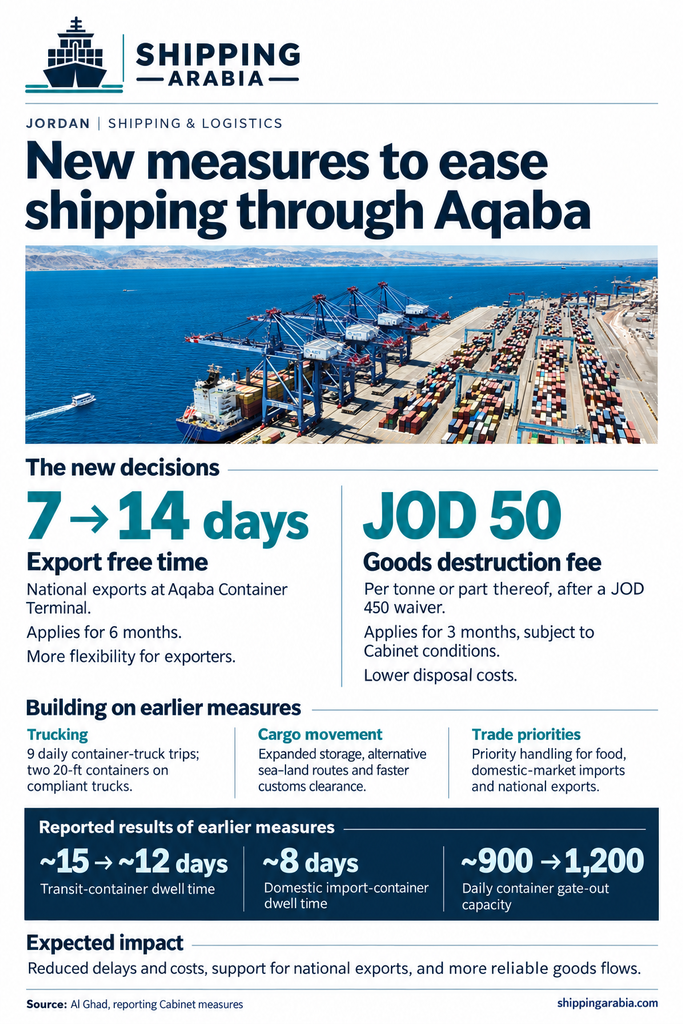
    Shipping Arabia, September 19, 2026 – Jordan has approved a new package of measures to ease operational pressure across Aqaba’s port and logistics system, including doubling the free period for national exports at Aqaba Container Terminal from seven to 14 days for six months, as the kingdom moves to strengthen supply chain resilience and maintain cargo flows.

    The measures were approved by the Cabinet, chaired by Prime Minister Dr. Jaafar Hassan, and build on earlier steps to expand storage capacity, develop logistics centers and supporting infrastructure, accelerate customs clearance and provide alternative sea-land multimodal corridors.

    The government also reduced the charge associated with the destruction of cargo from JOD 450 to JOD 50 per tonne or part thereof for three months, subject to specified conditions and coordination with the Ministry of Finance.

    Operational measures already introduced include transferring part of customs clearance activity to Amman Customs, exempting transit truck movements through border crossings from existing trip limits for three months and increasing the permitted number of daily container-truck trips to nine.

    Trucks meeting technical and safety requirements are also being permitted to carry two 20-foot containers on a single vehicle, while priority in handling, clearance and gate-out is being given to food cargo, imports destined for the domestic market and Jordanian exports.

    The measures are already being reflected in port performance. Average dwell time for transit containers has fallen from around 15 days to 12 days, while inbound local containers are averaging around eight days. Daily container gate-out capacity has increased from approximately 900 to 1,200 containers, helping reduce pressure on the port and accelerate cargo movement.

    The latest measures reinforce Aqaba’s role as Jordan’s principal maritime gateway and an increasingly important regional transit corridor, with the government seeking to increase port capacity and logistics flexibility while limiting additional costs caused by shipping delays and regional supply chain disruption.

    Source: Alghad

Back to top button