Container Shipping

  • Maersk Suez Canal Services Expected to Fully Return by March 2027

    Shipping Arabia, October 24, 2026 – A.P. Moller-Maersk is working to accelerate the return of its shipping services to the Suez Canal, with the Group anticipating that all its services could resume transiting the waterway by March 2027. The development follows discussions with the Suez Canal Authority (SCA) on the gradual restoration of Maersk’s shipping network through the Egyptian waterway.

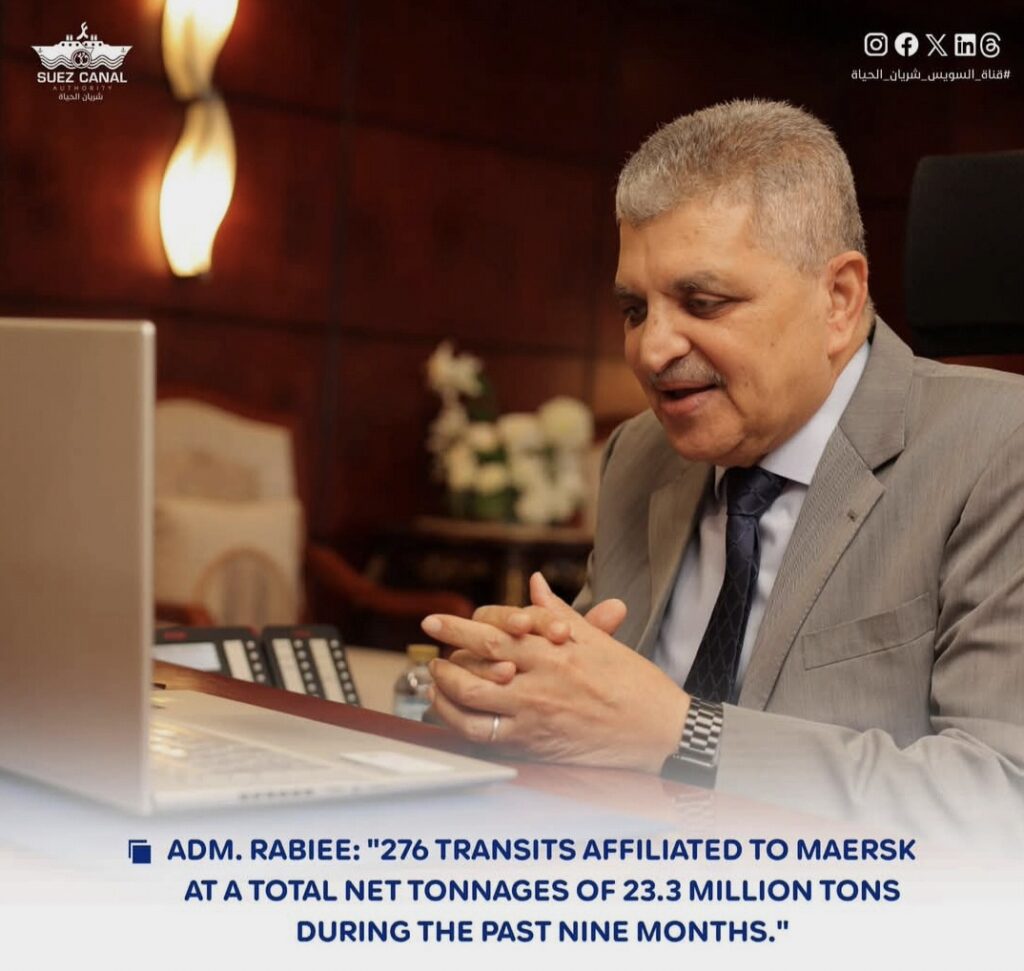
    The discussions took place on October 20 during a video conference between SCA Chairman and Managing Director Adm. Ossama Rabiee and senior Maersk executives. Participants included Rabab Boulos, Chief Operating Officer and Executive Board member of A.P. Moller-Maersk; Ahmed Hassan, Vice President of Operations; and Hani El-Nady, the Group’s representative in the Middle East and North Africa.

    The meeting focused on strengthening cooperation between the two organizations and reviewing Maersk’s navigation plans and sailing schedules through the Suez Canal during the coming months.

    Maersk Suez Canal Transits Rise Sharply in 2026

    According to figures presented by the Suez Canal Authority, Maersk-affiliated vessels completed 276 transits through the waterway between January and September 2026, generating a combined net tonnage of 23.3 million tons.

    During the corresponding period in 2025, the Canal recorded 146 Maersk-affiliated transits, representing a total net tonnage of 7 million tons.

    These figures indicate an approximately 89% year-on-year increase in vessel transits. Meanwhile, the combined net tonnage more than tripled, reflecting a substantial increase in Maersk-affiliated shipping activity through the Canal.

    Rabiee highlighted the increase as evidence of the ongoing return of Maersk’s shipping services. He also emphasized the longstanding strategic partnership between the Suez Canal Authority and the shipping group.

    The figures reflect the progress achieved during the first nine months of 2026, while discussions continue over the return of additional Maersk services in the coming period.

    Maersk Anticipates Full Service Restoration by March 2027

    During the meeting, Boulos praised the longstanding relationship between Maersk and the Suez Canal Authority. She highlighted the return of several shipping services affiliated with the Group to the Suez Canal route.

    Boulos expressed her expectation that all Maersk shipping services could return to the Suez Canal by March 2027. She also reaffirmed that the waterway remains the Group’s preferred navigation route, emphasizing the strategic relationship between both organizations.

    Meanwhile, Hassan confirmed that Maersk continues to update its navigation schedules. These adjustments are intended to accommodate the return of additional shipping services through the Canal in the coming period.

    El-Nady also stressed that Maersk is working to accelerate the restoration of its shipping services to the Suez Canal route.

    The statements underline the Group’s intention to increase its use of the waterway while continuing to review its operational schedules.

    Suez Canal Highlights Economic and Navigational Advantages

    Rabiee also addressed the impact of current geopolitical developments on international shipping, particularly their influence on fuel prices and freight rates.

    He emphasized that these developments reinforce the strategic importance of the Suez Canal for global maritime transportation.

    According to Rabiee, the Canal offers significant savings for large container vessels compared with navigating around the Cape of Good Hope. He also highlighted the navigational safety advantages associated with using the Suez Canal route.

    The SCA chairman presented these factors as important considerations for shipping lines reviewing their route choices amid changing geopolitical and commercial conditions.

    The discussions also reflected the strategic importance both organizations attach to their longstanding cooperation, particularly as Maersk continues adjusting its service network.

    SCA and Maersk Agree to Continue Discussions

    At the conclusion of the meeting, the Suez Canal Authority and Maersk agreed to hold further bilateral discussions to strengthen cooperation.

    The continued dialogue will focus on supporting the return of additional Maersk shipping services and coordinating future navigation arrangements through the Canal.

    With Maersk-affiliated transits already showing substantial year-on-year growth, the Group’s anticipated return of all services by March 2027 represents the next objective in its ongoing discussions with the Suez Canal Authority.

    Source: Suez Canal Authority
  • Saudi Ports Cargo Throughput Falls 25% to 16.5 Million Tons in September 2026

    Shipping Arabia, October 23, 2026 – Saudi ports cargo throughput declined by 25% in September 2026, with total handled volumes exceeding 16.5 million tons, compared with 22.1 million tons during the same month in 2025, according to the Saudi Ports Authority (Mawani).

    The decline was accompanied by a reduction in container throughput across the Kingdom’s ports. However, inbound container volumes increased, while outbound container movements recorded a slight decrease.

    Saudi Ports Container Throughput Declines 4.46%

    Saudi Arabia’s ports handled approximately 625,300 twenty-foot equivalent units (TEUs) in September 2026, representing a reported 4.46% decrease compared with the corresponding period last year.

    During September 2025, total container throughput reached approximately 655,700 TEUs, according to Mawani’s figures.

    The reduction in container handling accompanied the sharper decline in overall cargo tonnage, which fell by 25% year-on-year.

    Inbound Container Volumes Increase as Exports Decline

    Despite the overall reduction in container throughput, Saudi ports recorded an increase in inbound container movements during September 2026.

    Inbound container volumes reached approximately 367,700 TEUs, compared with 251,100 TEUs during the same month in 2025.

    The published report described this as a 6.58% increase, although the two reported volume figures indicate a larger percentage rise.

    Meanwhile, outbound container throughput declined by 0.61%, reaching approximately 236,000 TEUs compared with 237,500 TEUs in September 2025.

    The figures show contrasting trends in Saudi Arabia’s container traffic, with inbound movements increasing while outbound volumes declined slightly.

    Overall, Mawani’s September results indicate lower cargo tonnage and total container throughput across Saudi ports, despite growth in inbound container handling.

    Source: Maaal

  • Aqaba Ports Cargo Throughput Rises 12% to 19.68 Million Tons in First Nine Months of 2026

    Shipping Arabia, October 23, 2026 – Aqaba ports cargo throughput increased by 12% during the first nine months of 2026, reaching approximately 19.68 million tons, according to a report issued by Aqaba Development Corporation (ADC). The growth was accompanied by higher container volumes and vessel arrivals, although performance varied significantly across cargo segments and port facilities.

    The report, prepared by ADC’s Transport and Logistics Directorate, showed that container throughput increased by 6.58% to 786,950 TEUs. Meanwhile, vessel arrivals rose 7% to 2,060 ships, compared with 1,932 during the corresponding period of 2025.

    The figures also revealed contrasting trends across the port system. Aqaba New Port and the oil terminal recorded substantial cargo growth, while phosphate shipments, liquefied natural gas (LNG) volumes, and cruise ship arrivals declined.

    Aqaba New Port Records 64% Cargo Growth

    Aqaba New Port recorded a 64% increase in total cargo handling during the first nine months of 2026. Throughput reached 5,848,640 tons, compared with 3,574,052 tons during the same period in 2025.

    Grain handling was a major contributor to this growth, increasing 45% to 3,624,452 tons from 2,498,051 tons a year earlier. Coal volumes also increased significantly, rising 60% to 518,911 tons, compared with 324,125 tons.

    The port handled 810,402 tons of bulk sugar during the reporting period, compared with no recorded volumes during the corresponding period of 2025.

    Other general cargo handled at Aqaba New Port increased 20% to 894,875 tons, up from 746,476 tons.

    The report also recorded a 38% increase in the category identified as stone containers, from 68,314 to 94,530. In contrast, livestock numbers declined 38%, falling from 873,442 to 543,593.

    Aqaba Container Terminal Throughput Reaches 786,950 TEUs

    Container handling at Aqaba Container Terminal increased by 6.58% during the first nine months of 2026. Total throughput reached 786,950 TEUs, compared with 738,348 TEUs during the corresponding period of 2025.

    The report showed a 12% increase in imported containers, including transit containers. Volumes reached 415,382 container units, compared with 371,437 during the first nine months of 2025.

    However, imported containers excluding transit traffic declined by 14%. Volumes fell to 299,620 container units, compared with 347,844 during the same period last year.

    These figures highlight the difference between overall import container growth, including transit movements, and the decline in imported containers excluding transit traffic.

    Oil Terminal Cargo Handling Rises 39% as LNG Volumes Decline

    Cargo handling through Aqaba’s oil terminal increased by 39%, reaching 3,433,461 tons during the first nine months of 2026. This compares with 2,465,170 tons during the corresponding period of 2025.

    Crude oil accounted for the largest reported volume, increasing 14% to 1,223,957 tons from 1,075,146 tons.

    Diesel handling rose 7% to 799,561 tons, compared with 746,540 tons. Meanwhile, gasoline throughput increased 50% to 805,468 tons, up from 535,791 tons during the same period last year.

    Other liquid cargo categories also recorded substantial increases. A separately reported gas category rose 176% to 54,151 tons, while potassium hydroxide handling increased 77% to 21,363 tons.

    Phenol throughput climbed 309% to 147,036 tons. Chemical cargo handling also increased sharply, rising 943% to approximately 46,511 tons from 4,458 tons.

    Mineral oil volumes increased 1,047% to 32,715 tons, compared with 2,853 tons in the corresponding period of 2025.

    Vegetable oil handling reached 302,700 tons, compared with no recorded volumes during the previous year. In contrast, magnesium chloride volumes declined from 32,750 tons to zero.

    Performance also varied across Aqaba’s gas facilities.

    Liquefied petroleum gas (LPG) throughput increased 11% to 413,181 tons, compared with 371,664 tons during the first nine months of 2025.

    However, liquefied natural gas (LNG) handling declined by 31%, falling to 464,837 tons from 670,931 tons during the corresponding period last year.

    Dry Bulk, Liquid Bulk and General Cargo Record Growth

    The ADC report showed that dry bulk cargo handling increased 8% during the first nine months of 2026. Total dry bulk throughput reached 11,905,204 tons, compared with 11,043,692 tons during the corresponding period of 2025.

    The growth reflected higher grain and coal handling, alongside the addition of bulk sugar volumes. However, several established dry bulk cargo categories recorded declines.

    Phosphate handling fell 19.1% to 4,062,887 tons. Sulfur volumes declined 31% to 528,033 tons, while fertilizer throughput decreased 11% to 527,421 tons.

    In contrast, grain volumes rose 45% to 3,624,452 tons, while coal throughput increased 60% to 518,911 tons. Bulk sugar handling reached 810,402 tons during the same period.

    Liquid bulk cargo recorded stronger overall growth, increasing 16% to 5,428,110 tons, compared with 4,694,287 tons in the first nine months of 2025.

    The increase reflected higher volumes of crude oil, diesel, gasoline, LPG, and several chemical products. Nevertheless, ammonia and phosphoric acid handling each declined by 6%, while LNG throughput fell 31%.

    Beyond dry and liquid bulk cargo, general cargo handling across the port system increased by 25%. Total volumes reached 2,033,142 tons, compared with 1,626,697 tons during the corresponding period of 2025.

    Vessel Arrivals Increase 7% Despite Decline in Container Ship Calls

    Total vessel arrivals at Aqaba’s ports increased 7% during the first nine months of 2026, reaching 2,060 ships compared with 1,932 during the same period in 2025.

    Liquid bulk vessel arrivals increased 22% to 196 ships, compared with 161 vessels a year earlier.

    Dredging vessel arrivals rose 28% to 102 vessels, up from 80. Dry bulk ship calls also increased slightly, rising 1% to 278 vessels from 275 during the corresponding period.

    However, container vessel arrivals declined 2%, falling to 438 ships from 446 during the first nine months of 2025. This decrease occurred despite the 6.58% increase in overall container throughput.

    Cruise ship arrivals recorded a sharper decline, falling 80% to just two vessels compared with 10 during the corresponding period last year.

    Separately, the report recorded 95 arrivals in a category classified as vehicle-designated tourist vessels. No arrivals were recorded in this category during the first nine months of 2025.

    Passenger Traffic Rises Despite Declines in Cruise Activity

    The ADC report also covered passenger movements and air cargo activity during the reporting period.

    Total passenger movements by land and air increased 2% to 422,487 passengers, compared with 413,718 during the corresponding period of 2025.

    However, the report indicated a decline in passengers traveling aboard cruise ships, alongside the reduction in cruise vessel arrivals.

    Air cargo activity also decreased during the reporting period, although the published figures did not specify the extent of the decline.

    Overall, the nine-month results show higher Aqaba ports cargo throughput, container handling, and vessel arrivals. At the same time, the figures demonstrate differing performance across individual facilities and cargo segments, including declines in phosphate exports, LNG handling, and cruise activity.

    Source: Al Mamlaka

  • Maersk Announces Peak Season Surcharges on Shipments to Egypt, Portugal, U.S. and Tanzania

    Shipping Arabia, October 21, 2026 – Maersk has announced new Peak Season Surcharges (PSS) across several international container shipping routes, affecting shipments from South America to Egypt and Portugal, South Asia to the United States, and China and Hong Kong to Tanzania. The revised charges will take effect on different dates between October 30 and November 15, 2026, depending on the trade route.

    The Maersk peak season surcharges range from $500 to $6,500 per container across the affected corridors. The company has specified different rates based on shipment origins, destinations, and container sizes.

    Maersk Introduces $500 Surcharge on South America–Egypt and Portugal Routes

    Maersk will introduce a Peak Season Surcharge of $500 per container on shipments originating in Argentina, Uruguay, and Paraguay and destined for Egypt and Portugal, effective November 1, 2026.

    The surcharge applies to both dry and refrigerated containers, covering 20-foot and 40-foot equipment. The same charge will apply regardless of the two specified container sizes.

    For shipments originating in Brazil and destined for Egypt and Portugal, the $500 surcharge will take effect on November 15, 2026, and remain applicable until further notice.

    These measures establish separate implementation dates for shipments from Brazil and the other three South American countries, while maintaining the same surcharge amount across the specified container categories.

    Peak Season Surcharges Reach $6,500 on South Asia–U.S. Shipments

    Maersk has also announced additional Peak Season Surcharges on container shipments originating in several South Asian countries and destined for the United States, particularly the U.S. East Coast and Gulf Coast.

    Under the announced tariff, shipments from India, Bangladesh, Sri Lanka, the Maldives, Nepal, and Bhutan to these U.S. destinations will be subject to a surcharge of $6,500 per container.

    The charge applies to both 20-foot and 40-foot containers. The announced coverage also includes shipments originating in southern and eastern India.

    Meanwhile, shipments from Pakistan to the specified U.S. destinations will face a Peak Season Surcharge of $5,000 per container, applicable to both 20-foot and 40-foot equipment.

    The revised charges establish different surcharge levels for Pakistan and the other South Asian origins identified in Maersk’s announcement.

    Maersk Raises Surcharges on China and Hong Kong Shipments to Tanzania

    In a separate adjustment, Maersk will increase Peak Season Surcharges on shipments originating in China and Hong Kong and destined for the Port of Dar es Salaam in Tanzania.

    The revised charges will take effect on October 30, 2026, and remain applicable until further notice.

    Under the updated tariff, the surcharge will reach $1,100 per 20-foot container and $1,700 per 40-foot container.

    Unlike the announced surcharges on the South American and South Asian routes, the revised charges for Dar es Salaam vary according to container size.

    Together, the announcements introduce new and adjusted Maersk peak season surcharges across trade corridors connecting South America, Europe, North Africa, South Asia, North America, and East Africa.

    The implementation schedule begins with the China and Hong Kong–Tanzania adjustment on October 30, followed by the South America–Egypt and Portugal measures on November 1 and November 15, 2026.

    Source: Al Mal

  • New Taicang–Jeddah Shipping Service to Cut Transit Times by Up to Three Weeks

    Shipping Arabia, October 18, 2026 – A new direct shipping service has been launched between Taicang Port in China’s eastern Jiangsu province and Jeddah Islamic Port in Saudi Arabia, with the operator expecting to reduce cargo transit times by two to three weeks. The Taicang–Jeddah shipping service eliminates intermediate transshipment operations, offering a more direct maritime connection between eastern China and the Middle East.

    The new route was inaugurated with the departure of a cargo vessel carrying approximately 1,000 containers from Taicang Port to Jeddah. Operated by Hai Son Shipping, the service aims to improve transportation efficiency, provide more reliable sailing schedules and reduce logistics costs for cargo moving between China and Saudi Arabia.

    Direct Taicang–Jeddah Shipping Service Targets Faster Cargo Deliveries

    The introduction of the new service establishes a direct maritime connection between Taicang Port, located in Jiangsu province, and Saudi Arabia’s Red Sea gateway at Jeddah.

    Xu Dapeng, chairman of Hai Son Shipping, said the route could shorten cargo transportation times by two to three weeks by eliminating the need for container transshipment at intermediate ports.

    According to Xu, the direct connection also offers more predictable sailing schedules, helping improve transportation efficiency and reduce logistics costs for customers.

    The company intends to monitor market demand as the service develops. Based on future cargo requirements, Hai Son Shipping will consider increasing sailing frequency, optimizing available vessel capacity and continuously improving its integrated logistics services.

    The new Taicang–Jeddah shipping service responds to growing demand among international trading companies for direct and efficient maritime logistics connections between the two countries.

    Expanding China–Saudi Arabia Trade Drives Demand for Maritime Connectivity

    The launch comes amid continued growth in economic and commercial relations between China and Saudi Arabia.

    Trade between the two countries covers a wide range of energy resources, industrial materials, machinery and manufactured products, creating demand for maritime transportation services.

    China’s imports from Saudi Arabia include crude oil, petrochemical products and minerals. Meanwhile, Saudi Arabia continues to generate demand for Chinese engineering machinery, steel structural components, industrial electrical equipment and photovoltaic products.

    Other products moving within the bilateral trading relationship include household electrical appliances and light industrial goods manufactured in China.

    As commercial exchanges expand, trading companies are increasingly seeking efficient direct shipping routes that can improve cargo transportation and reduce dependence on intermediate logistics hubs.

    The new direct service between Taicang and Jeddah is intended to address these requirements by providing an additional maritime transportation option between the two markets.

    Bilateral Trade Reached $108.2 Billion in 2025

    Official figures published by China’s Ministry of Foreign Affairs show that bilateral trade between China and Saudi Arabia reached approximately $108.2 billion in 2025.

    During the first quarter of 2026, trade between the two countries amounted to approximately $24.15 billion, reflecting the substantial volume of commercial exchanges between the two economies.

    Energy trade remains an important component of the relationship. China imported approximately 80.76 million tonnes of crude oil from Saudi Arabia during 2025.

    In the first quarter of 2026, Chinese imports of Saudi crude oil reached approximately 17.9 million tonnes.

    Against this backdrop of substantial bilateral trade, the new Taicang–Jeddah shipping service provides another direct connection between China’s manufacturing and export markets and Saudi Arabia’s maritime gateways.

    By reducing the need for intermediate transshipment and offering more predictable sailing schedules, Hai Son Shipping aims to improve freight transportation efficiency while responding to demand for stronger maritime logistics links between China and Saudi Arabia.

    Source: Al Mal

  • CMA CGM Announces Rate Restoration Initiative of Up to $1,500 on US-Bound Shipments

    Shipping Arabia, October 12, 2026 – CMA CGM has announced a Rate Restoration Initiative (RRI) covering container shipments from several Mediterranean, Black Sea, Adriatic and North African countries to the US East Coast and inland destinations, effective November 1, 2026. The adjustment will apply to shipments covered by the relevant tariff rates or service contracts.

    According to Al Mal, the French container shipping group announced revised charges reaching $750 per 20-foot container and $1,500 per 40-foot container. The announcement also specifies a separate rate structure for cargo excluding out-of-gauge (OOG) shipments.

    CMA CGM Rate Restoration Initiative Covers Multiple Trade Regions

    The geographical scope includes several countries across the Eastern Mediterranean, Black Sea, Adriatic and North Africa, with shipments destined for US East Coast ports and inland locations served through those gateways.

    In the Eastern Mediterranean, the covered countries include Egypt, Lebanon, Syria, Greece, Malta and Cyprus, excluding Türkiye.

    The Black Sea coverage extends to Bulgaria, Georgia, Romania and Ukraine, also excluding Türkiye. Meanwhile, the Adriatic region includes Albania, Croatia, Montenegro, Slovenia and Italy.

    North African origins covered by the announcement include Algeria, Libya and Tunisia.

    The initiative applies to shipments originating from ports in these countries and moving to the US East Coast, including inland destinations connected through the relevant ports.

    Revised Container Charges Effective November 1

    Under the announced rate restoration initiative, Al Mal reports charges reaching $750 per 20-foot container and $1,500 per 40-foot container.

    The announcement also identifies charges of $500 per 20-foot container and $1,000 per 40-foot or 45-foot container for cargo excluding out-of-gauge shipments.

    The adjustments will take effect on November 1, 2026, and apply to tariff or service contract rates for shipments falling within the announced scope.

    The rate restoration initiative covers an extensive network of Mediterranean, Black Sea, Adriatic and North African origins serving the US East Coast and connected inland markets.

    Source: Al Mal

  • MSC Extends Piracy Risk and Suez Canal Surcharges to More Mediterranean and North African Ports

    Shipping Arabia, October 11, 2026 – Mediterranean Shipping Company (MSC) has announced an extension of its piracy risk surcharge and Suez Canal surcharge to additional destinations across the Mediterranean and North Africa. The expanded charges will take effect on October 19, 2026, and remain applicable until further notice, bringing the combined surcharges to $91 per TEU on affected shipments originating in Asia.

    MSC attributed the decision to continuing piracy risks around the Arabian Peninsula. According to the carrier, these risks continue to affect vessel operations and shipping routes, prompting the expansion of surcharge coverage to additional destinations.

    MSC Piracy Risk Surcharge and Suez Canal Charges

    Under the revised geographical coverage, MSC will apply two separate surcharges to shipments moving from Asia to the specified destinations.

    The piracy risk surcharge will amount to $55 per TEU, while the Suez Canal surcharge will be $36 per TEU. Together, the two charges total $91 per TEU.

    Both surcharges will apply from October 19, 2026, and remain in effect until MSC issues further notice.

    The announcement expands the geographical application of the charges across several Mediterranean and North African markets, covering a range of container shipping destinations.

    Eastern Mediterranean and North African Ports Included

    The MSC piracy risk surcharge extension covers all shipments originating in Asia and destined for Derince in Turkey and West Port Said in Egypt.

    Beyond these Eastern Mediterranean destinations, the carrier has expanded coverage to numerous ports across North Africa.

    The affected North African destinations include Agadir, Algiers, Annaba, Béjaïa, Benghazi, Casablanca, Al Khums, Misrata, Nador, Oran, Skikda, Tripoli and Tunis.

    These locations form part of the wider geographical extension announced by MSC for its piracy risk and Suez Canal surcharges.

    Western Mediterranean, Adriatic and Other Destinations

    The expanded surcharge coverage also includes several major container shipping destinations in the Western Mediterranean and Adriatic regions.

    Among the Spanish destinations covered are Alicante, Barcelona, Cartagena, Málaga and Valencia. The extension also includes Arrecife de Lanzarote, Las Palmas, Puerto del Rosario and Santa Cruz de Tenerife in the Canary Islands.

    In Italy, the affected destinations include Ancona, Augusta, Bari, Cagliari, Civitavecchia, Genoa, Gioia Tauro, La Spezia, Livorno, Naples, Palermo, Pozzallo, Ravenna, Salerno, Trapani and Venice.

    Additional destinations include Fos-sur-Mer in France, Marsaxlokk in Malta, Bar in Montenegro, Durrës in Albania and Ploče in Croatia.

    The expanded list extends the application of the charges across a broad network of ports serving Mediterranean, North African and Adriatic container shipping markets.

    Surcharges to Remain Effective Until Further Notice

    MSC confirmed that the expanded charges will apply from October 19, 2026, with no specified expiration date.

    The decision extends the application of the piracy risk and Suez Canal surcharges to additional shipments originating in Asia and moving to the designated destinations.

    For affected cargo, the combined charge of $91 per TEU will remain applicable until the shipping line announces a further revision.

    Source: Al Mal

  • Damietta Port Ship Calls Rise 18% in August as Cargo Throughput Grows

    Shipping Arabia, October 2, 2026 – Damietta Port ship calls increased 18% year on year in August 2026, reaching 316 vessels compared with 267 in the same month of 2025. The increase came alongside a 6% rise in total cargo throughput to about 3.54 million tons, according to Damietta Port Authority data reviewed by Al Mal.

    Container vessel calls rose 21% to 104 ships from 86 a year earlier. Dry bulk vessel calls increased 28% to 95 from 74, while general cargo vessel calls declined 17% to 35 from 42.

    Liquid bulk vessel calls remained unchanged at 14 ships, while RoRo calls were also stable at four vessels. Meanwhile, the category covering regular and service vessels increased 36% to 64 ships from 47 in August 2025.

    Damietta Port Ship Calls Accompany Higher Cargo Volumes

    Total cargo handled at Damietta Port reached approximately 3.54 million tons during August, up from 3.34 million tons in the corresponding month last year. Performance varied significantly across individual cargo segments.

    Traditional general cargo declined 44% to about 268,000 tons from 480,000 tons. In contrast, dry bulk cargo increased 11% to 1.62 million tons, compared with 1.46 million tons in August 2025.

    Liquid bulk recorded the strongest growth among the major cargo categories, rising 113% to approximately 405,000 tons from 190,000 tons. RoRo cargo also increased sharply, reaching about 15,900 tons compared with 6,300 tons a year earlier, representing growth of 152%.

    Containerized cargo by weight reached approximately 1.23 million tons, up 3% from 1.19 million tons in August 2025.

    Container Numbers Decline Despite Higher Containerized Cargo Weight

    Although containerized cargo tonnage increased, the number of containers handled by Damietta Port fell 13% year on year. The port handled about 130,000 containers during August, compared with approximately 148,600 in the same month of 2025.

    Import containers declined 26% to about 50,000 from 67,600. Export container volumes moved in the opposite direction, increasing 2% to approximately 74,800 from 73,200 containers.

    Other additional container movements totaled about 5,000 containers, compared with 8,700 in August 2025, a decline of 35%.

    Regional Shipping Developments Support Vessel Traffic

    A Damietta Port Authority official attributed the strong increase in vessel calls to developments around Bab el-Mandeb and the Strait of Hormuz. According to the source, those developments prompted a significant number of vessels carrying cargo from the Arabian Gulf region to pass through Damietta on voyages to and from Europe.

    The official said August recorded the port’s highest increase in vessel calls, at 18%, adding that changes affecting international shipping routes had influenced vessel traffic patterns at transshipment ports.

    The source also said Hapag-Lloyd and Maersk had recently increased the frequency of their calls at Damietta Port as relative calm returned to the Bab el-Mandeb area.

    According to the official, the additional calls contributed to Damietta Port’s inclusion in services operated by the two shipping lines and strengthened maritime connectivity between Asia and Europe through the Suez Canal. The source said this development supports Damietta Port’s position within international trade routes.

    Source: Al Mal

  • Global Shipping Adapts to Middle East Disruptions as Suez Return Remains Gradual

    Shipping Arabia, October 1, 2026 – Global container shipping has adapted to prolonged disruptions across the Middle East, maintaining cargo flows through alternative routes and operational adjustments, but the industry’s return to normal conditions is expected to be considerably more gradual.

    Shipping companies have spent months adjusting their networks in response to disruptions affecting the Red Sea and the Strait of Hormuz. While those measures have allowed global trade to continue, they have come at the expense of higher operating costs, longer voyages and reduced network efficiency.

    Several Maersk services have now returned to the Red Sea and Suez Canal route after earlier diversions prompted by regional security concerns, providing one of the clearest indications that carriers are gradually restoring some of their traditional routing.

    Maersk’s global head of chemicals, Patrick Hore, said the container shipping system had adapted to disruption in the Middle East, although vessel availability and irregular trade flows continued to present significant challenges. The carrier has been increasing the number of services operating through the Red Sea and Suez Canal, including six major Asia-Europe services as well as services connecting the Middle East with Europe and North America.

    For the wider industry, however, adaptation should not be confused with a complete return to normal operating conditions.

    AbdulRahman Taleb Ali, a maritime specialist and researcher, board member of the Jordan Shipping Association and founder of Shipping Arabia, a leading maritime news platform covering the Middle East and North Africa, told CNN Business Arabic that the global maritime shipping system had successfully adjusted to disruptions in both the Red Sea and Strait of Hormuz, but that this adjustment had come at a cost to efficiency and operating expenses.

    Shipping companies have maintained the movement of cargo by introducing alternative routes, particularly around the Cape of Good Hope, but longer voyages have increased fuel consumption, security-related expenses and other operating costs.

    The gradual return to the Suez Canal represents another part of that adaptation process rather than an immediate restoration of pre-disruption shipping patterns.

    Ali said carriers continue to assess security risks, market demand and costs as they determine when and how to restore services through the canal. Suez nevertheless remains the shortest and most efficient maritime connection between Asia and Europe.

    A broader return to the Suez route could reduce both transit times and transportation costs for cargo moving from China and other Asian markets into Europe, while helping shipping networks regain some of the efficiency lost during prolonged diversions around southern Africa.

    The transition is taking place against a backdrop of continued pressure on global container shipping capacity.

    DHL Global Forwarding data cited by CNN Business Arabic showed that global freight rates continued to rise during September, with particularly strong upward pressure on eastbound trans-Pacific services.

    Carriers are also gradually increasing their use of the Suez Canal. Around 18% of relevant Asia-Europe services are now planned to operate through the route, according to the report.

    Capacity constraints, meanwhile, are not necessarily being driven by stronger cargo demand alone. ICIS reported that Maersk was operating at around 96% of capacity, with slower vessel movements through ports and inland distribution networks absorbing available ships and equipment.

    Equipment availability has also evolved as shipping networks adjust.

    Ali said shortages of empty containers were no longer the industry’s primary challenge, with the gradual return of services through the Suez Canal helping improve equipment availability. However, the continued use of the Cape of Good Hope by some carriers is contributing to imbalances in the distribution of empty containers between export ports.

    Longer voyages around the Cape also require additional vessel capacity to maintain scheduled services. The consequences extend beyond the additional distance, with carriers facing higher fuel consumption, insurance premiums and war-risk costs, as well as increased seafarer wages and risk allowances.

    These pressures are being compounded by strong demand for shipping capacity and limited routing alternatives in parts of the global network.

    A larger shift back toward the Red Sea and Suez Canal could ultimately ease some of these pressures by shortening voyages and releasing vessel capacity. In the short term, however, the transition itself could create a new operational challenge for European ports.

    Ships travelling through the Suez Canal reach Europe considerably faster than vessels continuing around the Cape of Good Hope. As carriers gradually restore Suez routings, faster vessels using the canal could therefore arrive at European ports at approximately the same time as slower ships that departed earlier via southern Africa.

    This convergence could temporarily increase congestion at some European terminals.

    DHL data showed that global port congestion was approaching capacity equivalent to 4 million containers, highlighting the pressure already affecting parts of the international logistics network.

    Ali said any congestion resulting from the overlapping arrival patterns should be viewed as a transitional challenge rather than a permanent condition. As shipping lines progressively restore traditional routes, ports and shipping networks will need time to realign vessel schedules, equipment flows and capacity.

    The developments illustrate how the global shipping industry has demonstrated its ability to adapt to prolonged geopolitical disruption, but also how difficult it is to reverse those adjustments once networks have been reorganized around alternative routes.

    The return to Suez is therefore likely to remain progressive. Even as more services resume passage through the Red Sea, carriers will continue balancing security, cost and operational considerations while global shipping networks work through the consequences of months of altered vessel schedules and longer voyages.

    Source: CNN Business Arabic

  • Aqaba Transit Traffic Surges as Regional Trade Routes Shift

    Shipping Arabia, September 27, 2026 – The Port of Aqaba is taking on a larger role in regional trade as disruptions to traditional shipping routes encourage companies and importers to seek alternative supply chains, with transit container traffic through Jordan recording particularly strong growth toward Iraq, Syria and Lebanon.

    Aqaba is increasingly moving beyond its traditional role as Jordan’s maritime gateway for the domestic market. Its location on the Red Sea is allowing cargo arriving by sea to continue overland to other markets in the region, providing an alternative for some shipments that previously reached Iraq through Gulf ports.

    Transit activity has been the main beneficiary of this shift. During the first half of 2026, transit traffic through Aqaba increased by 155% compared with the same period in 2025.

    More than 60,000 TEUs of transit containers passed through Aqaba Container Terminal during the six-month period, compared with approximately 23,000 TEUs a year earlier.

    Iraq-bound containers drive transit growth

    The strongest change has emerged in cargo moving through Jordan toward Iraq.

    Around 37,000 containers reached Iraq through Jordan in July 2026, compared with approximately 3,600 containers in July 2025. That represented an increase of nearly 900% year on year.

    The shift comes as regional conflict and tensions affect established trade routes and encourage cargo owners and companies to consider alternatives that avoid areas facing greater maritime risk, particularly around the Strait of Hormuz.

    Some cargo that previously entered Iraq through ports in the Gulf is now being redirected to Aqaba before continuing overland into the Iraqi market.

    Aqaba also provides a route for cargo moving toward Syria and Lebanon, strengthening its position as a sea-to-land logistics gateway linking maritime services with markets across the Levant.

    By the period from the beginning of 2026 through July, transit container traffic through Aqaba had recorded growth of around 180%, indicating that the changing regional trade environment is having a significant impact on cargo flows through the Jordanian port.

    Growth extends beyond container traffic

    The increase in activity is not limited to containers.

    Cargo and dry bulk traffic, including grains as well as food and industrial inputs, rose by more than 40% in July, with volumes reaching approximately 666,000 tonnes.

    Activity at Aqaba’s liquefied natural gas facilities also increased. Around 370,000 tonnes were received from the beginning of the year through July, representing growth of nearly 12%.

    Meanwhile, volumes handled through oil and gas facilities exceeded 2 million tonnes during the first half of 2026, an increase of more than 40%.

    The source attributed the increase to higher discharge volumes of crude oil and petroleum products, alongside stronger maritime movements involving fuel cargoes.

    These figures show that changes in regional trade flows are affecting several parts of Aqaba’s port system rather than a single cargo segment.

    Aqaba gains a wider regional logistics role

    The changes are contributing to a partial redrawing of regional supply chains.

    For Iraq in particular, the Aqaba route offers an alternative to cargo movements traditionally dependent on Gulf ports. Vessels can discharge cargo in southern Jordan before shipments continue by road toward the Iraqi market.

    Aqaba’s role is therefore increasingly linked not only to its status as Jordan’s sole seaport but also to its ability to connect maritime cargo flows with inland markets across the region.

    For shipping companies and importers, continued uncertainty around traditional maritime routes has increased the importance of route diversification and reduced reliance on corridors considered more exposed to disruption.

    The rise in transit volumes through Aqaba illustrates how those decisions are translating into actual changes in cargo routing.

    As risks and costs affect established trade corridors, ports capable of providing alternative connections between maritime and overland transport are gaining greater significance. In Aqaba’s case, the recent growth in transit and cargo activity is expanding the port’s role from a national maritime gateway toward a more prominent position within regional trade networks.

    Source: Al Jazeera

Back to top button