
Evergreen Returns to Suez Canal as Egypt Sees Signs of Shipping Recovery
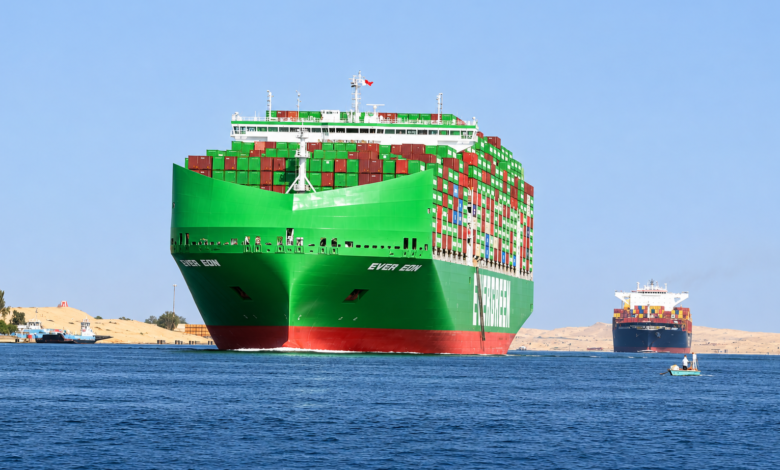
Shipping Arabia, November 13, 2026 – Evergreen returns to Suez Canal operations after nearly three years of Red Sea shipping disruptions, marking a significant development in efforts to restore container shipping services between Asia and Europe. The Taiwanese carrier’s return coincides with improving vessel traffic and revenues at the Egyptian waterway, although sustained recovery remains dependent on maritime security and insurance costs.
The return began on November 8, 2026, when the 16,556-TEU container vessel EVER EON transited the Suez Canal while sailing from the Netherlands to Singapore. The vessel operates on the NEU 7 service of the Ocean Alliance, connecting major ports in the Far East with Northwest Europe.
Admiral Ossama Rabiee, Chairman and Managing Director of the Suez Canal Authority (SCA), described Evergreen’s return as a positive indication of global trade gradually resuming its traditional East-West shipping routes.
The development follows nearly three years of disruptions that prompted major container carriers to divert vessels around the Cape of Good Hope. However, industry experts caution that restoring regular services will require sustained security improvements in the Red Sea and commercially viable insurance conditions.
Evergreen Returns to Suez Canal with 16,556-TEU Vessel
The EVER EON measures 369 meters in length and has a reported tonnage of approximately 185,000 tonnes. Its passage represents Evergreen’s return to a shipping corridor that previously played a central role in the carrier’s Asia-Europe operations.
According to the Suez Canal Authority, Evergreen intends to resume additional voyages through the waterway. Shipping schedules reported by Lloyd’s List indicate that other vessels, including EVER EDIT and EVER GIFTED, are expected to use the canal during November 2026.
Evergreen is the world’s seventh-largest container shipping company. According to Alphaliner data from October 2026, the carrier operates approximately 243 vessels with a combined capacity exceeding 2 million TEUs.
The company accounts for around 5.9% of global container shipping capacity, making its routing decisions significant for international container transportation.
Evergreen is also a member of the Ocean Alliance alongside CMA CGM, COSCO and OOCL. The alliance operates scheduled services connecting major manufacturing and commercial centers in Asia with markets across Europe.
These networks transport manufactured goods, consumer products and intermediate materials between major Asian ports, including those in China and Singapore, and destinations in Northwest Europe and the Mediterranean.
Political economy professor Abdel Nabi Abdel Mottaleb told Al Jazeera Net that Evergreen’s extensive global network makes its return economically important for the Suez Canal.
He explained that regular transits by a carrier of this scale could increase vessel movements and container volumes while generating additional transit revenue for Egypt.
Red Sea Security and Insurance Costs Remain Critical
The Red Sea shipping crisis began in late 2023 following escalating Houthi attacks against commercial vessels in the Red Sea and Bab el-Mandeb amid the war in Gaza.
These developments prompted international shipping companies to reassess risks affecting their vessels, crews and cargoes. Many carriers subsequently diverted services around the Cape of Good Hope, despite the longer distances and additional operating expenses associated with the alternative route.
Higher war-risk insurance premiums also became an important factor in shipping companies’ routing decisions. Carriers must weigh the cost of Suez Canal transit against the expenses and risks associated with alternative routes.
Alia El Mahdi, former dean of Cairo University’s Faculty of Economics and Political Science, identified security stability near the southern entrance to the Red Sea as a key factor influencing carriers and marine insurers.
She told Al Jazeera Net that Evergreen’s return, alongside the resumption of some services by other carriers, indicates improving confidence in the route. She also expects vessel traffic to increase during 2027.
Meanwhile, insurance and risk management consultant Louay Talal Abdo emphasized that Evergreen’s return carries operational significance beyond a single vessel transit.
The scheduling of additional voyages suggests that the carrier is considering a broader return to the canal. Nevertheless, Abdo cautioned that it remains premature to conclude that regular shipping operations have fully recovered.
He noted that shipping companies remain sensitive to new security developments that could affect vessels operating in the Red Sea.
Suez Canal Offers Major Voyage and Operating Cost Savings
The Suez Canal provides a shorter maritime route between Asia and Europe than sailing around the Cape of Good Hope.
According to Abdel Mottaleb, using the canal can reduce voyage times by approximately two to three weeks, depending on the ports of departure and destination.
Shorter voyages reduce fuel consumption, maintenance expenses and crew-related operating costs. They can also improve cargo delivery schedules and allow shipping companies to use their vessels more efficiently.
Reduced voyage durations enable carriers to complete transportation cycles more quickly, potentially increasing the number of voyages available within a year.
However, Abdo explained that the economic case for returning to the canal depends on more than distance and fuel savings.
Shipping companies must assess canal transit fees alongside war-risk insurance premiums and other additional expenses associated with operating through the Red Sea.
He cited estimates from maritime consultancy Drewry indicating that a 24,000-TEU container vessel could save approximately $1 million by using the Suez Canal instead of the Cape of Good Hope route, before accounting for additional insurance-related costs.
Higher insurance premiums could absorb a substantial share of those savings or even exceed them in certain circumstances. Consequently, Abdo stressed that lower security risks and more favorable insurance conditions remain essential for attracting larger numbers of vessels back to the canal.
Suez Canal Revenues Rise 94% in October 2026
Evergreen’s return coincides with a substantial improvement in Suez Canal traffic and revenues.
The canal generated $724 million in October 2026, compared with $373 million during the same month in 2025, representing a year-on-year increase of 94%.
According to the Suez Canal Authority, October marked the canal’s highest monthly revenue since the Red Sea shipping crisis began.
Vessel transits increased from 1,128 ships in October 2025 to 1,490 ships in October 2026, a rise of 32%.
Meanwhile, net tonnage increased from 47 million tonnes to 88 million tonnes, representing growth of 86%.
These figures indicate an improvement in both the number and size of vessels using the waterway. The return of large container ships could further support the recovery in transit volumes and revenues.
The latest results follow a substantial decline in canal activity during the Red Sea crisis.
Annual Suez Canal revenues fell from a record $10.25 billion in 2023 to approximately $4 billion in 2024, a decrease of nearly 61%.
Over the same period, annual vessel transits declined from 26,434 ships to 13,213 ships as carriers shifted services away from the Egyptian waterway.
Abdel Mottaleb explained that restoring services operated by major container carriers could gradually strengthen Egypt’s foreign currency earnings.
Since canal transit fees provide an important source of dollar revenue, increased vessel traffic could contribute to easing pressure on the Egyptian pound.
The Suez Canal Authority has set a revenue target of $6.6 billion for 2026, with projections of $7.6 billion in 2027 and $12 billion by 2030.
Long-Term Suez Canal Recovery Depends on Stable Shipping Conditions
Despite the improving figures, industry experts emphasize that a sustained recovery requires more than the gradual return of individual shipping lines.
Abdo explained that restoring regular services will depend on an extended period of safe navigation, continued Suez Canal transit incentives and improvements to supporting maritime services.
He highlighted maintenance, bunkering and logistics services as areas that could strengthen the canal’s attractiveness to shipping companies.
The consultant also noted that vessel routing decisions frequently involve interconnected shipping networks and alliances rather than individual operators acting independently.
Consequently, Evergreen’s return could encourage other carriers to reconsider their routes. However, renewed security incidents could prompt shipping companies to reassess their operating plans.
Beyond transit revenues, Abdel Mottaleb identified opportunities to increase the economic benefits generated by the Suez Canal Economic Zone.
He suggested expanding warehousing, grain handling, fuel-related activities and logistics services to capture additional value from vessels and cargo moving through the region.
Such developments could help Egypt generate broader economic benefits from maritime trade instead of relying primarily on canal transit fees.
Evergreen’s return to the Suez Canal represents an important step toward restoring regular container shipping operations through the Red Sea. Nevertheless, the pace and sustainability of the recovery will continue to depend on navigational security, insurance conditions and the overall economics of operating through the waterway.
Source: Al Jazeera Net
