
Morocco Advances $825 Million Tanger Med Expansion as Nador West Med Nears Opening
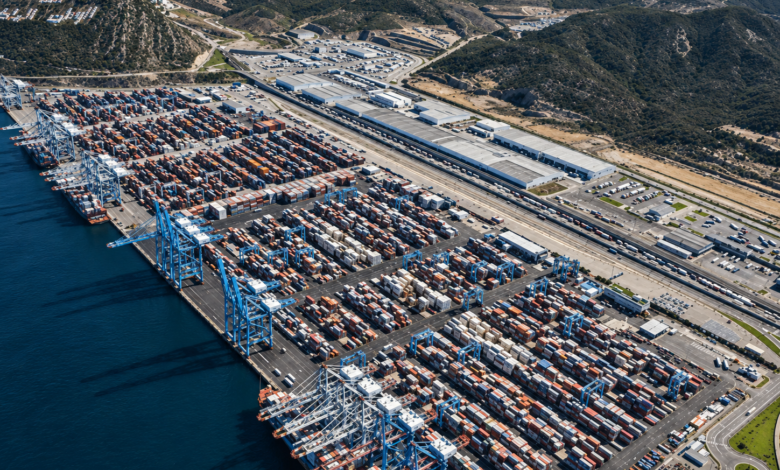
Shipping Arabia, November 1, 2026 – Morocco is advancing two major Mediterranean port developments, with an $825 million Tanger Med expansion planned to increase the complex’s annual container capacity to approximately 20 million TEUs, while the new Nador West Med port prepares to begin operations following $5.5 billion in public and private investment.
The developments were presented during a meeting chaired by King Mohammed VI, which reviewed progress at the Nador West Med port and industrial complex and plans for the third expansion phase of Tanger Med. Both projects form part of Morocco’s strategy to strengthen its port infrastructure, expand maritime and logistics capabilities, and improve its competitiveness within global trade networks.
According to Morocco’s Royal Cabinet, the investments aim to establish an efficient port system capable of responding to changes in global value chains. The strategy also emphasizes supporting regional economic development, creating employment opportunities and increasing the economic value generated in areas surrounding the new infrastructure.
The projects come as Mediterranean ports gain importance amid disruptions affecting strategic shipping routes, particularly the Strait of Hormuz and Bab el-Mandeb. These challenges have increased risks to global oil, gas and cargo movements, reinforcing the importance of maritime infrastructure and alternative trade connectivity.
Nador West Med has attracted more than MAD 54 billion ($5.5 billion) in combined public and private investment. The port’s first terminal is expected to enter operation in the coming days, marking a major milestone for the new maritime, industrial and energy complex on Morocco’s Mediterranean coast.
The development combines container handling, fuel storage, liquefied natural gas processing, industrial activities and logistics facilities. Its first container terminal will have an annual capacity of 3.5 million TEUs upon completion, while a second terminal is scheduled to enter service in April 2027 with additional capacity of 1.8 million TEUs.
Together, the two container terminals represent approximately MAD 8 billion ($825 million) in private investment, according to the Royal Cabinet. Their development will expand Morocco’s container handling capabilities and strengthen its infrastructure serving international maritime trade.
Energy infrastructure represents another major component of Nador West Med. The complex includes a fuel terminal with potential storage capacity of 4 million cubic meters, alongside Morocco’s first liquefied natural gas (LNG) terminal, designed to process up to 5 billion cubic meters annually.
The LNG facility will enable Morocco to import natural gas from international markets and process it domestically to meet industrial demand and support electricity generation. Combined with the fuel storage facilities, the development will expand the country’s energy handling and storage infrastructure.
Nador West Med will also connect to national railway and highway networks, supporting the integration of maritime operations with inland transport and industrial activities. The project seeks to replicate aspects of Tanger Med’s success in attracting investment and developing integrated port and logistics infrastructure.
Additional facilities include terminals for dry bulk and general cargo, further diversifying the port’s operational capabilities. The associated industrial zone has already entered operation, with one factory currently operating and three others under construction.
Alongside the Nador West Med development, Morocco is preparing a third major expansion of Tanger Med through the planned Tanger Med 3 project, representing approximately MAD 8 billion ($825 million) in investment.
The Tanger Med expansion will include 1,200 meters of quays and provide additional annual container handling capacity of 4.5 million TEUs. A concession agreement has been signed with Maersk-APM for the development of the new container terminal.
The broader investment program also includes expanding passenger port facilities and infrastructure serving international road freight transport. In addition, the plans provide for an eastern extension of Tanger Med 2, further increasing the complex’s capacity and operational infrastructure.
Once these developments are completed, Tanger Med’s total annual container handling capacity is expected to reach approximately 20 million TEUs. According to the Royal Cabinet, this would position the complex among the world’s ten largest ports by capacity.
Tanger Med already holds a leading position in international maritime trade, ranking first among ports in Africa and the Mediterranean, according to the source. Since beginning operations in 2007, it has become one of Morocco’s most significant port infrastructure investments.
Beyond its container terminals, Tanger Med has developed into an integrated industrial and logistics platform, supported by major economic and industrial zones. These facilities include Renault’s largest automotive manufacturing plant in Morocco, alongside other industrial companies producing goods for export to European markets.
The combination of port infrastructure, manufacturing activities and logistics services has supported Tanger Med’s development as a major trade and industrial hub. The planned expansion aims to build on this model by increasing container handling capacity and strengthening the complex’s position in international shipping networks.
Morocco currently operates 44 ports, including 14 serving foreign trade, supported by approximately 3,500 kilometers of coastline. Its geographic position provides maritime connections between Europe, Africa and the Americas, while its Mediterranean facilities also serve shipping routes linking European and Asian markets.
The parallel development of Nador West Med and Tanger Med reflects Morocco’s approach to expanding its maritime infrastructure across several strategic activities. While Tanger Med focuses on increasing container handling capacity and strengthening its established logistics and industrial ecosystem, Nador West Med introduces additional capabilities in energy storage, LNG processing, container operations and industrial development.
Together, the projects form part of the kingdom’s efforts to strengthen its position in maritime trade, attract investment and improve the competitiveness of its port system amid changing global supply chains and disruptions affecting international shipping corridors.
Source: Asharq Business