
Saudi Ports Authority

  • King Fahd Industrial Port in Yanbu Exports Over 1,490 TEUs of SABIC Products via Red Sea Express

    Shipping Arabia, October 12, 2026 – King Fahd Industrial Port in Yanbu, Saudi Arabia, exported more than 1,490 TEUs of SABIC products through the Red Sea Express shipping service in September 2026, according to the Saudi Ports Authority (Mawani). The port also handled the import of 1,000 TEUs of empty containers through the service during the same period.

    The figures highlight container activity at King Fahd Industrial Port in Yanbu, with the Red Sea Express service supporting the maritime transportation of Saudi industrial products to regional markets.

    Red Sea Express Supports SABIC Exports

    The Red Sea Express service facilitated the export of more than 1,490 TEUs of SABIC products during September, alongside the inbound movement of 1,000 TEUs of empty containers.

    According to Mawani, the service provides fast and direct maritime transport options, supporting the movement of Saudi products through King Fahd Industrial Port in Yanbu. The authority also highlighted its contribution to enhancing the competitiveness of national products in regional markets.

    The combination of export cargo and imported empty containers reflects the service’s role in facilitating container movements through the industrial port.

    Improving Cargo Handling and Operational Efficiency

    Beyond container volumes, Mawani emphasized the operational benefits associated with the Red Sea Express service. These include accelerating cargo handling procedures and reducing waiting times at the port.

    The authority identified improved operational efficiency and direct maritime transport options as important elements in supporting Saudi exports and strengthening their competitiveness in regional markets.

    The September performance demonstrates the Red Sea Express service’s contribution to handling SABIC export shipments and supporting containerized maritime trade through King Fahd Industrial Port in Yanbu.

    Source: Saudi Ports Authority (Mawani)
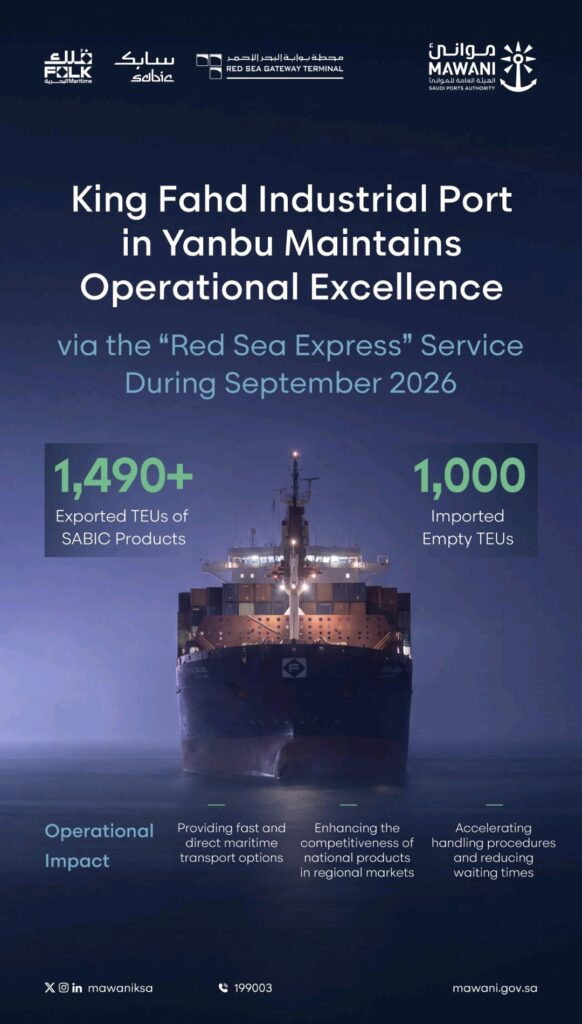
    King Fahd Industrial Port in Yanbu Red Sea Express infographic highlighting over 1,490 TEUs of SABIC exports and 1,000 TEUs of empty container imports in September 2026.
  • Saudi Ports Authority Introduces Port Community System Enhancements to Streamline Cargo Operations

    Shipping Arabia, October 10, 2026 – The Saudi Ports Authority (Mawani) has introduced new Port Community System enhancements aimed at improving service efficiency, simplifying cargo clearance procedures, and increasing transparency in container storage charge calculations. The updates form part of the authority’s ongoing efforts to develop digital services and facilitate procedures for port users.

    Announced on October 4, the improvements cover three operational areas: inbound container storage charges, cargo exit permit validity, and electronic shipment readiness verification.

    Through these changes, Mawani aims to provide more accurate storage charge calculations, greater flexibility in cargo exit procedures, and easier access to shipment information through its digital platform.

    Improving Container Storage Charge Calculations

    One of the key Port Community System enhancements focuses on improving the calculation of storage charges for inbound containers.

    Mawani has updated the timestamp calculation mechanism used to determine container storage fees. The improvement aims to increase the accuracy and transparency of calculations, providing port users with clearer information about applicable charges.

    The enhancement addresses an important administrative component of container handling by improving how storage periods are calculated within the digital system.

    By refining this process, the authority seeks to make storage charge calculations more reliable and transparent for businesses and other stakeholders using Saudi Arabia’s ports.

    Extending Cargo Exit Permit Validity

    Mawani has also extended the validity period for cargo exit permits to 24 hours from the time a permit request is submitted.

    The change provides port users with greater flexibility to complete the procedures required for cargo to leave the port. It is intended to facilitate cargo release arrangements and simplify the administrative process.

    The extended validity period forms part of the authority’s efforts to improve the efficiency of port services and make cargo handling procedures more convenient for beneficiaries.

    Introducing Digital Shipment Readiness Verification

    Another improvement involves a digital service that allows users to verify shipment readiness through the Port Community System.

    The service enables beneficiaries to check shipment status electronically and confirm whether cargo is ready to leave the port.

    This functionality provides users with direct access to shipment readiness information, supporting clearer coordination of cargo exit procedures.

    Alongside the improvements to storage charge calculations and exit permit validity, the service strengthens the range of digital functions available to port stakeholders.

    Supporting Digital Transformation Across Saudi Ports

    The latest Port Community System enhancements reflect Mawani’s continued focus on improving its digital services and simplifying procedures for businesses operating through Saudi Arabia’s ports.

    By addressing storage fee calculations, cargo exit permits, and shipment readiness verification, the authority is targeting administrative processes that directly affect port users.

    The improvements aim to increase service efficiency, enhance transparency, and provide greater flexibility when completing cargo-related procedures.

    Through the continued development of its Port Community System, Mawani is working to strengthen the accessibility and efficiency of digital port services while facilitating day-to-day operations for stakeholders across the maritime and logistics sectors.

    Source: Saudi Ports Authority (Mawani)

  • King Fahd Industrial Port Storage Exemption Extended Until December 5, 2026

    Shipping Arabia, October 9, 2026 – The Saudi Ports Authority (Mawani) has extended the King Fahd Industrial Port storage exemption in Yanbu until December 5, 2026, providing a 20-day storage fee waiver for eligible loaded export cargo and empty import units. The measure aims to facilitate cargo movements and improve operational efficiency at the Red Sea port.

    The extension applies to several categories of cargo and transport equipment, including containers, flat racks and trailers. Dangerous goods classified under the International Maritime Dangerous Goods (IMDG) Code are also included in the exemption for loaded exports.

    According to Mawani, the extended free storage period is intended to support smoother cargo flows and strengthen the efficiency of port operations.

    King Fahd Industrial Port Storage Exemption Covers Multiple Cargo Categories

    Under the extended arrangement, eligible loaded export cargo will benefit from a 20-day exemption from storage charges.

    The exemption covers containers, flat racks, trailers and dangerous goods classified under the IMDG Code. Including these categories provides storage flexibility for different types of export cargo handled at the port.

    For empty import units, Mawani has also established a 20-day free storage period. This applies to containers, flat racks and trailers.

    The distinction between loaded exports and empty imports defines the scope of the exemption. While dangerous goods are explicitly included in the loaded export category, the announcement does not separately list them under empty imports.

    The exemption will remain in effect until December 5, 2026, according to the authority’s announcement.

    Supporting Cargo Flow and Operational Efficiency at Yanbu

    Mawani stated that extending the storage fee exemption will support the smooth movement of goods and enhance operational efficiency at King Fahd Industrial Port.

    The measure provides eligible exporters, shipping lines and logistics operators with additional flexibility in managing cargo storage and equipment movements.

    A 20-day free storage period can provide more time to coordinate export shipments and manage the movement of empty transport equipment without incurring storage charges during the eligible period.

    The inclusion of containers, flat racks and trailers also reflects the range of cargo transport equipment covered by the arrangement.

    For businesses using King Fahd Industrial Port, the extension provides a defined period of storage cost relief for qualifying exports and empty imports.

    The initiative is consistent with Mawani’s stated objective of improving cargo movement and operational efficiency at the port.

    By maintaining the exemption until December 5, 2026, the authority is continuing a measure designed to facilitate port operations and support the movement of goods through Yanbu.

    Source: Saudi Ports Authority (Mawani)

  • Saudi Empty Container Return Procedures Set by Mawani

    Shipping Arabia, October 7, 2026 – Saudi empty container return procedures have been standardized by the Saudi Ports Authority (Mawani) for designated storage yards at the Kingdom’s ports, with the measures aimed at improving operational efficiency, clarifying responsibilities and limiting additional costs resulting from changes to container return locations.

    The procedures set out requirements for informing beneficiaries of where empty containers must be returned, documenting that information and managing any subsequent change to the designated location. They also define responsibility for additional costs when a return location differs from the location previously agreed.

    Beneficiaries Must Receive Return Location in Advance

    Under the Saudi empty container return procedures, the location and address for returning an empty container must be clearly specified when the delivery order is issued and before the beneficiary receives the container.

    Mawani also requires clear and accurate information on the designated empty container return location and the storage yard assigned for the return. This is intended to give beneficiaries clear information before arranging the movement of the container.

    For transit containers, the return location and city must be identified before the container is collected. According to the authority, providing this information in advance allows the beneficiary to arrange the required transportation beforehand.

    Written Notice Required for Location Changes

    If the designated container return location or storage yard changes, the beneficiary must be notified in writing before the scheduled return date.

    Shipping agents are also required to retain documentation showing that the beneficiary was informed of the empty container return location. The same requirement applies to any subsequent update or change to that location.

    These documentation requirements form part of Mawani’s effort to make the process clearer and establish a record of the information communicated to the beneficiary.

    Shipping Agents Responsible for Additional Costs

    The procedures also address additional costs that may arise when a previously agreed container return location changes.

    Mawani stated that the shipping agent will bear additional costs resulting from changing the agreed location for the delivery or collection of the container. The measure is intended to limit the financial impact on beneficiaries when return arrangements are altered after the original location has been established.

    The Saudi Ports Authority said the overall objective of the new procedures is to improve the efficiency of empty container returns, enhance clarity across the process and reduce additional costs caused by changes to designated return locations.

    The measures form part of Mawani’s wider efforts to improve operational efficiency at Saudi ports by organizing the return of empty containers to designated storage yards and defining the responsibilities associated with those movements.

    Source: Saudi Ports Authority (Mawani)

Back to top button